



In Bihar’s bustling political theatre, there are no dull scripts — only recurring dramas where old protagonists adopt new forms and freshly nuanced positions. The latest edition of this multifaceted saga has cast Prime Minister Narendra Modi and Rashtriya Janata Dal (RJD) leader Tejashwi Yadav in the central roles. Their exchanges — often caustic, sometimes cuttingly humorous — have begun to define the texture and tone of the Bihar campaign, and arguably even the grammar of Indian federal politics in the post-2024 landscape.
Modi’s Arguments and the BJP’s Lasting Dilemma
As the international news agency Reuters noted in its recent pre-poll analysis, Modi’s National Democratic Alliance (NDA) enjoys only a slim lead in the state, with voter anger palpably evident over youth unemployment and issues surrounding electoral-roll revision. In that context, the face-off between Modi — campaigning as the national leader — and Tejashwi, positioning himself as the challenger promising change, has become the central axis of the contest.
Modi’s campaign in Bihar is consciously built around two themes:
First, a sweeping promise of jobs and industrial growth for the state; and
Second, portraying the opposition as a potential return to the “Jungle Raj” era of misrule.
At a rally in Arrah, he promised one crore jobs for Bihar’s youth and projected the idea that a “new industrial Bihar” would emerge under continued NDA rule. He has repeatedly invoked the phrase “Jungle Raj” to describe the regime he accuses the opposition of representing.
He has also emphasised the narrative of “unity, stability, and development” as his side’s virtue against the opposition’s alleged internal discord. For instance, he claimed that the Indian National Congress was forced into naming Tejashwi the Chief Ministerial face “at gunpoint.” In short, Modi is applying a high-stakes frame: vote for the NDA for growth and order, or risk a return to chaotic governance if the opposition wins.
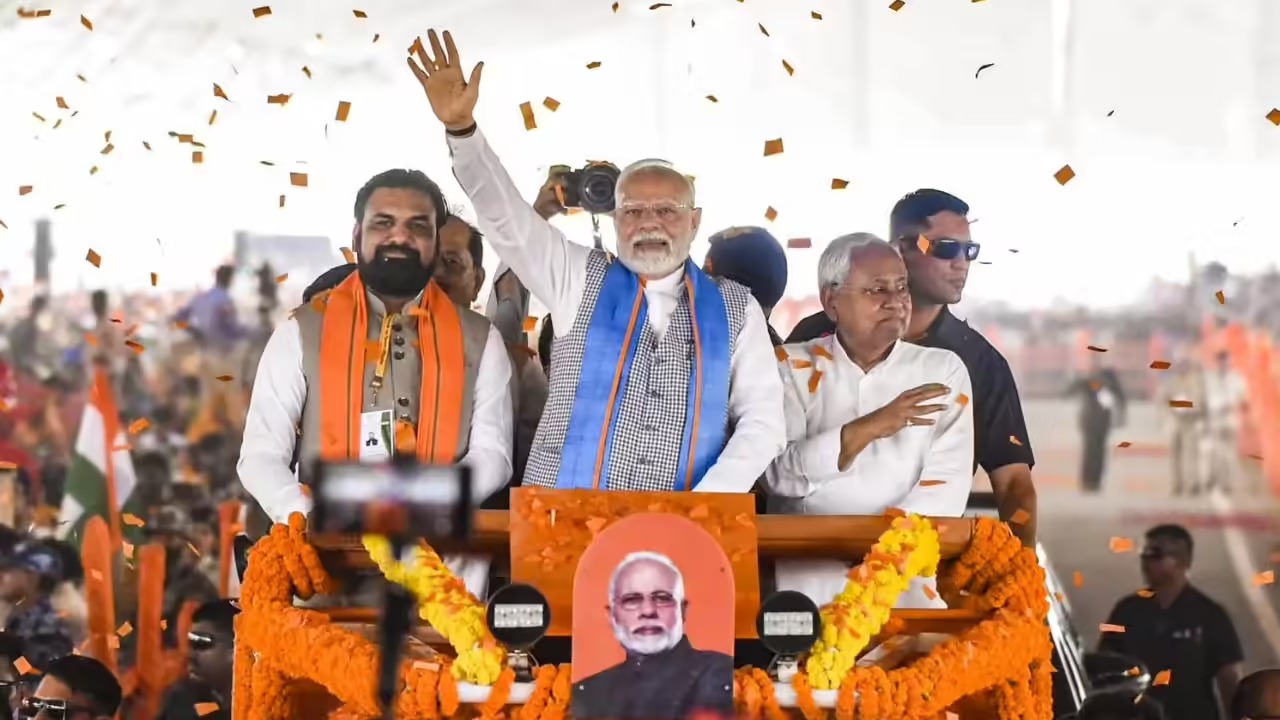
Yet Modi and the Bharatiya Janata Party (BJP) know from experience that Bihar has always been more than just another electoral arena. The state represents both a moral and a political argument — as well as a dilemma — for the Prime Minister and his party. Despite all projections of political modernity, Modi and the BJP have repeatedly been unable to install their own Chief Minister in the state.
They have been forced, rather systematically, to play second fiddle to the older order of regional social assertion. Thus, every mention of the RJD’s “Jungle Raj” under Lalu Prasad Yadav serves not merely as rhetoric but as a reminder of the collective memory of the 1990s — when Lalu and his party stood both as symbol and as symptom of an OBC-driven popular churning.
In the current campaign, Modi once again invoked that era’s imagery — kidnappings, lawlessness, fear — to remind voters of what the NDA claims to have rescued them from. Yet beneath this familiar script lies a subtle unease. After two decades of dominance in national politics, the BJP now confronts not merely the RJD, but a generational challenge embodied by Tejashwi — young, assertive, and fluent in the language of aspiration rather than grievance.
Tejashwi’s Counter: From Memory to Measurement
Tejashwi Yadav has sought to shift the campaign away from the law-and-order discourse toward a socio-economic one: unemployment, migration, and the lack of opportunity in Bihar. “My age may be young, but my promise is mature,” he declared, signalling a younger, more energetic leadership ready to deliver.
He has attacked the ruling alliance’s development narrative by pointing to industrial and land-related setbacks in the state — even quoting the Union Home Minister’s admission that industries cannot be set up due to a lack of available land. He also underscores the opposition INDIA alliance’s focus on concrete governance promises: colleges, hospitals, and jobs.
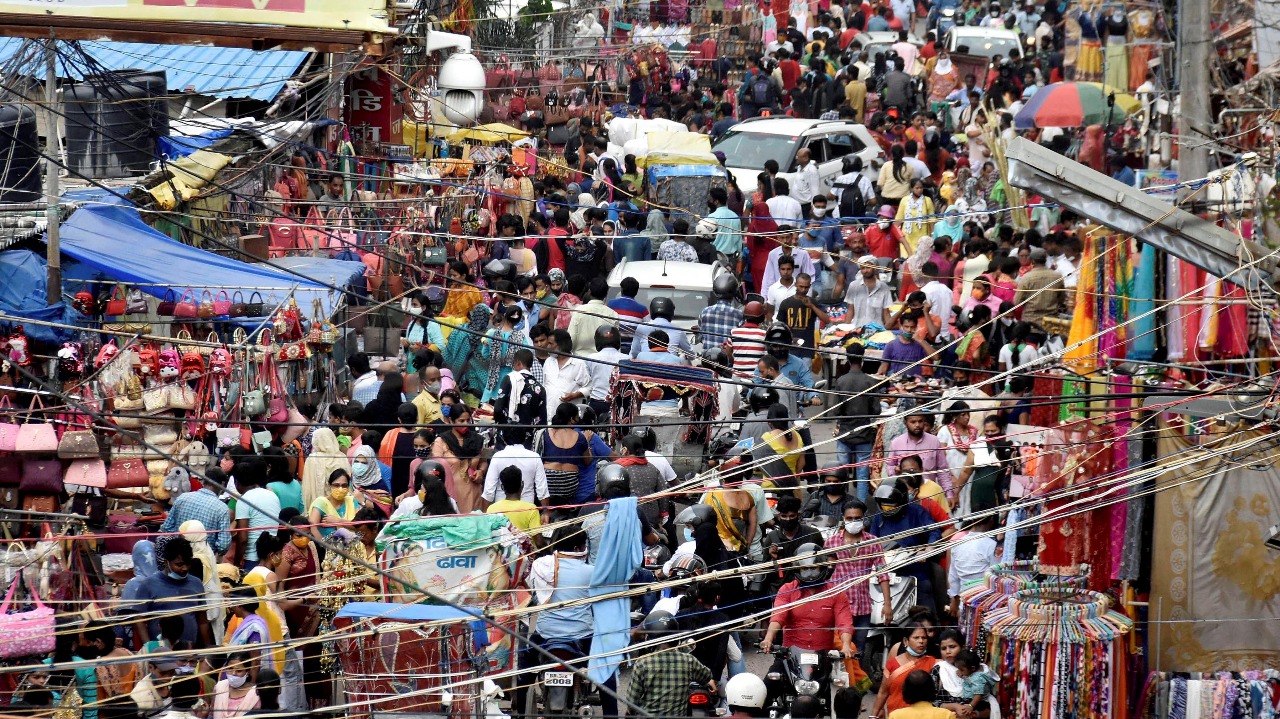
Tejashwi’s strategy is clear — to challenge Modi’s development narrative by asking a simple question: Your promises sound grand, but where are the results? He pivots his message around youth and inclusion while sharpening the economic argument.
At a broader level, Tejashwi’s political journey remains shadowed by his father’s charisma and controversy. Yet his rhetorical frame is markedly different. By countering Modi’s “Maha Jungle Raj” charge with the dry arithmetic of crime statistics and employment data, he signals a shift from the politics of memory to the politics of measurement.
Modi may promise one crore jobs; Tejashwi reminds the crowd that the Prime Minister had once pledged two crore jobs a year nationally — a promise that evaporated in the heat of time. By offering government jobs for every family, he inverts the BJP’s national slogan into a local one: jobs, but this time ours, not theoretical.
The Grammar of a Duel
Both leaders, in their contrasting idioms, are shaping a new campaign grammar. Modi speaks as the national patriarch invoking caution — a vote for him is a vote against chaos. Tejashwi speaks as the local son invoking hope — a vote for him is a vote for dignity. Modi’s oratory draws from epic imagery; Tejashwi’s from lived experience.
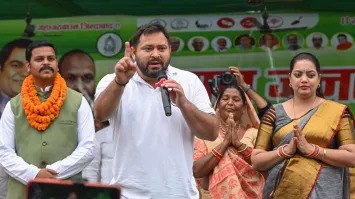
In this dialectic lies the election’s defining rhythm: fear versus faith, past versus possibility. Modi’s claim that Tejashwi “forced the Congress at gunpoint to name him CM face” is not merely a jibe but a calculated attempt to expose opposition fragility. Tejashwi’s riposte — that lawlessness now thrives under the NDA — seeks to puncture that narrative from within. The contest is no longer over who governs better but who defines governance itself.
Between Slogans and Sentiments
Bihar’s electoral landscape, shaped by decades of caste realignments and class anxieties, is once again being recast by competing moral appeals. Modi’s vision of vikas (development) now competes not with nostalgia but with impatience. The migration of Bihar’s youth — both physical and psychological — has created a constituency tired of being told to wait.
Here, Tejashwi’s youth becomes his politics. His meetings are not just rallies; they are conversations with a restless generation that views Delhi’s promises with growing scepticism. In contrast, Modi’s narrative — built on stability, national pride, and redemption — still commands awe, but no longer unquestioned acceptance. The battle, therefore, is between two different currencies of credibility.
The Alliance Equation
Modi’s repeated references to the Congress’s “subservience” within the Mahagathbandhan are deliberate — an attempt to magnify the contradictions of coalition politics. In contrast, Tejashwi’s response has been to dissolve the very question of hierarchy by claiming a generational moral mandate: “I am not just the RJD’s leader; I represent Bihar’s future.”
Whether that assertion holds electorally remains to be seen. Politically, however, it has already widened the field. It forces the Congress to remain relevant within the alliance and compels the BJP to defend its own uneasy equations with allies such as the JD(U). The irony is striking — Modi, often projected by associates like Amit Shah as the master of alliance management, now finds himself criticising the very politics he supposedly perfected at some point of time.
Beyond Bihar
The Modi–Tejashwi duel is not merely a state skirmish; it is a test of whether India’s political discourse can transcend personality and dynasty — and whether generational politics can rewrite inherited narratives. Interestingly, this question found a creative answer in neighbouring Uttar Pradesh during the 2024 Lok Sabha elections, where Samajwadi Party (SP) leader Akhilesh Yadav crafted a calibrated synthesis of his father Mulayam Singh Yadav’s foundational ideas with a contemporary grammar of inclusion and development. The stunning SP victory in the 2024 elections of Uttar Pradesh highlighted this achievement of Akhilesh Yadav. The SP, on its own, won 37 seats and helped its ally Congress garner 6 seats in that election.
Bihar, historically, has been a laboratory of social change — from JP’s movement to Mandal to Nitish Kumar’s early experiments in governance. The question now is whether it can become the incubator of a new developmental politics, driven not by caste alone but by aspiration.
If Modi wins, it will reaffirm the BJP’s national grip and the continuing power of centralised charisma. If Tejashwi holds his ground, it will mark the arrival of a credible regional counterpoint to Delhi’s dominance — perhaps the first after a long drought.
The Verdict that Will Matter
Whatever the electoral outcome, the Modi–Tejashwi face-off has already achieved something rare in Indian politics: it has restored a state-level contest to the centre of national conversation. And that, in itself, is a political statement.
Bihar, as always, is not merely voting for a government — it is negotiating its place in the Republic’s imagination.









Objective reporting with a poetic intro and the final paragraph,shrewd.