

Noida as Symptom: Capital, Precarity, and Emerging Class Formations

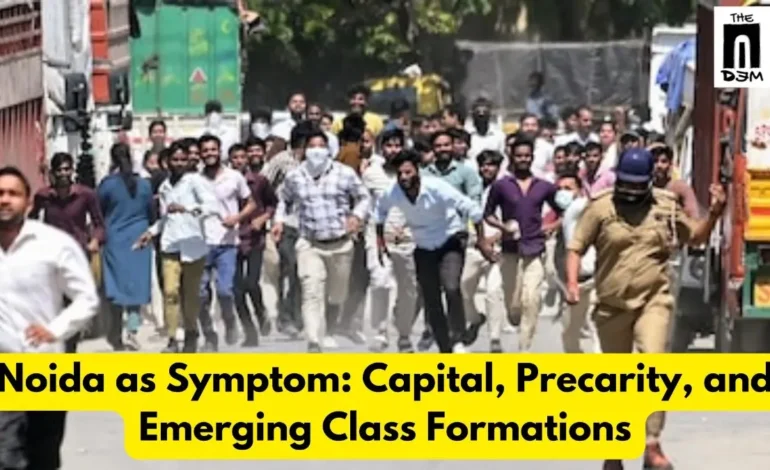
The Noida agitation offers a sharp window into the changing character of class struggle in contemporary India, where labour unrest is increasingly shaped by fragmentation, precarity, and the uneven reach of organized politics. What is striking is that the protests were not initially orchestrated by established unions but emerged from the lived contradictions of contract labour, migrant workforces, and industrial informality concentrated in zones like Noida. The demands, around wages, working conditions, and basic security, are classical in a Marxian sense, yet the form of mobilisation departs from the traditional factory-based, union-led strike. Instead, we see a more diffuse, networked eruption of discontent, enabled by informal worker solidarities and rapid communication channels. The Noida agitation is, thus, best understood not as an isolated episode of unrest but as a revealing symptom of deeper structural contradictions within contemporary capitalism in India. It brings into sharp relief how precarity, fragmentation, and informalisation are not peripheral conditions but constitutive of an emerging, though unstable, class formation struggling to articulate itself within, and against, the dominant regimes of capital.
This might seem to signal a shift from organized class action to what might be called situational or conjunctural class formation, where shared grievances momentarily crystallize into collective action without a stable institutional base. From here, two divergent trajectories appear possible. One is the consolidation of these episodic mobilisations into a more durable and coherent class politics, where labour struggles acquire organizational depth and begin to form the nucleus of a broader social formation of workers and allied groups. The other is the persistence of spontaneity, where discontent continues to erupt in temporary, fragmented, and often short-lived agitations without institutional consolidation. While the former remains normatively desirable and politically transformative, the structural conditions of contemporary India, marked by informality, labour fragmentation, and the weakening of collective institutions, suggest the likely endurance of the latter pattern, with its inevitable limitations. It is precisely at this juncture that the support of communist parties and the broader Left movement in India becomes crucial to the success of the agitation and to the consolidation of future labour mobilisations.
The Caste–Class Dialectic in India’s New Labour Politics
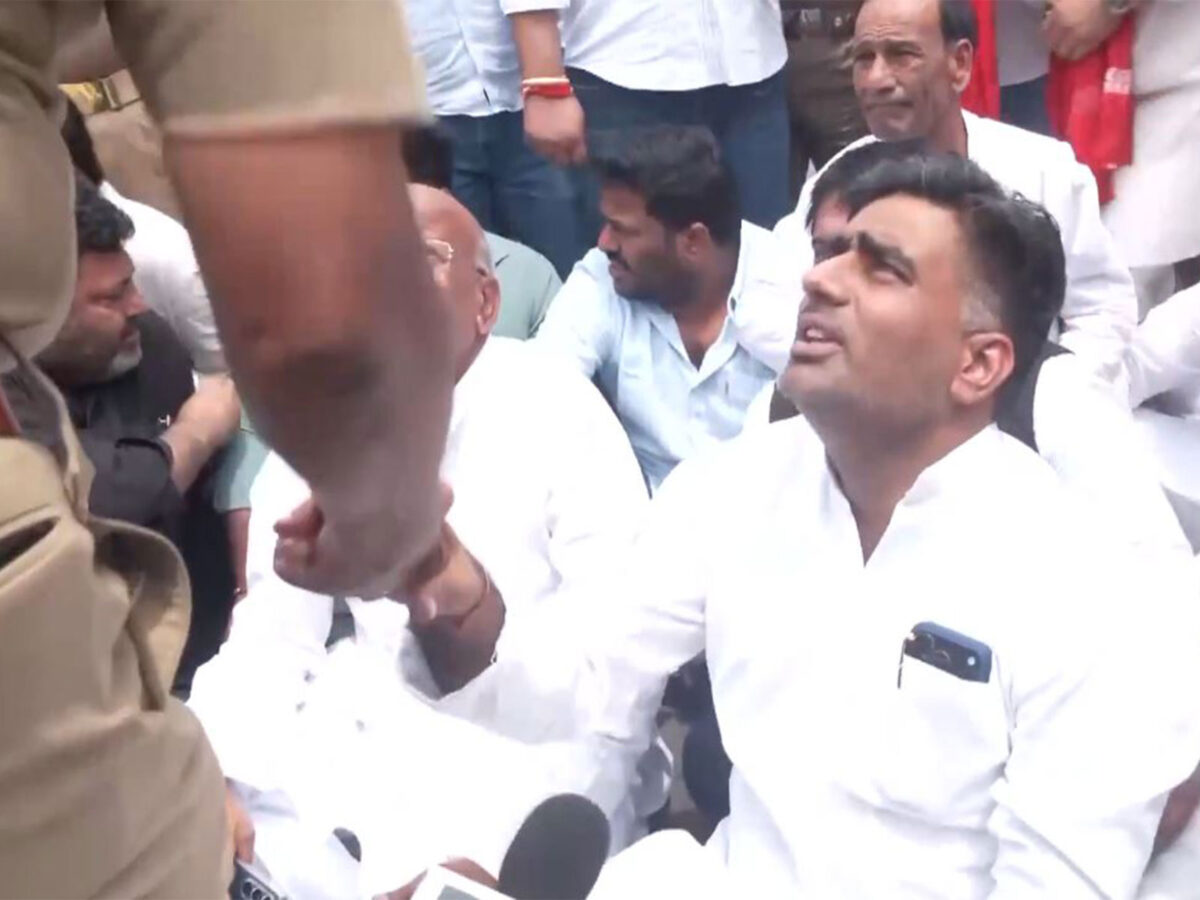
While the Noida agitation is not led by a single, centralized trade union but it emerged from a dispersed mobilisation of workers that subsequently drew in organized labour formations, among the most visible supporters was the Centre of Indian Trade Unions (CITU), which extended solidarity, critiqued the wage revisions, and framed the struggle within a broader national labour question. Other unions, including sectoral bodies such as the BSNL Employees Union, also condemned state repression and expressed support, while smaller activist formations like Mazdoor Bigul Dasta were involved in grassroots mobilisation. Significantly, leaders from the Communist Party of India (Marxist) rushed to the protest site, indicating an attempt to politically engage with the unfolding unrest. However, the overall pattern, where unions and party formations appeared to follow rather than lead the agitation, reveals the limits of this new, fragmented labour politics. While networked, semi-spontaneous mobilisations can rapidly gather force, their lack of sustained organisational coherence and strategic direction underscores the continuing, albeit strained, relevance of traditional trade union structures in shaping durable labour movements.
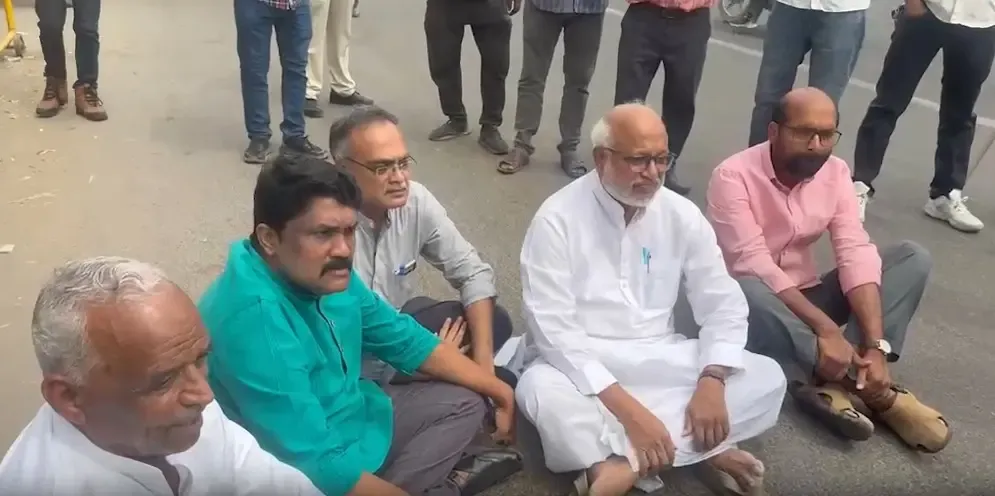
While the CPIM has been more vocal and has extended relatively structured, institutional support to the agitation, the response of liberal and regional parties reveals a markedly different orientation. Leaders and local units of parties such as the Indian National Congress have largely confined their intervention to criticizing the state government over police excesses and delays in addressing workers’ grievances, framing the issue primarily in terms of governance failure and administrative accountability rather than structural questions of labour and capital. The Samajwadi Party, while more visible on the ground due to its regional base in Uttar Pradesh, has similarly sought to mobilize the agitation within an oppositional electoral framework. Other political formations, too, have expressed solidarity, but mostly through statements and symbolic gestures rather than sustained organizational engagement. The contrast is significant: where the CPI(M) attempts to situate the agitation within a broader class politics, other parties engage it episodically, as an opportunity for political positioning rather than as part of a deeper, programmatic commitment to labour struggles.
At the most immediate level, the workforce driving the agitation, contract labourers, migrant workers, and those in precarious industrial employment, draws disproportionately from historically marginalized caste groups, including Dalits and Other Backward Classes (OBCs). This is a long-standing structural feature of India’s labour market, where caste hierarchies are reproduced within capitalist production. Thus, even when the agitation is framed around wages, working conditions, and labour rights, it is also, implicitly, a struggle of socially subordinated groups against economic exploitation. In this sense, caste operates as a background condition of class formation, shaping who becomes part of the most exploited segments of the workforce. This suggests a partial subsumption of caste under class, especially in urban-industrial contexts where migrant workers from diverse regions and caste locations are brought together under similar conditions of exploitation. Yet, this should not be mistaken for the disappearance of caste; rather, it indicates a reconfiguration, where caste inequalities persist but are expressed through labour precarity rather than explicit identity claims.
The Noida agitation can be read as a timely and symptomatic protest against the layered operations of capital, global, national, and regional, whose cumulative effects are increasingly visible in peri-urban India. At its core, the unrest reflects deep anxieties around land acquisition, speculative real estate expansion, delayed housing projects, caste oppression and the dispossession of agrarian communities. Noida, envisioned as a node in India’s integration into global circuits of finance and infrastructure, has long functioned as a site where state policy, corporate interests, and global capital converge. The agitation emerges from this contradiction: between the promise of development and the lived realities of exclusion, stalled projects, financial precarity, and erosion of local livelihoods. Farmers resisting inadequate compensation, homebuyers protesting indefinite delays, and informal workers confronting insecurity together articulate a critique of a development model that privileges capital accumulation over social justice.
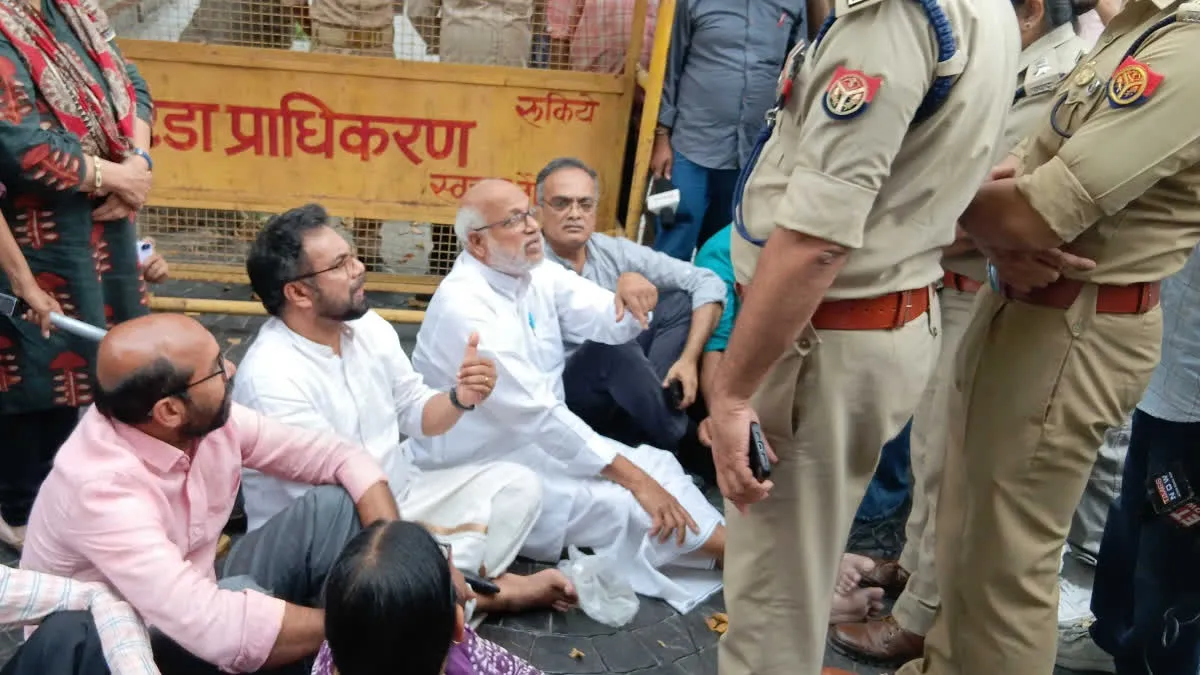
Politically, the agitation is marked by a heterogeneous and somewhat unstable coalition of actors. Farmers’ groups, resident welfare associations, homebuyers’ collectives, and sections of informal labour have come together, often uneasily, around shared grievances. While opposition parties have sought to mobilize and channel this discontent, particularly parties positioning themselves against the dominant neoliberal developmental narrative, the agitation cannot be reduced to partisan politics alone. It also reflects a broader crisis within mainstream political formations, including those in power, which remain deeply entangled with corporate capital and real estate interests. Civil society groups, activists, and issue-based organizations have played a mediating role, attempting to frame the protests in terms of rights, accountability, and democratic participation. Yet, the fragmentation of these formations also points to the difficulty of sustaining a unified political front against a highly networked and institutionalized regime of capital.
Proactive Unionism and the Crisis of Organized Labour
At the same time, the role of established trade unions such as the Centre of Indian Trade Unions and the intervention of political actors like the Communist Party of India (Marxist) point to a proactive rather than directive presence of traditional class organizations. Their arrival at the site of protest suggests both the persistence of older forms of class politics and their diminished capacity to initiate or sustain struggles in the new industrial landscape. This reveals a paradox: while the objective conditions for class struggle, intensified exploitation, wage suppression, and labour flexibilization, have deepened under neoliberal capitalism, the subjective and organizational coherence of the working class has weakened. The result is a politics that oscillates between spontaneity and co-optation, with unions attempting to retroactively frame and stabilize what are essentially volatile and episodic uprisings.
In a broader analytical sense, the Noida agitation reflects the contours of a post-Fordist class struggle in India, where the classical industrial proletariat has been reconstituted into a precarious, mobile, and often invisible workforce. This makes sustained collective action difficult, even as it generates periodic explosions of resistance. The state’s response, combining repression with limited concessions, further indicates an awareness of this volatility, managing unrest without fundamentally altering the underlying relations of production. Thus, the emerging class struggle is marked by intensity without continuity, visibility without consolidation. Whether such moments can be translated into durable political formations remains an open question, but the Noida agitation underscores that the contradictions of capital are far from resolved; they are merely taking new, less predictable forms in India’s evolving political economy.
State, Capital, and the Production of Precarity
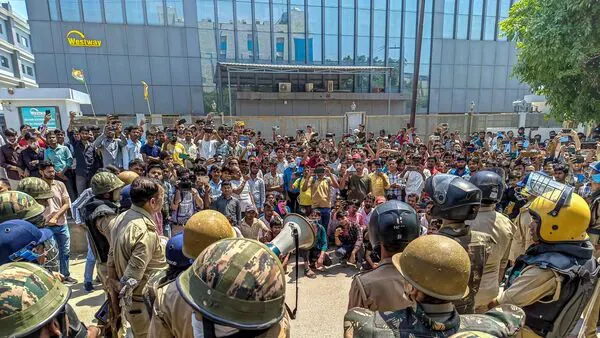
Under the current regime led by the Bharatiya Janata Party, there is a clear alignment between state policy and the imperatives of capital, particularly in industrial regions like Noida. This is evident in the implementation of recent labour reforms, especially the Code on Wages 2019 and related labour codes, which have been widely critiqued for weakening collective bargaining, diluting protections, and increasing flexibility for employers at the expense of workers’ security. Such reforms, combined with the state’s facilitative role in land acquisition, real estate speculation, and industrial expansion, create the very conditions of precarity that trigger these eruptions of discontent. In this sense, the agitation is not merely a reaction to immediate grievances but a response to a broader political economy in which the state’s ideological and policy commitments consistently privilege capital over labour. As The Communist Manifesto observed, “the executive of the modern state is but a committee for managing the common affairs of the whole bourgeoisie,” a formulation that subsequent developments under global capitalism have only deepened, rendering it an enduring and powerful depiction of reality across successive phases of capitalist expansion and intensification.
In a wider theoretical sense, the Noida agitation resonates with global patterns of resistance against neoliberal urbanism and financialized capitalism. It echoes struggles elsewhere where urban expansion, driven by speculative capital, produces uneven geographies of wealth and dispossession. The Indian state, particularly in its post-liberalization phase, has increasingly positioned itself as a facilitator of capital rather than as a guarantor of welfare, thereby intensifying contradictions within democratic structures. The agitation thus signals not merely a localized protest but a deeper structural discontent, one that questions the legitimacy of development paradigms anchored in market logic. Whether this moment can consolidate into a sustained political movement remains uncertain, but it undeniably foregrounds the urgent need to rethink the relationship between capital, state, and citizen in contemporary India.









“A sharp and insightful take on how Noida reflects deeper shifts in capital and class dynamics—really makes you think about the hidden layers of urban growth.”