


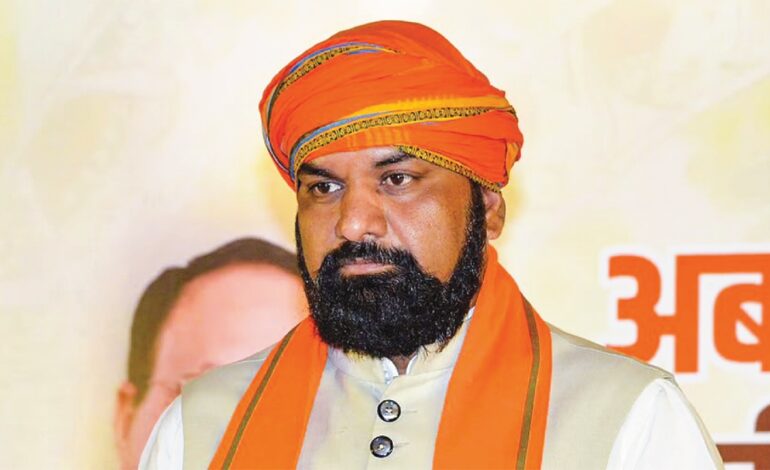
In the 32nd article of the “Everything Under the Sun” column, Nalin Verma traces the rise of Samrat Choudhary—from contested beginnings to the highest office in Bihar—unpacking the shifting grammar of leadership, symbolism, and political legitimacy in contemporary India.
Robert Frost once wryly noted, “A diplomat is a man who always remembers a woman’s birthday but never remembers her age.”
Does the new Bihar Chief Minister, Samrat Choudhary, fit into the American poet’s observation—one who wrote philosophical poems about the rural life of New England?
Not at all! Frost’s satirical take on political figures is subtle. Moreover, the political-cultural milieu that served as the laboratory of his creativity was itself nuanced, perhaps compelling the philosopher-poet to embed his insights in layers of suggestion.
But there is nothing subtle or nuanced about Samrat Choudhary. The apt expression for him and his style is “khullam khel Farrukhabadi.” It is difficult to find an exact translation of this adage—rooted in the soil and lingo of Bihar and the larger Bhojpuri region—into English or any other language. Broadly, it means doing something openly, even scandalously, without the pretence of secrecy or restraint.
Juliet, in William Shakespeare’s classic Romeo and Juliet, argues that a name is merely a label and does not define a person’s true nature, even when she is reminded that Romeo belongs to the rival Montague family.
But in this case, there is much to be gleaned from the journey of a man who began as Rakesh Kumar, became Rakesh Kumar alias Samrat Chandra Maurya, and has finally settled as Samrat Choudhary, now the Chief Minister.
It is well known in Tarapur and Parbatta—his ancestral roots in north Bihar’s Khagaria district—that his politically prominent parents, Shakuni Choudhary and Parvati Devi, named him Rakesh Kumar.
In 1995, Rakesh was charged in a case involving the killing of seven persons belonging to his own Koiri-Kushwaha caste and was subsequently jailed. However, he submitted an affidavit in court claiming that he had been born in 1981 and was therefore a minor, which led to his release.
The ace election strategist-turned-Jan Suraj Party founder, Prashant Kishor, later produced documents from the court indicating that a little-known school in Tarapur had issued a certificate in the name of Samrat Chandra Maurya, son of Shakuni Choudhary, stating that he had failed in Class 7 and was born in 1981.
Subsequently, he became an MLA but was disqualified by the court on grounds of being underage. Prashant Kishor, who crisscrossed Bihar for three years offering his alternative vision for the state’s development ahead of the 2025 Assembly polls, also cited Election Commission records showing that Samrat Choudhary had declared his age as 51 in his 2020 election affidavit. “It means Choudhary was 26 years old in 1995,” Kishor told the media, while demanding that the Prime Minister, Chief Minister, and Governor drop him as Deputy Chief Minister and reopen the cases of murder and fraud against him.
In the course of his nearly 30-year journey—from jail to the Rashtriya Janata Dal, then to Janata Dal (United), Hindustani Awam Morcha, and finally to the Bharatiya Janata Party; from Rakesh Kumar to Samrat Chandra Maurya to Samrat Choudhary; and from BJP state president to Deputy Chief Minister to now Chief Minister—the leader whose date of birth remains mired in ambiguity presents a saga of striking political success.
His school certificate, produced in court in 1995, showed him as having failed Class 7. Today, he flaunts an honorary D.Litt (Doctor of Literature) degree. A reasonably qualified and erudite Prashant Kishor was among the first to question it. Subsequently, the JD(U) spokesperson and a leader of the ruling National Democratic Alliance (NDA) in the state—then headed by Nitish Kumar as Chief Minister—Neeraj Kumar publicly repeated the charge and declared that Samrat Choudhary’s D.Litt degree was fake.
“Going through his affidavit, I noticed that he had procured his D.Litt degree from California Public University,” Neeraj Kumar said, displaying a copy of the affidavit. He added, “When I researched further, I found that there is a well-known University of California, but nothing called California Public University.”
The Irony
Will Neeraj Kumar—a prominent face of JD(U)—repeat these allegations of fraud against Samrat Choudhary now? Samrat has replaced Nitish Kumar as Chief Minister, and party members of Nitish Kumar are expected to fall in line with the new NDA leadership. Samrat, belonging to the BJP, has become the first BJP Chief Minister of Bihar.
An unrelenting Prashant Kishor, however, continues his attacks on Samrat Choudhary—arguably even more forcefully than before the 2025 elections. Ironically, Kishor, who left behind a successful career in election management to walk through the dust and mud of Bihar—offering a vision for improving education and tackling migration, unemployment, and poverty in one of India’s poorest states—drew a blank in the polls.
A cash dole of ₹10,000 to women’s accounts, coupled with the controversial Special Intensive Revision (SIR) of electoral rolls and several alleged manipulations of the poll process, produced unexpected results: the NDA won 202 out of 243 seats, reducing opposition parties—including the RJD—to near insignificance.
The media narrative in Bihar has since shifted. Several newspapers and digital platforms now discuss how Samrat Choudhary might strengthen the NDA’s “Law-Kush” (Kurmi–Koiri) social combination, given his Koiri background.
Some commentators link his rise to the legacy of the Triveni Sangh, a pre-Independence farmers’ formation comprising Yadav, Kurmi, and Koiri leaders. They argue that Samrat Choudhary completes the “circle” of representation: a Yadav in Lalu Prasad Yadav and a Kurmi in Nitish Kumar have already led the state, and now it is the turn of the Koiri community, which Samrat represents.
For quick commentators posing as “Bihar experts” on ubiquitous digital and TV platforms, it is easy to draw such parallels with the Triveni Sangh. However, serious sociologists and historians may well find these interpretations simplistic.
A large section of Bihar-based media argues that Samrat, despite belonging to the BJP, is essentially Nitish Kumar’s choice. But this raises a critical question: how could a leader perceived as increasingly non-functional due to health concerns—who could not retain his own position as Chief Minister despite his party winning 85 seats against the BJP’s 89—manage to install a CM of his choice?
Moreover, Samrat has not become Chief Minister all of a sudden. Though he joined the Bharatiya Janata Party barely eight years ago, he was groomed under the leadership of Narendra Modi and Amit Shah. What may have surprised the core cadres of the Sangh Parivar was his elevation as the state BJP president—a position traditionally held by leaders deeply rooted in the party’s Hindutva ideology. Later, his political trajectory led him to become Deputy Chief Minister under Nitish Kumar.
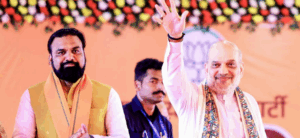
In fact, leaders like Samrat are often rewarded in the BJP’s current political framework. Some commentators see in him a Himanta Biswa Sarma of Bihar. In some ways, the comparison holds. Sarma, once associated with the Indian National Congress, had faced allegations of corruption and fraud before rising to become a prominent Chief Minister under the BJP. Samrat, it is argued, possesses similar attributes that could shape his trajectory in Bihar.
Taqiyah
A video showing Samrat Choudhary refusing to wear a taqiyah (skull cap) offered by a Muslim cleric has gone viral. Some liberal observers have questioned his refusal. They are, perhaps, overlooking a broader political pattern.
They may recall that Samrat Choudhary’s political superior, Prime Minister Narendra Modi, had similarly declined to wear a taqiyah offered by a cleric during his tenure as Chief Minister of Gujarat. In that light, Samrat’s gesture appears consistent with the symbolic politics of the current leadership.
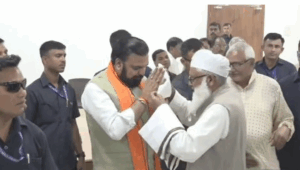
Of course, leaders such as Nitish Kumar, Lalu Prasad Yadav, Jagannath Mishra, and other previous Chief Ministers of Bihar had accepted the taqiyah as a gesture of respect towards Muslim cultural practices. But Samrat represents a Chief Minister in what is often described as the “New India” shaped by the post-2014 BJP leadership.
Despite being a relatively poor state, Bihar has produced several distinguished and erudite Chief Ministers—Sri Krishna Sinha, a freedom fighter with a doctorate in law; Mahamaya Prasad Sinha; Abdul Ghafoor; Karpoori Thakur; Satyendra Narayan Sinha; Bindeshwari Dubey; Bhagwat Jha Azad; and Jagannath Mishra—leaders who commanded stature in their own right. Lalu Prasad Yadav and Nitish Kumar, too, belong to this lineage in terms of their political contributions and leadership.
Now Bihar has Samrat Choudhary. Best wishes to him.







“A thought-provoking take on how leadership is crafted in New India—highlights the interplay of power, narrative, and public perception in a compelling way.”
Thank you, Raj Veer, for reading & commenting…
Superb analysis ,as always . Nalin verma has clearly exposed the shenanigans of the BJP. But such analysis is meaningless as the Sangh Parivar’s political juggernaut marches on spreading communal venom and social discord matched with devious games in governance.
Thank you, Partha, for reading it, and thank you for your kind words
The article, presented with clarity, reflects a revealing mirror: the “making of a Samrat” in New India is less about individual merit and more about the kind of leadership rewarded and reproduced by today’s political culture.
Mr. Samrat Choudhary is not a new phenomenon for Bihar, which has long witnessed figures like Lalu Prasad Yadav and Rabri Devi dominate its political landscape. Since Independence, while the Constitution offered a democratic framework, in practice, voters often chose along caste and religious lines—patterns that have deeply shaped leadership in states like Bihar.
Moreover, even highly educated leaders have disappointed the electorate through poor governance, corruption, or a lack of inclusive vision. Against this backdrop, the rise of Mr. Choudhary is hardly surprising: it reflects social engineering, symbolism, and political survival more than academic credentials.
Ultimately, however, his success or failure will rest not on biography or image but on his ability to deliver governance, economic development, and inclusive growth. With expectations already modest, he has little to prove beyond consolidating his position.
Thank you, Ajay Sir, for your balanced comment on the column, humbled…