

The Bulldozer and the Governed: Sovereignty and the Spectacle of ‘Bare Life’


In a year scarred by the routine spectacle of demolition and displacement, the bulldozer has emerged as both instrument and icon of political atrocity. What once appeared as isolated acts of “law enforcement” have, over time, hardened into a governing culture — one that normalises punishment without trial and power without accountability. Solomon Mubash examines why the bulldozer is not merely a machine of destruction, but a language of hegemony and sovereignty in contemporary India, asking what becomes of citizenship, law, and democracy when governance is performed through steel, speed, and erasure.
In the final weeks of 2025, the bulldozer’s steel arm remains the most visible symbol of state power in India. What was once a tool of urban and infrastructural development has evolved into a potent instrument of infrastructural violence, blurring the line between executive action and judicial retribution. Despite a landmark Supreme Court intervention in late 2024 aimed at halting “bulldozer justice,” the practice has continued—albeit under a new, more insidious cover: administrative laundering, the practice by which the state deploys routine administrative laws to “cleanse” or mask what are, in effect, punitive, political, or extra-judicial actions.
From the coastal shrines of Beyt Dwarka in Gujarat to the congested lanes of Bengaluru’s Yelahanka, the pattern remains strikingly consistent. Following communal flashpoints or perceived political defiance, the bulldozer arrives not to build, but to erase. To understand this phenomenon, one must look beyond the immediate dust of demolition to the intersection of Giorgio Agamben’s Homo Sacer, Partha Chatterjee’s Politics of the Governed, and the emerging “bulldozer template” championed by the nation’s top leadership.
The Minority as ‘Bare Life’
Giorgio Agamben’s revival of the ancient Roman figure of the homo sacer—the “sacred man” who may be killed but not sacrificed—finds a chilling contemporary resonance in the figure of the Indian Muslim citizen. The homo sacer exists in a “state of exception,” a legal vacuum in which the Constitution is not so much violated as suspended.
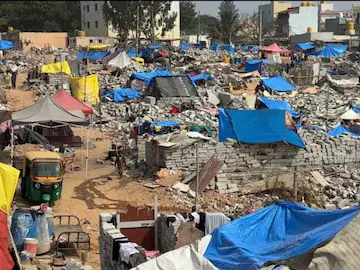
By re-categorising long-standing homes as “illegal encroachments,” the state effectively strips their inhabitants of political rights, reducing them to bare life—life devoid of citizenship and political protection. In this state of exception, the home, the ultimate sanctuary of privacy, is transformed into a site of administrative routine. The bulldozer does not argue; it simply erases the physical footprint of a life that has been rendered legally invisible.
The Death of Negotiation
While Agamben theorises the legal void, Partha Chatterjee’s distinction between “civil society” and “political society” illuminates the sociological rupture. In Chatterjee’s framework, political society is the realm in which the “governed”—the poor, squatters, and the marginalised—negotiate with the state for survival. The state engages with them not as rights-bearing citizens but as populations to be managed.
The “bulldozer state,” however, represents a fundamental refusal to negotiate. For the Muslim minority, the state has revoked the status of a “population to be managed” and replaced it with that of a “population to be eradicated.” When neighbourhoods that have existed for decades are levelled despite residents holding Aadhaar cards and voter IDs, the state signals that these citizens have been forcibly expelled from political society. They are no longer “the governed”; they are the excluded.
Indian Muslims increasingly find themselves outside a fascistic conception of citizenship that is coming to rest on ethnicity. The legal and political order is tilting towards ethnic democracy, in which citizenship is defined along ethno-cultural lines. Unlike the traditional concentration camps of the twentieth century, confinement in such a democracy assumes a different form. Walls are no longer physical structures; they are barrios produced and maintained by power.
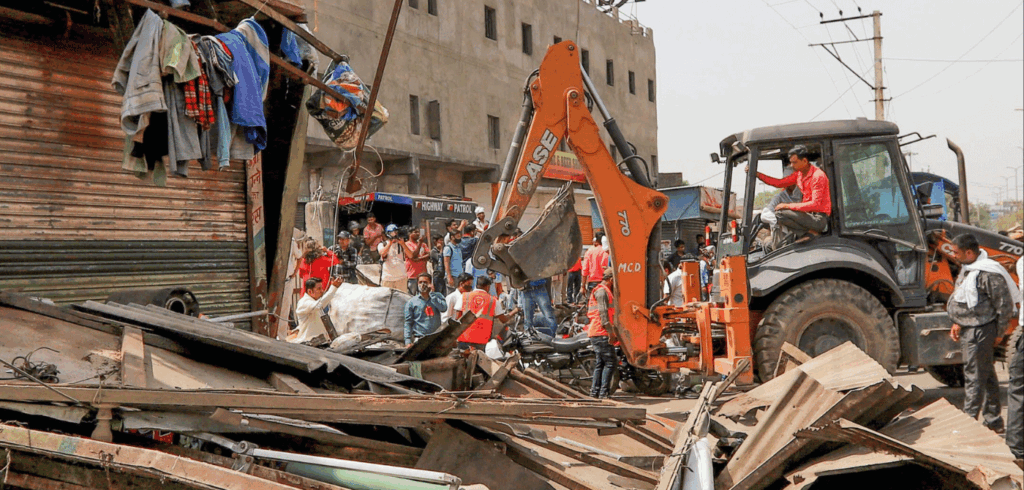
Under Hindutva, power is exerted directly on the Muslim body, bypassing the customary channels of law and governance. Every Muslim body exists within an invisible camp where the rule of law has little purchase. In this sense, Zionist Israel and Hindutva India converge along a necropolitical axis, sustaining ethnic democracy through direct control over life itself.
The Template of Tyranny: From Uttar Pradesh to Karnataka and More
The rise of this phenomenon is closely linked to the political branding of figures such as Prime Minister Narendra Modi and Uttar Pradesh Chief Minister Yogi Adityanath. Adityanath, the architect of the “Bulldozer Baba” archetype, has transformed an industrial machine into a symbol of assertive, extra-constitutional governance.
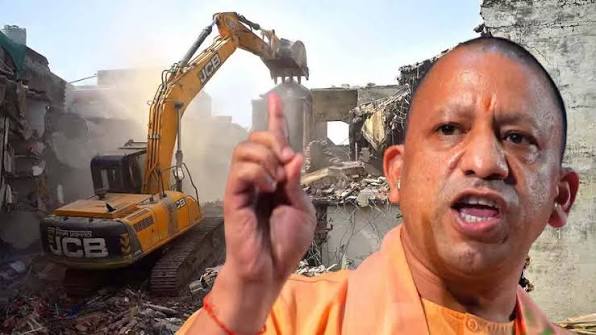
This is not merely a localised policy but a replicable template of repression. By weaponising law-enforcement agencies—the ED, the CBI, and local police—as partisan instruments, these leaders have devised a blueprint for silencing dissent. The bulldozer represents the final, material stage of this suppression.
Alarmingly, this template has acquired a viral quality. State governments ruled by political opponents of the BJP, including Karnataka and Himachal Pradesh, have begun to employ similar mechanics to curb democratic protests or “clear” minority settlements. This suggests that the “Modi template” has outgrown the man himself; it has become an institutionalised form of fascist governmentality. The spectre of this method—the systematic use of administrative machinery to bypass judicial scrutiny—threatens to haunt Indian democracy long after its present architects have exited the stage.
Administrative Laundering: The 2025 Adaptation
The Supreme Court’s November 2024 ruling was intended to halt this practice. The Bench mandated a 15-day notice period and personal hearings for affected parties. Yet throughout 2025, the executive has responded with a strategy of administrative laundering. Instead of overtly punitive rhetoric, officials now justify targeted actions in the language of “environmental preservation” or “urban regulation.” By framing demolition as routine necessity, the state sidesteps constitutional safeguards while maintaining a façade of bureaucratic legality.
The Hallowing of the Republic
As 2025 draws to a close, the “logic of the camp” has become increasingly adaptable. In India, the concentration camp is no longer a fortified enclosure, as in Nazi Germany, but an invisible space in which minorities are reduced to bare life. The bulldozer no longer requires a fixed geography; it establishes a camp wherever it pauses.
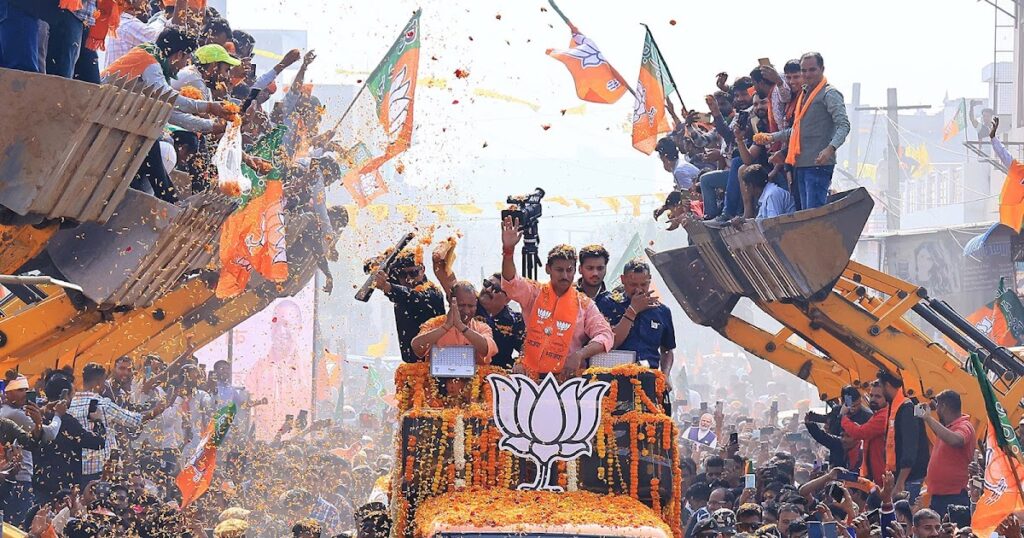
When sovereignty is asserted not by building homes but by demolishing them, the foundations of equal citizenship begin to crumble. The “Modi–Yogi template” has fundamentally reconfigured the relationship between the state and minorities, and between the state and democratic dissent. In this landscape, the rule of law is not merely broken; it is being paved over by a machinery of power that equates justice with the weight of steel. This authoritarian turn is now embedded in the functional software of the Indian state, ready to be activated by any ruler, irrespective of party affiliation.








