


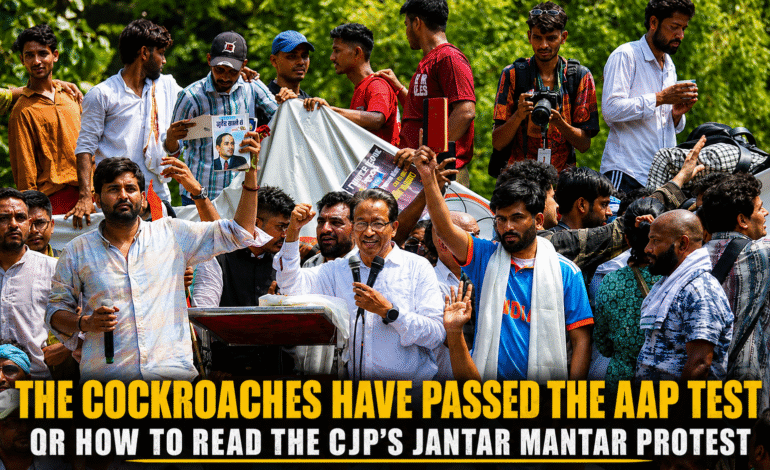
How To Read The CJP’s Jantar Mantar Protest
We live in deliciously perverse times.
The Chief Minister of Delhi, Rekha Gupta announced a few days ago that our water evaporates before it reaches the ground, so our taps run dry. An 18 year old boy asks basic questions about why a blacklisted company is re-hired by the government to set exam papers where the results are all mixed up. We don’t know why the government is putting public money into a private export company’s stock when all other investors are pulling out. We don’t know if some of the country’s gold reserves were sold by our reserve bank or not.

In times of such little transparency, nothing is a shock to the system. Everything is suspect. So how to make sense in these times of evaporated faith, of the Kafka-esque protest on June 6th at Jantar Mantar? Are The Cockroaches for real?
I wasn’t on Ground Zero, but I ran the movement through my special `AAP lens,’ acquired while being on ground when the India Against Corruption Movement took off in 2010, that subsequently morphed into the Aam Aadmi Party. I wrote then, how the Arvind Kejriwal and co. ‘built and blew a movement.’ Now, looking at the sudden meteoric rise of the Cockroach Janta Party, everyone had the AAP on their minds. Is this an AAP part deux? Is it going to fail and disappoint at scale, spectacularly, like its predecessor? My AAP barometer is telling me differently.
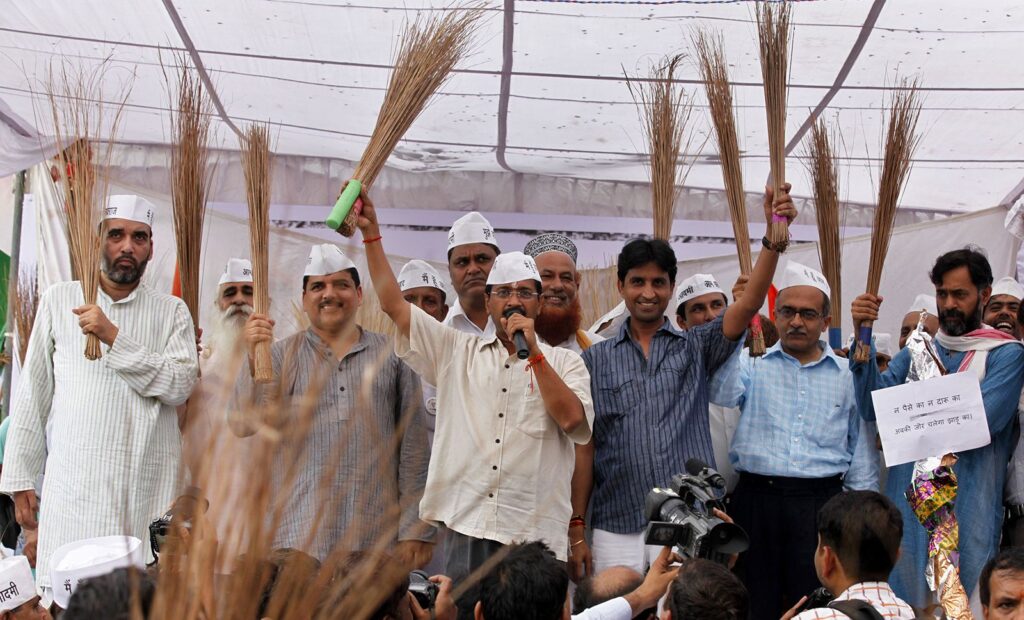
The first lesson I took from studying the rise and fall of AAP was this – when the crowds swell to lakhs on the ground, it’s not a good sign. It means the crowds are possibly curated. People who study crowds and movements – historians and journalists, have always maintained that it is highly improbable for lakhs of people to gather spontaneously.
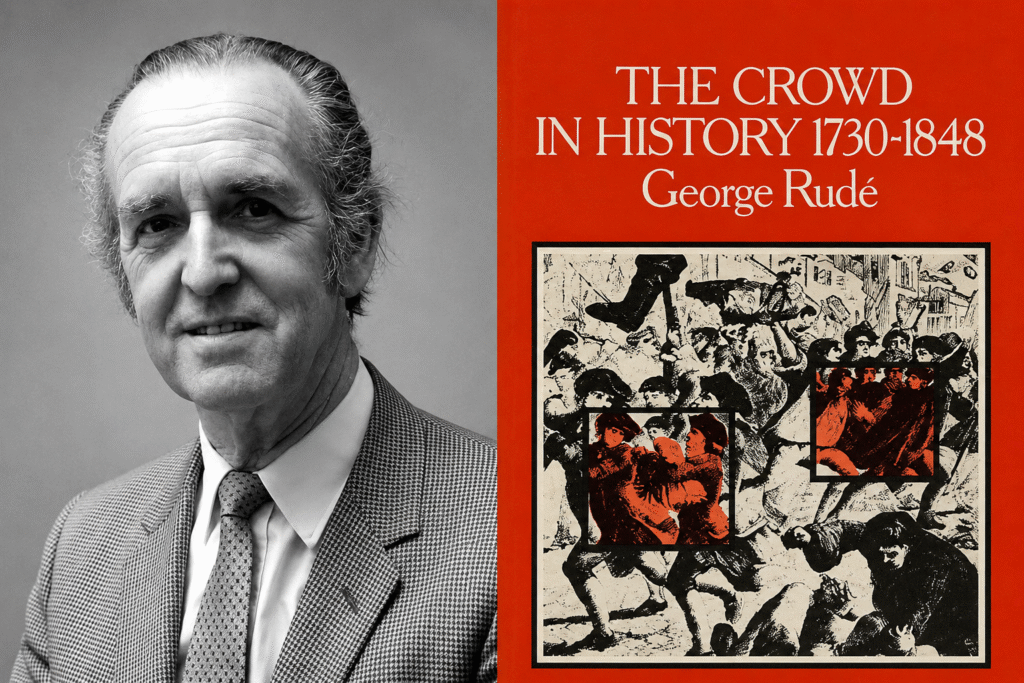
The renowned historian George Rude wrote a very long time ago, while studying the French Revolution of 1789, that there is no such thing as a spontaneous crowd – people are persuaded, convinced, dragged, pushed to places and this has always required work. (`The Crowd in History – A study of popular disturbances in France and England 1730 – 1848,’ by George Rude, Published by John Wiley and Sons, 1964)
The appearance of lakhs of people on Day One of the India Against Corruption movement, we now know, came from Arvind Kejriwal having befriend and been a friend/disciple of Sri Sri Ravishankar. Arvind also brought in Ramdev and his people, and Jaggi Vasudev or Sadhguru and his disciples. It was this triple whammy – Guru plus Guru plus Guru that led to lakhs arriving. It’s no surprise then that in time, the movement began to pull in so many different directions and still has no coherent set of ideas that binds it.
If instead of lakhs, on June 6, there were two or three thousand people thronging Jantar Mantar in Delhi, its actually a sign that this may have been a more organic assemblage. This may represent a more honest cohering of people around the Cockroach Janta Party.
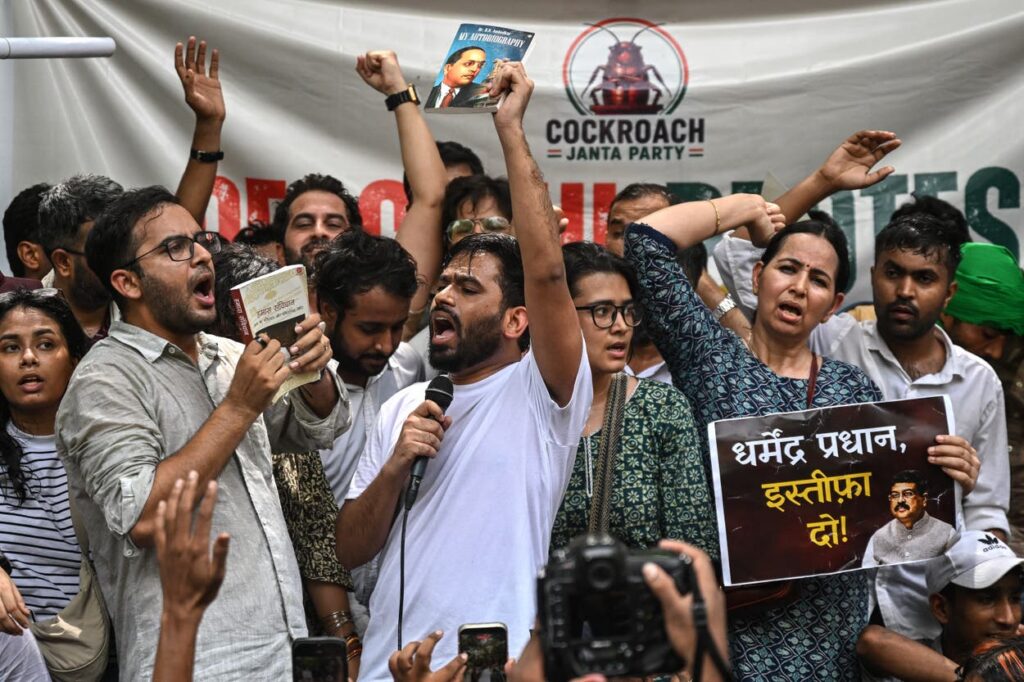
The caveat here is the presence of Sonam Wangchuk – sometimes bending towards the government, at other times, sitting in protest against. With a wind-blowing neta like this, it’s hard to tell what Wangchuk was there for. And his speech at Jantar Mantar made it even harder to decipher.
“Jis tarha zimmedari aur samvedansheelta sarkar ne dikhai hai, mai bahut garvit hoon…”I am very impressed with the responsibility and sensitivity the government has shown (in allowing this peaceful protest to take place). Wangchuk’s fear-ridden, carefully constructed statements were in sharp contrast to the boldness of the CJP’s organisers . “They are only doing Hindu-Muslim politics for ten years,” said Abhijeet Dipke to the swelling crowd.
The other departure from AAP seemed to be the clarity that this is politics 101. The AAP and its leader, Arvind Kejriwal had , in the early days of the movement, sought to repeatedly deny that the movement had political aspirations.
The Cockroaches are saying they are waiting and watching. They have clearly positioned themselves as a political movement and are not ruling out becoming a full-fledged political party.
If I were to read the signs, I would infer that the CJP has been deeply political from the start. Their digs at the present regime borrow from traditions of Ambedkarite and Left protests and political formations. They were strategic to have started out overseas, in Boston. They may not have calculated that their satire would grow to 13 million followers in a few days. But pushing well past the BJP’s online following gave them enough online heft and muscle power to put the government in a spot. It would be impossible for any government to arrest CJP’s leaders. That would likely cause a further spike in their popularity and give it a cloak of martyrdom. From the point of view of the government, this would perhaps be a damned if you do and damned if you don’t moment in time.
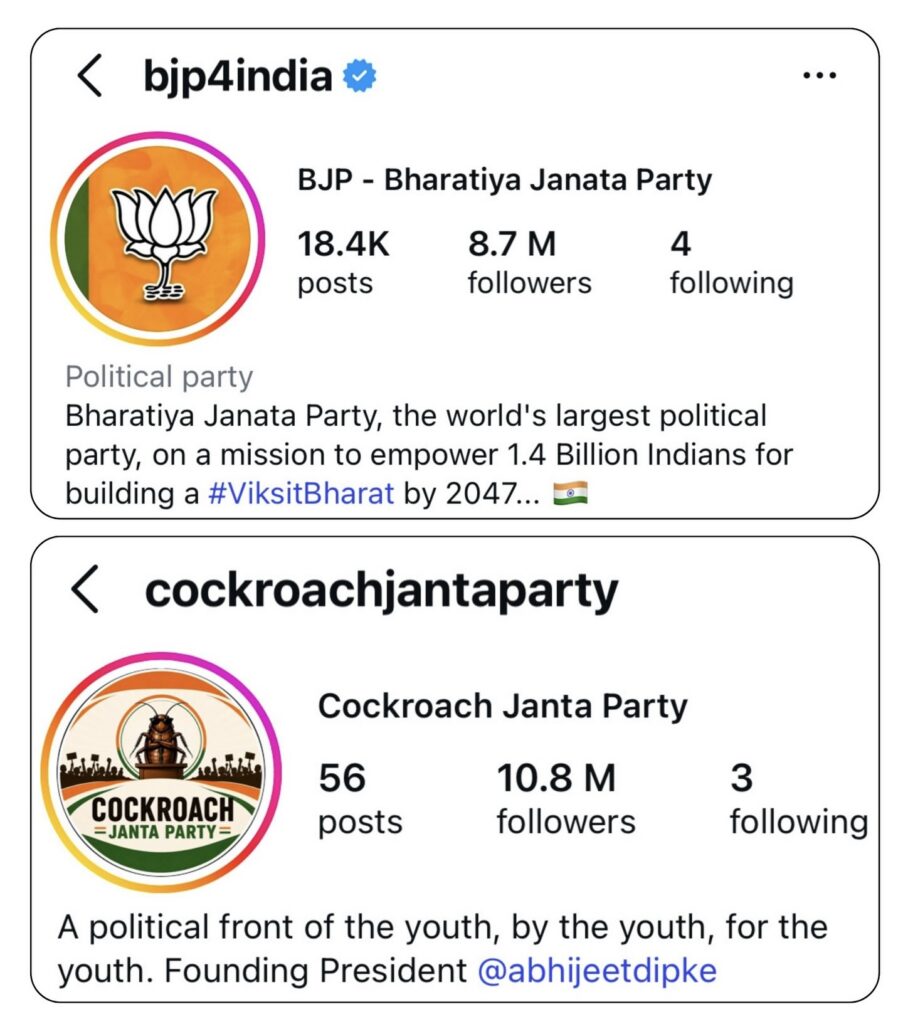
It also appeared as if the ostensible purpose for the CJP’s asking everyone to gather at Jantar Mantar to demand the resignation of the Education Minister was a thin cover for a much more full-bodied wide-ranging critique of the Modi government. Whether the protest picks up over time, results in a resignation or not seems premature to analyse for now. That a two-week old satirical movement could persuade a few thousand people to push past their fears and risk arrest is a political earthquake in and of itself. Its main function has been to demonstrate that even against heavy odds, people turned up. In so doing, this is possibly a bigger structural breach than the lakhs that turned up as Guru-curated crowds at the nascent AAP movement sixteen years ago.
Finally, the 13 million followers online and 23,000 `party members’ who joined on the CJP website are a barometer of dissent. It punctures the saffron balloon projected as invincible by a pliant mainstream media.
At a time when citizens are excluded from electoral rolls and the information gateways are flooded with a mostly one-way traffic of propaganda, there has been no real gauge of dissent, except the recent elections. If that was the only yardstick, it would appear as if people’s dissent, palpable at the time of the general elections of 2024; has now waned. And then, as if out of nowhere, came the Cockroach-styled breach.
What happens to the CJP hereafter is another matter. It’s performance as seen in the present moment has been like a supra-parliamentary opposition, where the in-parliament version seems to have lost its grip. Whether the opposition builds into something more tangible remains to be seen. For now, the rising of citizens on this one day is a demonstration of how fragile the regime’s popularity is. Also, it makes amply clear that at the slightest provocation, citizens are willing to push past fear and the mighty bulwark of the paid media and mobs.










**”The journey from online satire to street mobilisation is a remarkable story of contemporary civic engagement. An insightful article that captures the aspirations, frustrations, and political awakening of a new generation.”**