


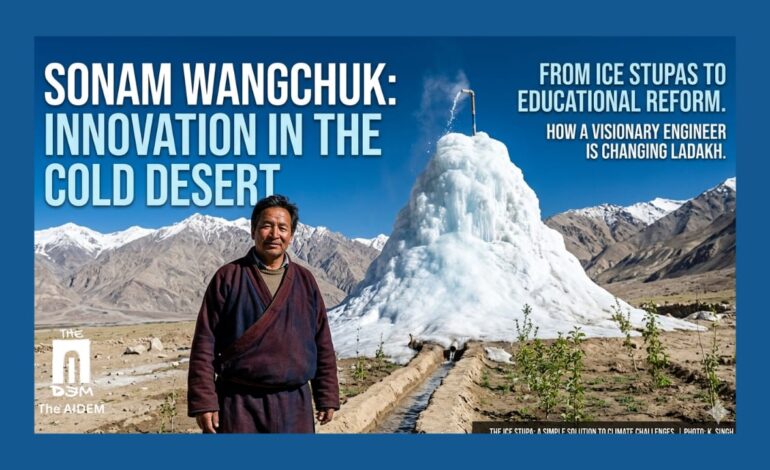
Ladakh occupies sixty thousand square kilometres of the northwestern Himalayan plateau, at altitudes where the air is thin and the sunlight, paradoxically, is abundant—three hundred clear days a year in one of the world’s most extreme cold deserts. Its population, roughly two lakh seventy-five thousand people, lives mostly along the Indus River, which originates here and has sustained the Ladakhi civilization for millennia. The region is beautiful in the manner of places that have been shaped entirely by necessity: its architecture, its agriculture, its social arrangements all bear the mark of a people who learned, over many generations, to extract maximum life from minimum resources. Then the Indian education system arrived and declared their children stupid.
For most of the twentieth century, Ladakhi students were taught in Urdu—a language that most of them did not speak at home, in schools staffed by teachers from elsewhere in Jammu and Kashmir who found postings in Ladakh inconvenient and attended them accordingly. The result was predictable. In the nineteen-eighties, fewer than five per cent of Ladakhi students passed the Class Ten board examination, the basic threshold of formal schooling. This was taken, in the way that such statistics tend to be taken, as evidence of an educational deficit in the students rather than a structural failure in the system.
Sonam Wangchuk was born into this system in 1966 and survived it by luck and persistence. He went on to become a mechanical engineer, reform the Ladakhi school curriculum, invent a method for manufacturing artificial glaciers from a pipe and the physics of pressure, win the Rolex Award for Enterprise, attract the attention of Switzerland, and begin planning a research university in a high-altitude desert. The thread connecting these activities is not complicated: he is a man who was told, repeatedly and with institutional authority, that a problem was too difficult to solve, and who repeatedly found that the problem was simply being approached from the wrong direction.
“The Ladakhis are not stupid. They are victims of an alien education system—one that teaches children in a language no one around them speaks.” —Sonam Wangchuk
The Boy Who Could Not Speak
Wangchuk grew up in comfortable circumstances by Ladakhi standards. His father, Sonam Wangyal, rose to become a minister in the Jammu and Kashmir government, and when the family moved to Srinagar, the boy who had been educated until the age of nine by his mother, in Ladakhi, was enrolled in a school where instruction was conducted in English and Urdu—languages he did not know. He sat in class unable to follow the lessons, unable to respond when called upon, and was labelled stupid by teachers and classmates alike. He describes this as the darkest period of his life. He eventually ran away to Delhi, presented himself to the principal of a Kendriya Vidyalaya, and talked his way back into school.
He completed a degree in mechanical engineering at the National Institute of Technology in Srinagar. His father wanted him to study civil engineering; Wangchuk refused and chose his own field; his father, in response, stopped paying his fees. Wangchuk began tutoring Ladakhi students preparing for their board examinations, which gave him both an income and a front-row view of the problem that would define his professional life.
The students he tutored were not slow. Wangchuk had grown up among Ladakhis and knew what they were capable of: the precision with which they managed water in a cold desert, their facility with improvised technology, their practical intelligence in conditions that would defeat most people. They were failing their board examinations not because they lacked ability but because the examination system was designed around assumptions—about language, about context, about what counted as knowledge—that had nothing to do with their lives. A child who had spent years learning to read the landscape for signs of subsurface water was being tested on vocabulary lists in a language her parents did not speak. The five-per-cent pass rate was not a measure of Ladakhi intelligence. It was a measure of the gap between the examined and the examiner.
In 1988, Wangchuk founded the Students’ Educational and Cultural Movement of Ladakh, known as SECMOL. In 1994, working with the Jammu and Kashmir state government, he launched Operation New Hope, a reform program that brought together the state education department, local communities, and non-governmental organizations to address the structural failures in Ladakhi schooling. The program changed the language of early instruction to Ladakhi, replaced Urdu-speaking teachers who had no connection to the communities they served, revised textbooks to use images and references that Ladakhi children would recognize, and provided teacher training calibrated to local conditions. The Dalai Lama contributed a hundred and fifty thousand rupees to the effort.
By 2015, the pass rate in Ladakhi schools had risen from five per cent to seventy-five. This is a significant achievement, and Wangchuk does not claim it is sufficient. With the class X board examination being the minimum threshold of formal education, the fact that passing it constitutes a major accomplishment indicates how badly misaligned the system remains. He has continued to push for deeper reform, and in the process built something that began as a remedial institution has since become one of the more interesting experiments in educational design operating anywhere in India.
The School Without A Principal
The SECMOL campus, which Wangchuk designed and built with his students on a plot of land near Phyang, in the Indus Valley, was conceived from the outset as a school for students who had already failed—specifically, students who had not passed their board examinations and had been, in consequence, written off by the formal system. The campus has no conventional administration. Every two months, the students hold an election and choose a prime minister from among themselves. The prime minister appoints a cabinet: ministers for food production, cooking, construction, sports, education, and the other departments required to keep an institution running. The academic schedule, the curriculum, the daily operations of the school are planned and managed by the students.
This is not a pedagogical conceit. It is the school’s operating system, and it functions because the alternative—hierarchical administration imposed from outside—had already demonstrably failed these particular students. Wangchuk’s argument is that the capacity for governance is not something that needs to be taught before it can be exercised; it develops through exercise. The students who arrive at SECMOL having been labelled failures by the formal system typically leave having discovered that they are capable of considerably more than the system suggested.
The campus itself is a working demonstration of the philosophy. Before designing the buildings, Wangchuk spent time in Grenoble, France, studying earthen architecture at a school that specialized in sustainable construction in extreme environments. He returned and applied what he had learned to the specific conditions of Ladakh: the abundant sunlight, the extreme cold, the absence of grid electricity, the scarcity of water. The south-facing walls of the campus buildings are largely glass, to capture maximum solar radiation. The walls and floors are made of compacted earth and insulating organic materials—wood, sawdust—that retain heat. In winter, a greenhouse structure of plastic sheeting is erected along the south face of each building; the sun heats the air inside the greenhouse, and the warm air flows into the building’s interior. When the outside temperature falls to minus fifteen degrees Celsius, the interior stays at plus fifteen. The campus uses no fossil fuels for heating. Cooking is done on parabolic solar concentrators. Water is pumped by a solar motor. Electricity is generated by photovoltaic panels.
The school runs, in other words, entirely on sunlight and ingenuity, in a place that has plenty of the first and has been systematically underestimated for the lack of the latter.
The Ice Stupa
The water problem in Ladakh is not new, but it is worsening. The Himalayan glaciers that feed the Indus and its tributaries are retreating as global temperatures rise—a process that produces, in the short term, increased meltwater and flooding, and in the longer term, the prospect of a region that has depended on glacial water for thousands of years finding itself without it. In the spring, Ladakhi farmers face water shortages before the summer melt begins; in the summer, they face flash floods from glacial lakes that have grown beyond their natural boundaries. Both problems are intensifying.
Wangchuk’s response was to think about where the water goes in winter. The Indus flows through Ladakh throughout the cold months, carrying water that nobody uses, toward the Arabian Sea. What if a portion of that water could be stored—frozen—close to the villages that would need it in spring, and released gradually as temperatures rose? The question was straightforward. The engineering solution arrived at through what Wangchuk describes as months of thinking about basic physics, elegant.
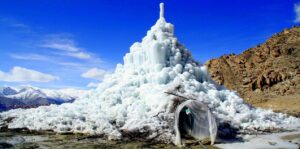
A pipe is laid from a point on the river some two kilometres upstream and sixty feet above a chosen storage site, following the riverbed underground to a depth of five feet—deep enough that the water inside does not freeze. At the storage site, the pipe turns upward and terminates in a nozzle. The water, driven by the pressure difference between its elevated source and its lower exit point, rises into the winter air and falls as a fountain. At Ladakhi winter temperatures, the water freezes on contact with the air and accumulates on the ground. Because water falling in a fountain distributes itself in a rough cone around the nozzle, the ice builds into a conical structure—naturally, without any mold or framework. Wangchuk named this structure a ‘stupa’ – an ice stupa, echoing the dome-shaped Buddhist monuments that dot the Ladakhi landscape.
A cone, as any schoolchild learns in geometry, has a lower surface-area-to-volume ratio than a flat sheet of the same mass. This means that a conical ice structure melts more slowly than the same amount of water stored as a shallow frozen pond would. The ice stupa retains its water longer into the summer, releasing it gradually as temperatures rise—precisely when the farmers downstream need it most. The physics that Wangchuk applied were not novel; the application was.
He tested the concept near his home village and it worked. In 2014, with support from Drikung Kyabgon Chetsang Rinpoche—the head of the Drukpa lineage of Tibetan Buddhism, second in authority only to the Dalai Lama—he launched a crowdfunding campaign to build a large stupa in front of the Phyang monastery. The target was a hundred and twenty thousand dollars. The structure was completed on the 5 March, 2015. A sixty-five feet tall, the highest artificial ice stupa ever built, containing fifteen million litres of stored water! Five thousand trees were planted in the meltwater zone at its base. Chetsang Rinpoche came to bless it.
The Rolex Award for Enterprise, which Wangchuk won in 2016, cited the ice stupa as an example of appropriate technology—a solution that worked with local conditions rather than imposing external systems on them. Switzerland, whose own alpine glaciers are retreating and whose ski resorts have been looking for ways to extend their seasons, invited Wangchuk to build ice stupas there as a means of creating tourist attractions and supplementing snowfall. The invitation confirmed something that Wangchuk had observed from the beginning: that the problems facing Ladakh are not unique to Ladakh. They are early-warning versions of problems that will, as climate change advances, face much of the world.
When the outside temperature is minus fifteen degrees Celsius, the interior of the SECMOL campus stays at plus fifteen—using no fossil fuels. The campus runs entirely on sunlight.
The Lake At Seventeen Thousand Feet
In 2023, the Lonak glacial lake in Sikkim, situated at seventeen thousand feet on the Tibetan border, behind a moraine dam formed by the retreating Zemu Glacier, breached its natural boundary after abnormally rapid glacial melt. The resulting flash flood killed more than forty people, destroyed roads, bridges, and the Teesta III hydroelectric dam and caused damage estimated at several billion rupees. The Lonak disaster was not a surprise to glaciologists, for glacial lake outburst floods, or GLOFs have been occurring with increasing frequency throughout the Himalayan range as temperatures rise. What was lacking was not warning but preparation.
The Sikkim government, in the aftermath, assembled a team of experts—from the state’s science and technology department, the State Disaster Management Authority, the Geological Survey of India, the Central Water Commission, the Indo-Tibetan Border Police, and the Indian Army—and invited Wangchuk to lead it. The assignment was to assess the lake’s condition and, if possible, install infrastructure to control the water level before the next catastrophic event.
The journey to Lonak took five days – one day by vehicle from Gangtok and four on foot through terrain that rises above the treeline and into permanent snow. The team carried pipes manufactured by Jain Irrigation and transported the final stages of the journey on yaks. At seventeen thousand feet, in snowfall, connecting and sealing pipes on a steep moraine slope is not a straightforward task. The work took days. Sensors were installed in the lake to monitor water levels and transmit data via satellite. A siphon system was eventually established to drain excess water from the lake in a controlled manner, reducing the pressure on the moraine dam.
Wangchuk is careful to describe this as a temporary measure rather than a solution. Controlled drainage reduces the immediate risk of a catastrophic breach; it does not address the underlying process that is causing the lake to grow. The glacier is still retreating. The meltwater is still accumulating. The technology can buy time, but the clock it is buying time against is the global one, and that clock is not under any local engineer’s control.
The Dream At The End Of The Pipe
Wangchuk’s larger ambition is, by his own admission, audacious to the point of seeming implausible. He wants to build hundreds of ice stupas across the Himalayan range—not as individual water-storage structures but as the nuclei of a new, distributed glacier. The logic is straightforward – if enough ice stupas are built close enough together, and if enough of each winter’s meltwater is recaptured and refrozen, the accumulated ice could theoretically begin to function as how a small glacier functions – persisting through the summer, accumulating mass each winter, growing over years into something substantial. He is describing the deliberate reconstruction of Himalayan glacial cover using a pipe, a nozzle, and the physics of a fountain.
Whether this is achievable at the scale that climate change demands is a question that glaciologists tend to answer carefully. The mass of ice lost from Himalayan glaciers each year is enormous; the ice stupa technology, as currently deployed, replaces a small fraction of it. Wangchuk does not dispute this.
He argues, rather, that the technology needs to scale—that the research and engineering required to scale it is precisely what his proposed Himalayan Institute of Alternatives is designed to produce.
The Institute for which he received two hundred acres of land from the Ladakh Autonomous Hill Development Council will be funded in its early stages by the Rolex prize money. It will focus on the specific problems of high-altitude life—water, energy, food, education, and the intersection of traditional Himalayan knowledge with contemporary science. Wangchuk wants it to function not as a conventional research university but as what he calls a ‘live laboratory’ – an institution where the problems are real, the solutions are tested in the field, and the students are, from the beginning, participants in both.
This is recognizably the same institution as the SECMOL campus, scaled up and given a different name. The students who could not pass their board examinations became the engineers who build ice stupas. The ice stupas become the proof of concept for glacial regeneration. The glacial regeneration research becomes the reason for the institute. The institute trains the next generation of students who, in Ladakh and across the Himalayas, will spend their careers on problems that the global scientific establishment has not yet figured out how to address.
There is something deliberate about the progression, and something that calls to mind the Gandhian model of beginning with the most local and specific problem—a child who cannot read in a language she does not speak—and following it, through patience and ingenuity, toward consequences that are genuinely global. Wangchuk did not set out to become a climate-change engineer. He set out to help Ladakhi children pass their school examinations. The path from one to the other ran through a pipe buried five feet underground in a cold desert, and through the simple observation that water under pressure, released into freezing air, rises and falls and freezes into a cone.
He did not set out to rebuild the Himalayan glaciers. He set out to help Ladakhi children pass their school examinations. The path between those two things ran through a pipe and a fountain.
What The Desert Knows
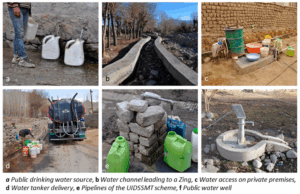
Ladakh has been managing water scarcity for a very long time. The traditional irrigation channels called ‘yura’ that carry glacial meltwater to terraced fields, the careful timing of planting to align with the melt cycle, the communal agreements that govern water distribution in villages without reliable rainfall—these represent accumulated hydrological knowledge of considerable sophistication, developed without recourse to engineering degrees or satellite sensors. Wangchuk did not invent this knowledge. What he did was recognize that it constituted knowledge in the first place, and that it could be combined with contemporary science to produce solutions that neither tradition alone could have reached.
The ice stupa is the clearest example of this combination. The idea of storing water in a frozen form, close to where it will be needed, in a shape that minimizes melting—this is an engineering refinement of something Ladakhis already understood intuitively. The pipeline that delivers the water is modern technology. The physics of the fountain are basic Newtonian mechanics. The cone is geometry. None of these elements is exotic; what Wangchuk supplied was the synthesis, and the willingness to test it.
He is not a romantic about tradition. He does not argue that Ladakh should remain isolated, or that its problems can be solved without external resources or scientific knowledge. What he argues, with some force, is that solutions imposed from outside tend to fail for the same reason that Urdu-language schoolbooks failed Ladakhi children; they are designed for a different place, by people who have not looked carefully at the place they are trying to help. The ice stupa works because it was designed by someone who grew up in Ladakh, for conditions that he had spent his life inside. The SECMOL school works because it was built by the students who live in it. The glacial regeneration project, if it works, will work because it is rooted in the specific hydrology of a specific mountain range, not in a general theory of climate intervention.
Wangchuk was called a fool, as a child, because he could not answer questions in a language he had not been taught. The word has a way of following people – it attaches to those who propose things that seem impractical, who pursue problems that established institutions have decided are intractable, who insist that the person closest to the problem usually understands it better than the person furthest away. The ice stupas stand sixty-five feet high in the Ladakhi winter. The schools are full. The lake at seventeen thousand feet is being drained through a pipe. The glacier, for now, is still retreating. But the work has started, and the people doing it were not supposed to be able to do it!








“The Ice Maker by Balasubramaniam Muthusamy is a quietly powerful narrative that captures depth through simplicity, leaving a lasting emotional impact. In a similar spirit of inspiration, Sonam Wangchuk: Innovation in the Cold Desert highlights how vision and resilience can transform harsh realities into opportunities. Together, these works reflect creativity, human endurance, and the power of thoughtful innovation. Truly engaging and meaningful reads.