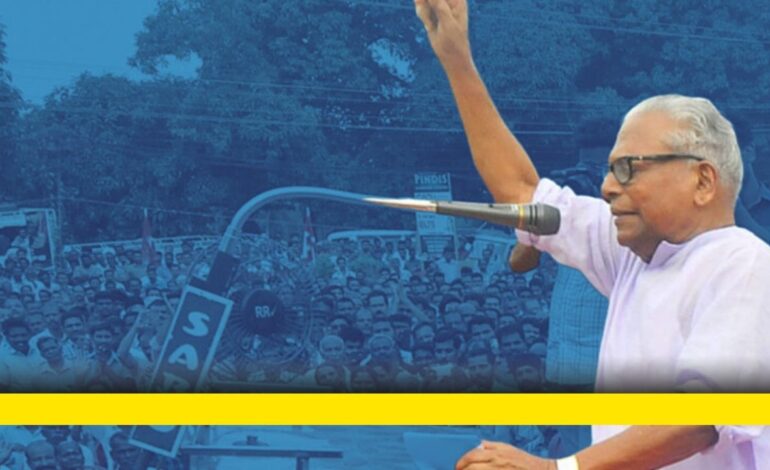



The life of V.S. Achuthanandan, the veteran leader of the Communist Party of India (Marxist) – CPIM, who passed away on July 21 at the age of 101, reads like a masterclass in human resilience – a tale that could serve as a case study in the most elite motivational courses.
It is not just the chronicle of a survivor, but of a fighter, a statesman who rose from abject poverty to become a towering figure in Indian politics—uncompromising in his values, unwavering in his pursuit of social justice.
Born into the social and economic margins of early 20th-century Kerala, he lost his mother at the age of four, and his father at eleven. Talking about those times, years later, at a private gathering with VS, a question arose: “ Why did you stop studying in the seventh grade? Answer: One had to walk three to four miles to school and back. That was tiring enough on an empty stomach. During those days, there was no point in talking about buying books and other study materials ; shouldn’t we eat something at least once in a while? “. Yes, Achuthanandan’s childhood was one of extreme poverty.

The child, who had thus plunged into the darkness of orphanhood and penury did not merely endure; he emerged from despair, shaped by a fierce inner resilience. This inner strength later transformed into a steadfast political will, making him one of the most indomitable fighters in the history of Indian, especially Kerala, politics.
Despite being consistently sidelined—his party delaying his candidature, internal factions criticising him harshly—he emerged stronger after every blow. What is more remarkable is that he contested elections even when the party was reluctant to field him. He became Chief Minister despite being branded an overly strict disciplinarian, one who is not for moden, accommodating times. Yes, there were many occasions when the party establishment stood against him.
The name “Achuthanandan” means “one who experiences unwavering joy.” Perhaps his parents could not have imagined how prophetic that name would be. For he did not just resist defeat; he seemed to thrive on it. Political observers often described him as “the leader who found strength in setbacks.

From his humble beginnings to his heroic stature, the early chapters of Achuthanandan’s life are steeped in the footprints of modesty and unwavering resolve. He held the spotlight in both the legislature and within his party: 35 years in the Legislative Assembly, 15 of which he served as Leader of the Opposition; Chief Minister from 2006 to 2011; eleven years as the State Party Secretary; convener of the Left Democratic Front (LDF); chairman of the Administrative Reforms Commission; and Chief Editor of Deshabhimani. He carried these many roles without ever slowing down.
His early struggles were immense. Yet, it was his graceful austerity and elegant simplicity that became his signature.
His oratory was studied and admired by younger generations—marked by honesty, clarity, and discipline. They were also marked by signature intonations in a unique style of Malayalam dripping of wit, satire and of course ferocious attack on political adversaries. Each sentence stemmed from moral certainty and social conscience. His words, though meticulously composed, were never dull—they had the sting of truth and the strength of justice.

Whether one admired him or disagreed with him, it was impossible to ignore his courage and principle. In an era when many leaders blurred the lines between power and compromise, VS remained a symbol of fearless defiance. Corruption, exploitation, injustice—he took them all head-on, from street protests to legislative battles.
Even as Chief Minister, he retained this stance. In 2007, during a visit to Prime Minister Manmohan Singh, he was his usual candid self—never deferential, always forthright.
Time and again, the media predicted his political end. Rumours of his decline were rampant within the CPI(M) and outside. But he faced every conspiracy and pressure—be it the ousting of M.V. Raghavan and his supporters, the controversial inclusion of IUML in the LDF, the Lavlin case, or protests against foreign loans from the IMF/ADB. He confronted them all head-on. At the Alappuzha state conference and elsewhere, he stood his ground even when it meant defying the party line. He never feared the loss of position. He never compromised.
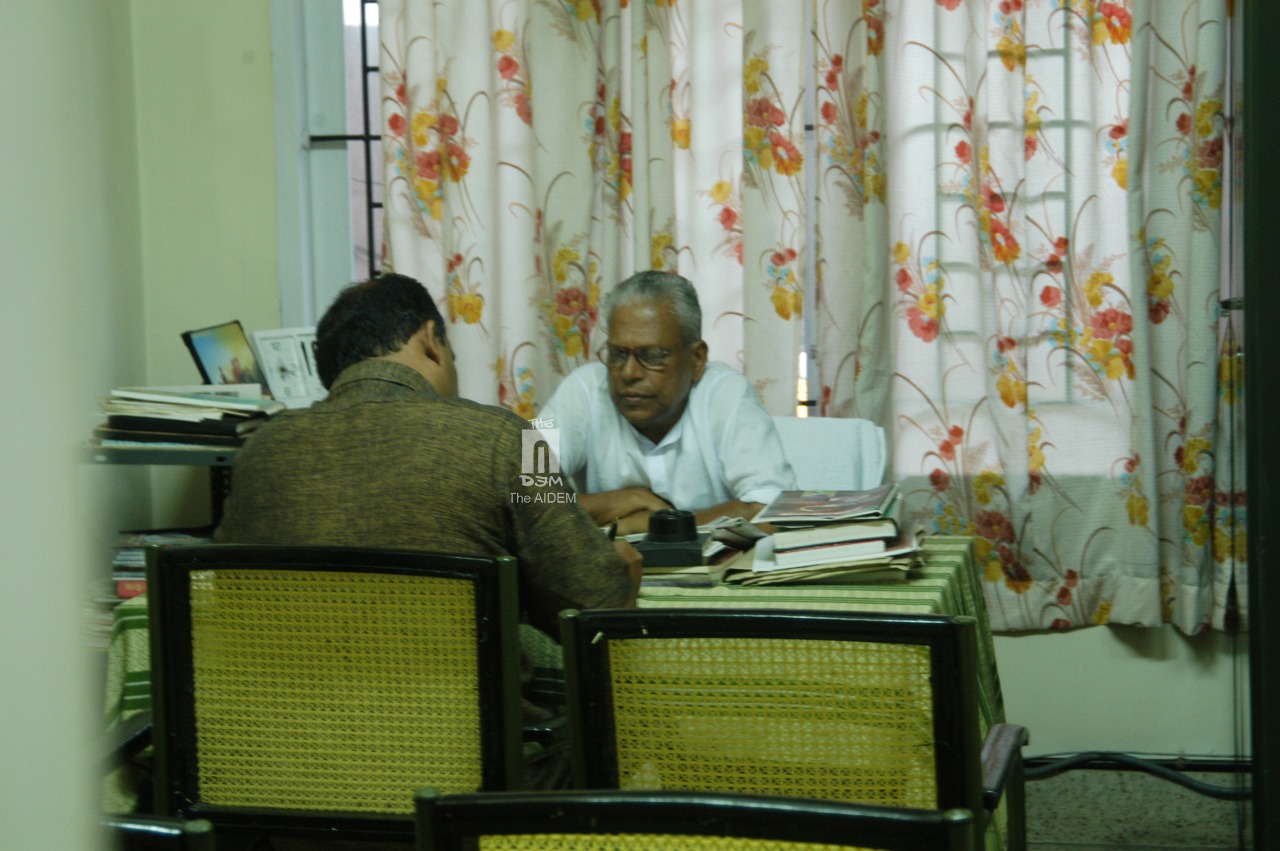
He journeyed through the most turbulent periods of modern Kerala, always at its epicenter. And yet, the party that he built, too, subjected him to reprimand—warnings, suspension, even removal from the Politburo. Among India’s political figures, few have led such a relentless and vulnerable public life.
Eventually, age and illness took their toll, and he withdrew from active politics. For four long years, the powerful voice that had once roared against injustice fell silent. Only then did people begin to realise the void it left behind—a voice of integrity, always willing to critique and correct.
VS’s tryst with politics began in the incandescent days of the freedom struggle. He worked at the Aspinwall coir factory in Alappuzha, where he joined the trade union movement. In 1939, he entered the State Congress. At 17, he joined the CPI. His political rise was steady: district secretary, member of the National Council of the undivided CPI, and, after the 1964 split, one of the founding district secretaries of the newly formed CPI(M). He later entered its Central Committee and Politburo and became one of the party’s longest-serving state secretaries (1980–1992). By the time he retired, he was one of the most senior communist leaders in India—and indeed the world.

What distinguished VS from most other politicians—in Kerala or elsewhere—was that unlike many leaders who gained popularity only after acquiring power, he was long ridiculed by the mainstream media. Yet, even after turning eighty, he remained the most beloved opposition leader. The victories of 2006 and the close contest in 2011 were clear testaments. Though power tempered his tone, it never subdued his spirit. His essence remained that of a rebel who never bowed to power or privilege.
He will be remembered not just as an able administrator, but as a people’s leader. His eviction drive in Munnar against illegal encroachments, his fierce stance against film piracy and the lottery mafia, and his determination to jail the corrupt former minister R. Balakrishna Pillai—these acts of moral bravery define his legacy.
He bore witness to and suffered through Punnapra-Vayalar, police torture, an underground life from 1948 to 1952, detention during the China War (1962–63), and imprisonment during the Emergency (1975–77). His life is a saga of relentless resistance and uncompromising principles.

A political warrior, a principled rebel, a voice of the people—V.S. Achuthanandan’s legacy will remain etched in the heart of Kerala and Indian politics for generations to come.