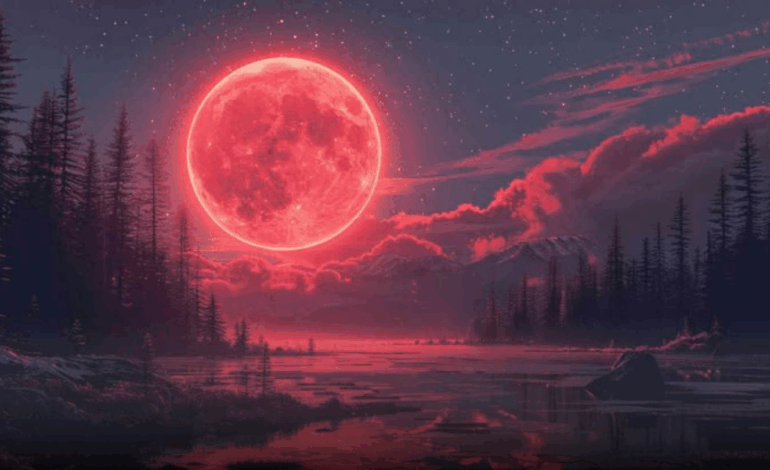
The moon has always been humanity’s silent companion. It lights the night, guides tides, and inspires poetry. But when it suddenly darkens and bleeds red, it becomes something else entirely: a riddle of the heavens.
Today, we call it a *lunar eclipse*, explained through physics. Yet for ancient civilizations, the *blood moon* was no mere shadow—it was a drama of gods, demons, and beasts. Let us journey through these myths before returning to science and faith.

Mesopotamia and Babylon: The King’s Doom
In Mesopotamia, the moon god Sin ruled the night. When the moon turned red, it meant evil spirits were attacking him. For the Babylonians, the eclipse was even more direct: it spelled doom for the king.
To protect him, they crowned a substitute king, who bore the wrath of the gods. When the shadow passed, the real king returned, and the substitute often faced death. The eclipse, to them, was the divine handwriting of fate.
Egypt: Seth Against the Moon
To the ancient Egyptians, the moon was under the guardianship of Khonsu, the god of time. But during an eclipse, they saw the hand of Seth, the god of chaos, wounding the cosmic order. The red moon was a sign that chaos was clawing at creation. Priests would recite protective hymns, burn incense, and restore balance through ritual, ensuring that Ma’at—the divine harmony—triumphed once again.
China: The Dragon’s Bite
In China, the moon’s reddening was a cosmic struggle: a dragon had caught it in its jaws. Villages erupted in noise, with drums, gongs, and firecrackers, to frighten away the beast. When the moon emerged whole again, it proved the people’s cries had power against the dragon.
India: Rahu’s Eternal Revenge
In Hindu mythology, the demon Rahu once tricked the gods and drank the nectar of immortality. Vishnu struck off his head, but Rahu lived on. Ever since, he seeks revenge—swallowing the sun or moon.
The eclipse was Rahu’s bite, staining the moon red. But because he had no body, the moon always escaped. Even today, many in India observe rituals during eclipses: fasting, avoiding food, and bathing afterward to cleanse Rahu’s shadow.

Maya: The Moon Goddess in Peril
The Maya, great astronomers of Mesoamerica, could predict eclipses with accuracy, yet feared them deeply. They believed a jaguar or serpent from the underworld attacked the moon goddess during an eclipse.
Pregnant women and rulers were thought especially vulnerable. Protective ceremonies were held, mixing astronomy with myth—showing how science and belief often coexisted.
Inca: The Jaguar’s Feast
For the Inca, the blood moon meant the moon was being devoured by a jaguar. If the jaguar succeeded, he would descend to earth to feast on humans.
To prevent disaster, the people shouted, clashed weapons, and let their dogs howl, hoping their combined noise would frighten the beast and save the world.
Norse: Wolves of Doom
In the frozen lands of the Norse, two wolves—Sköll and Hati—forever chased the sun and moon. When the moon turned red, it meant one wolf had sunk its teeth into it.
One day, they believed, the wolves would win, devouring both sun and moon. That would be the day of Ragnarök, the end of the world. Every blood moon was a warning of that final destiny.
Native Americans: The Wounded Moon
The Hupa people of California said the moon had wives and pets—mountain lions and snakes. When they attacked him, his face turned red. The Luiseño tribe believed rituals and chants could heal the moon’s wounds, restoring harmony.
Here, the blood moon was not just fear—it was compassion. Humans became caretakers of the heavens.
The Science Behind the Blood Moon
Modern astronomy explains the blood moon with clarity. A lunar eclipse happens when Earth passes directly between the sun and moon, casting its shadow on the lunar surface.
The red color comes from Earth’s atmosphere. Sunlight bends around Earth, filtering out blue light and letting red light scatter onto the moon. It is the same reason we see red sunsets.
So, the blood moon is not a god’s wound, nor a demon’s bite—it is light itself, bent by our world, painting the heavens in crimson.
The Qur’an and Islamic Understanding
Islam reframed the meaning of eclipses. The Qur’an presents the sun and moon as signs of Allah’s power, moving in perfect measure:
*“It is He who made the sun a shining light and the moon a derived light, and determined for it phases—that you may know the number of years and calculation. Allah did not create this except in truth.”* (Qur’an 10:5)
When the Prophet Muhammad ﷺ witnessed an eclipse, he rejected superstitions that tied it to births or deaths. He said:
“The sun and the moon are two signs among the signs of Allah. They do not eclipse because of the death or life of anyone. When you see them, pray and call upon Allah.” (Sahih al-Bukhari, Sahih Muslim)
Muslims were taught to perform *Salat al-Khusuf (Eclipse Prayer)*, turning the moment from fear into worship, from superstition into reflection.

From Myth to Meaning
Across the world, the blood moon was seen as beast, omen, curse, or god. Civilizations raised noise, prayers, chants, and sacrifices to make sense of the red glow.
Science reveals the eclipse as a play of light and shadow. Islam transformed it into a reminder of divine majesty. And yet, even now, when the moon turns red, people still pause, look up, and feel the ancient awe of the universe—a reminder that we are part of a story far larger than ourselves.