
Sankarshan Thakur (63); A Reporter Who Wrote With a Poet’s Pen

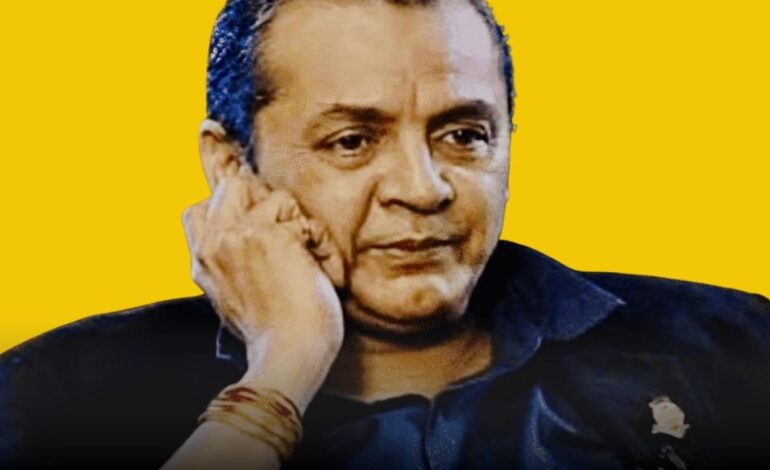
I first met Sankarshan Thakur in Patna in the mid-eighties. He was then a handsome, young and enthusiastic reporter with Sunday, a magazine sold for just one rupee a copy. Though it was cheap in price, I rated the weekly high. I admired its editor M.J. Akbar’s flair for reporting—his piece on the funeral of Lok Nayak Jayaprakash Narayan was one I must have read several times.
Akbar had an eye for spotting talent and nurturing it. He made many outstanding reporters and editors. One of them was undoubtedly Sankarshan Thakur. Journalism, after all, was in his blood like the red corpuscle. His father, Janardan Thakur, was a formidable figure in the profession. Sankarshan inherited not just the instincts but also the literary verve of his father.

What drew me most to Sankarshan was his flair for writing. He was not the conventional reporter who filled his copy with dull phrases like “he said, he observed, he concluded.” He wrote instead with the heart of a storyteller and the brush of a painter. He could set a scene with the detail of a novelist: “As the sun set in the west and as the fisherman rowed his boat laden with only his net and no fish, Ramesh…”—that is the kind of opening line one might see in his reports.
He never disappointed me as a reader. His journalism had rhythm, cadence, colour. He made politics and conflict human, and human beings political, weaving narratives that were both sharp and lyrical.
Of course, I once locked horns with him. When his maiden book, The Making of Laloo and the Unmaking of Bihar, appeared, I picked up an early copy and wrote a review article. I praised the book but pointed out what I considered a lapse of taste. He had mentioned that Lalu Prasad Yadav scratched his groins. I asked, in my review, if a man felt like itching, what else could he do? To me it was unbecoming of a journalist to mock a leader’s mannerisms and pronunciation. He had every right to criticise policies, corruption, and governance, but not physical habits.
A few months later, I met Lalu Yadav in the company of my former colleague Nalin Verma. Lalu took me to a room in his wife and Chief Minister Rabri Devi’s official residence, stacked with books. “Don’t think I read any of them,” he said candidly. “These are books I receive. You can take any or all of them home.” Among them I noticed Thakur’s book. Lalu made some remarks about the author which are better kept in memory.

For years, I remained a regular reader of The Telegraph, where Sankarshan’s long features and dispatches stood out for their richness. One thing I noticed about him was his willingness—almost an impatience—to report from the scene of activity. As one of his editors remarked, “Within two hours, he would board a car or train or plane to reach the spot.”
He was holidaying in Goa when he heard about the “war” in Kargil. Without hesitation, he rushed there. His reports from the conflict zone were nuanced and riveting. Television reporters like Barkha Dutt became household names with their ground-zero coverage, but Sankarshan’s words captured the complexity of the war with a depth that only print could provide.
It was during the Kargil war that tragedy struck him personally. His father passed away while he was at the front. Twenty years later, he remembered the moment in a tweet that revealed the tenderness beneath his journalistic toughness:
“It has been 20 years, and we lost him while I was reporting the war over Kargil. Nothing fades, or it fades and colours up again and again, like shades on olden photographs. A tribute to the man who made me. He was also my father.”
Only a son with the soul of a writer could have composed such a tribute.
Providence made us colleagues when he joined the Indian Express as Associate Editor. On a few occasions, I requested him to write editorials, but he showed little interest. Perhaps because editorials carried no byline, and Sankarshan was a man who valued his signature on his work.

Yet he was generous in another way. He often wrote to the editor asking him to convey thanks to the sub-editors who improved his copy with subtle but effective editing. It was a rare acknowledgment in a profession where reporters often bristle at editorial changes.
Our relationship may have remained cool, but Sankarshan was known to be warm to his friends. He loved to host them with good food and conversation. Like some of my Maithil Brahmin friends, he was fond of cooking—especially mutton slow-cooked and served with litti, the baked wheat ball stuffed with roasted gram flour and dripping with ghee. His table, like his prose, had flavour and richness.
Journalism—and nothing but journalism—was his passion. He began humbly as a trainee at the Free Press Journal. From there, through Sunday, The Telegraph, and Indian Express, he rose steadily to the very top. He eventually became Editor of The Telegraph, a position that marked the zenith of a career built on curiosity, integrity, and craft.

But the summit was shadowed by illness. Cancer—described by author Siddhartha Mukherjee as “The Emperor of All Maladies”—crept into his life. Diagnosed with lung cancer, he was admitted to a prominent hospital in Gurugram. For a time, he responded well to treatment. Family and friends began to believe he might rally. But the disease was relentless. His health deteriorated, and he was finally put on a ventilator. It could not save him.
Sankarshan Thakur died this morning, leaving behind his wife, a daughter who is a conservationist with INTACH, and a son who graduated in law from Jindal University, besides a large circle of relatives, friends, colleagues, and admirers.
In his death, Indian journalism has lost one of its great practitioners. Sankarshan was not merely a reporter but a writer who turned reportage into literature. He humanised Bihar politics for a national audience, gave texture to war reporting, and kept alive the belief that journalism could be at once factual and lyrical.
For those of us who knew him in person or through his prose, his passing is an irreplaceable loss. Journalism in India has grown noisier, shallower and more transient. Sankarshan Thakur reminded us, by his example, that words can still be precise, humane, and enduring. I join his family, friends, and countless readers in mourning his death and celebrating his life.