

The Prisoner No One Came For: Administrative Silence, Systemic Failure, and the Duty of the Legal Fraternity

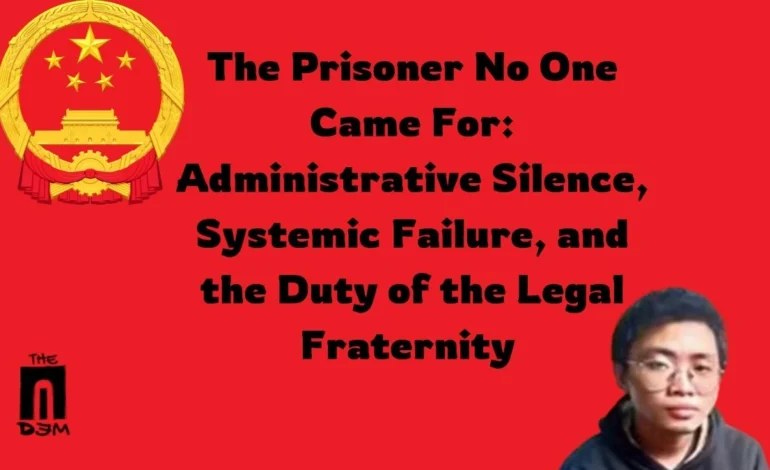
The case of Wang Gou Jun, a Chinese national held in a Uttar Pradesh jail for over two months after his sentence expired, is not an anomaly. It reflects deep systemic failures within the administrative machinery and raises larger questions about the functioning of institutions tasked with protecting personal liberty and ensuring due process.
On 7 May 2026, Wang Gou Jun, a Chinese national detained in District Jail, Lakhimpur Kheri, was finally released nearly two months after the expiry of his sentence. He was subsequently taken to Delhi under police and Intelligence Unit escort for repatriation to China.
On the morning of 17 February 2026, Wang Gou Jun had completed every day of his court-ordered sentence in District Jail, Lakhimpur Kheri. The sentence stood fully served. Yet he remained behind bars for more than two additional months — not because any court had authorised continued detention, nor because any fresh legal process required it, but because the administrative procedures necessary for his release and deportation were not completed. There was no FRRO coordination, no Emergency Travel Certificate, and no deportation order. The result was prolonged detention without judicial sanction.
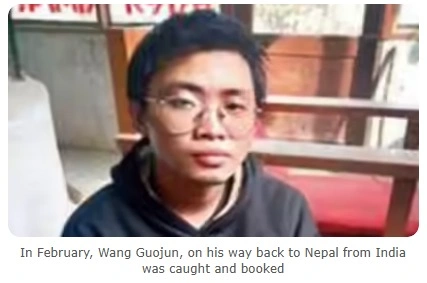
The matter first came to public attention through a report published in Dainik Jagran on 9 April 2026 under the headline, “Chinese Citizen’s Sentence Complete, Now to Return to His Homeland.” The report quoted Jail Superintendent P.D. Salonia as stating that Wang Gou Jun had completed his sentence and was awaiting release arrangements. Subsequent examination of court records and administrative actions raised serious concerns about the legality of his continued confinement.
The Facts of the Case
Wang Gou Jun, son of Wang Dong Xio, is a resident of District Maoming, Guangdong Province, People’s Republic of China. On 17 February 2023, he was apprehended at the Gaurifanta Checkpost on the India-Nepal border in District Lakhimpur Kheri by personnel of the Sashastra Seema Bal (SSB) while allegedly attempting to cross into Nepal without valid travel documents. An FIR bearing Crime No. 04/2023 was registered under Sections 3 and 12 of the Passport (Entry into India) Act, 1920, and Section 14 of the Foreigners Act, 1946. Sections 121 and 121A of the Indian Penal Code were later added during investigation.

On 20 March 2025, the Chief Judicial Magistrate, Lakhimpur Kheri, convicted Wang Gou Jun under Section 14 of the Foreigners Act, 1946, sentencing him to five years’ rigorous imprisonment along with a fine of Rs. 10,000 and a default sentence of three months’ imprisonment. Criminal Appeal No. 19/2025 was subsequently filed before the Additional District and Sessions Judge/Fast Track Court (New), Lakhimpur Kheri. By judgment dated 17 January 2026, the appellate court partly allowed the appeal and reduced the sentence from five years’ rigorous imprisonment to three years’ simple imprisonment, while directing that the period already undergone in custody be set off against the sentence.
Since Wang Gou Jun had remained in continuous custody from 17 February 2023, his lawful period of incarceration ended on or before 17 February 2026. Despite this, he continued to remain inside District Jail, Lakhimpur Kheri, without any fresh judicial order authorising his detention.
The Jail Superintendent later informed The Hindu that Wang Gou Jun had been housed in a temporary detention centre established inside the district jail with the permission of the District Magistrate. However, the existence of such a detention centre did not itself provide judicial authority for continued confinement after completion of sentence.
Administrative and Legal Interventions
Following public reports regarding the case, on 9 April 2026 I moved representations to the Chief Secretary, Uttar Pradesh; the Additional Chief Secretary (Home); the Director General of Police, Uttar Pradesh; the District Magistrate, Lakhimpur Kheri; and the Superintendent of Police, Lakhimpur Kheri.
The representations highlighted the absence of coordination between prison authorities, the Foreigners Regional Registration Office (FRRO), and diplomatic authorities despite the expiry of the prisoner’s sentence. They called for immediate intervention to secure an Emergency Travel Certificate and complete deportation formalities. Assistance for funding repatriation expenses was also reportedly offered if financial considerations were delaying the process.
Subsequently, on 23 April 2026, a further representation was addressed to the Minister of External Affairs, with copies marked to the Chinese Ambassador and other concerned authorities.
On 25 April 2026, an application under Section 7(1) of the Right to Information Act, 2005, was filed before the Public Information Officer and Superintendent, District Jail, Lakhimpur Kheri, invoking the 48-hour proviso applicable to matters concerning life and liberty. The application was registered as DRJAR/R/2026/60118 through the Uttar Pradesh RTI Online Portal.
The requested information was not provided within the statutory period. Authorities later denied disclosure citing “national security,” without detailing how a prisoner who had already completed his sentence could pose such a threat. A complaint was subsequently filed before the Uttar Pradesh State Information Commission under Section 18 read with Section 15(4) of the RTI Act, seeking action against the Public Information Officer under Section 20(1).
The matter also received media attention in Dainik Jagran and The Hindu on 24 April 2026, increasing public scrutiny of the case.
Constitutional and Statutory Questions
At the centre of the case lies Article 21 of the Constitution, which guarantees the right to life and personal liberty. The Supreme Court has repeatedly held that these protections extend to non-citizens as well. In Louis De Raedt v. Union of India (1991) 3 SCC 554, the Court affirmed that foreigners are entitled to Article 21 protections. In Maneka Gandhi v. Union of India (AIR 1978 SC 597), it held that any procedure curtailing liberty must be just, fair, and reasonable.
The case also raises questions regarding compliance with Paragraph 14 of the Foreigners Order, 1948, which requires authorities to take necessary steps for deportation upon completion of a foreign national’s sentence, in coordination with the Foreigners Registration Officer and relevant agencies.
Similarly, Section 7(1) of the RTI Act mandates disclosure within 48 hours where life or liberty is involved. The denial of information despite invocation of this provision raises additional concerns regarding transparency and accountability.
India’s obligations under the Vienna Convention on Consular Relations, 1963, are also relevant. Article 36 requires authorities to inform detained foreign nationals of their right to consular access and notify the appropriate consular authorities where requested.
A Wider Structural Problem
The circumstances surrounding Wang Gou Jun’s detention are not isolated. NCRB data indicate that several thousand foreign nationals remain lodged in Indian prisons at any given time. In many cases, prisoners continue to remain confined after completion of sentence because deportation proceedings are delayed, legal aid is unavailable, bail conditions remain technically unresolved, or administrative agencies fail to coordinate.
The issue extends beyond foreign nationals. Indian prisoners also frequently remain incarcerated beyond lawful periods due to procedural delays, sentence miscalculations, or failures in communication between courts, prisons, and district administrations.
The case highlights the layered nature of institutional omissions. The District Administration, prison authorities, legal services institutions, the FRRO, and diplomatic agencies all carried distinct responsibilities. Questions arise regarding whether these obligations were discharged in a timely and lawful manner.
The District Legal Services Authority, under the Legal Services Authorities Act, 1987, has a statutory duty to identify and assist persons entitled to release. Cases of prolonged post-sentence detention raise important concerns regarding the effectiveness of these mechanisms.
The Responsibility of the Legal Profession
The case also underscores the wider public role of the legal profession. Lawyers, legal aid institutions, and law students remain critical to identifying unlawful detention, monitoring prison conditions, and ensuring access to constitutional remedies.
Several practical interventions remain available within the existing legal framework:
- Conduct district-level jail audits to identify prisoners detained beyond completion of sentence or bail entitlement.
- Engage proactively with District Legal Services Authorities in cases involving indigent prisoners or foreign nationals lacking legal representation.
- Monitor compliance with consular notification requirements under the Vienna Convention.
- Use the RTI Act, particularly the life and liberty proviso under Section 7(1), to obtain urgent information in detention-related matters.
- Encourage public discussion and media scrutiny of unlawful detention and procedural failures within the criminal justice system.
The Outcome and Its Implications
On 7 May 2026, Wang Gou Jun was released from District Jail, Lakhimpur Kheri, and arrangements were initiated for his return to Guangdong Province, China.
The release brought an end to a period of detention that extended significantly beyond the expiry of the sentence imposed by the court. However, the broader concerns raised by the case remain unresolved.
For every detention that attracts media attention, there are likely many others that remain undocumented. Prisoners who have completed their sentences can continue to remain confined because of bureaucratic delay, lack of legal assistance, or administrative inaction. Such situations raise fundamental constitutional questions about liberty, due process, and the accountability of institutions entrusted with the administration of justice.
A sentence fully served should ordinarily mark the end of custody. Any continued detention without clear legal authority risks undermining the constitutional guarantees that form the foundation of the legal system.










A chilling reminder of how silence within institutions can become a form of injustice itself. This piece raises urgent questions about accountability, legal ethics, and the human cost of abandonment inside the system. Powerful and deeply necessary reading.
Absolutely well stated – Rizvi saab and Rag Veer