
The Uncanny Mirror: Fahmida Riaz and the Poetry of Shared Regression


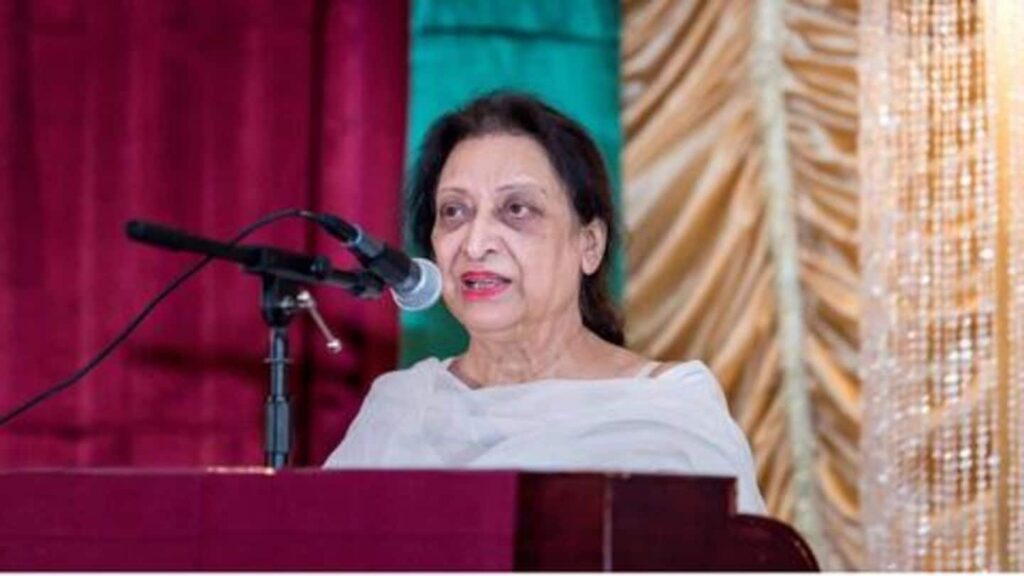
November 21 marks the seventh death anniversary of Fahmida Riaz, a titan of Urdu literature and an uncompromising voice of resistance.
Born in 1946, her life bridged the turbulent histories of a subcontinent grappling with the ghosts of Partition and the rise of fundamentalisms. A towering Progressive writer, Riaz’s fierce independence—especially her refusal to shy away from themes of female desire and political dissent—made her a perennial target of orthodox establishments. She famously declared that “one should be totally sincere in one’s art, and uncompromising. There is something sacred about art that cannot take violation.”
This sacred sincerity is perhaps best crystallised in her magnum opus, a searing indictment and lament titled “Tum Bilkul Hum Jaise Nikle.” Written during her exile in India, the poem is not a simple comparison of two countries; it is a profound philosophical statement on the futility of national divisions when societies collectively surrender to ignorance and prejudice. Facing the suffocating grip of General Zia-ul-Haq’s military regime and its forced Islamisation, Riaz found refuge in the very land from which her country had been carved. And yet, amid the rising tide of religious majoritarianism in India, she heard a terrifying echo of the pathology she had escaped. Her poem became a kind of sonic conjuration—a mirror held up to both nations.
The Stupidity Has Finally Arrived
The poem opens with a shock of recognition—delivered with mordant wit, sharpened irony, and painful familiarity:
Tum bilkul hum jaise nikle
Ab tak kahaan chhupe the bhai
Woh murakhata, woh ghaamarpan
Jisme hum sade gaye
Aakhir pahunchi dwaar tumhaare
Bade badhai, badi badhai
It is the sound of an artist tearing down a politically-carefully curated veneer that hides a society’s own rot. Riaz dismisses decades of rhetoric about distinct destinies and separate civilizational paths, exposing instead their shared vulnerability to ideological capture. The “murakhata” and “ghaamarpan” that consumed one nation are charting the steps of the other. Her fear is clear: they suggest where the historical cycles of unaccountability welcome India to a club no society should aspire to join.
The Tyranny of the Theological State
Having lived under the shadow of state-sanctioned religious extremism, Riaz possessed an uncanny foresight about the future of any society that embraces fundamentalism. It distorts public life, invites early rumblings of politicised Hindutva, she recognises from lived experience. Zia’s Pakistan: the creation of a theological state, the muddled policymaking, the devastation of intellectual landscapes, and the policing of identity.
Her verses map this descent with chilling prophetic precision:
Phir dharam hai raah rokey khara
Qayam Hindu ki jagah jogi
Saare uljhe kujor ghere
Aayee phir se wohi ghadi
Kaun hai tum, kaun nahin hai
Hum bhi karoge farq jaroor
Her metaphor for art is stripped of its religious specificity. It becomes an uncomfortable prophecy for any society whose power or one group over another is built on the foundation of expanding Islamic fundamentalism. The mechanism of the rise of Hindu majoritarianism, Riaz suggests, intensifies in warning the terrors of oppression invoked through the regulated policing of the inner world.
Gasping for Air in a Shared Abyss
The descent into dogma does not remain confined to politics; it suffocates daily life. Having tasted the airlessness of a moral police state, Riaz predicted the shared misery awaiting any society that trades liberty for orthodoxy. Her words capture the intimate, personal difficulty of surviving authoritarianism:
Hogā kahti yāhān bhi jeenā
Rātom jagenā pareshāni
Jaisi lāgti saīe karī
Jāhir labh sikhā sang ghuṭegi
This is populism embalmed within religious dogma—a descent from the frontlines of tyranny. Riaz reminds us that suffocation often feels identical, whether the state is draped in green or saffron.
The Path of Backward Walking
Riaz’s most scathing critique targets the wilful abandonment of rationality: civilizations in retreat, a “mutual” filialism of fundamentalism everywhere—where the future is traded for the comfort of nostalgia and the false promises of a Golden Age and the active rejection of education and modernity:
Bhāī meñ jāye shikshā-vikshā
Ab jhālhan ke gun gānā
Āge gaḍḍhā, yeh mat dekho
Vapas līo gayā zamānā
…
Dhyān na mann meñ doojā āye
Bas peecheñ nazar jamānā
Utte pāon hi chalte jānā
The poet sees this regression not as accident, but as design. Once lost in the jape of “kitnā veer mahan tha Bharat, kaisā ālīshān tha Bharat”, society marches steadily toward “parlok,” a chilling metaphor for breakdown and ruin.
Unity in Tragedy
The poem’s conclusion is devastating in its simplicity. Partition, the blood-soaked creation of two new nations, was justified with claims of irreconcilable difference. Riaz’s final verdict dismantles this narrative:
Kal dukh se sohā kartī thi
Sach ko behosh kartī thi Ajī
Tum bilkul hum jaise nikle
Hum do quām nahīñ the bhai!
Seven years after her passing, “Tum Bilkul Hum Jaise Nikle” stands as a masterpiece of political and literary foresight a cry not for political unity, but against moral homogeneity and shared regression. Her warning is to confront ourselves in the mirror she held up. Riaz delivered the verdict that grows more urgent by the day: the greatest walls were not erected between nations, but those built within minds. And yet the greatest tragedy is not division, but the shared, voluntary surrender to the stupidity of dogma.
Her uncanny mirror still reflects us wherever we live, however we name the Other.