


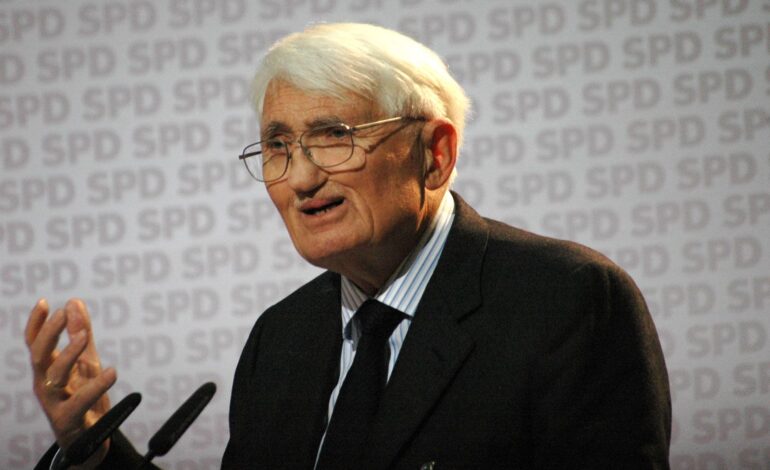
As one of the most influential philosophers of the twentieth and early twenty-first centuries, Jürgen Habermas occupies a singular place in the history of modern social and political thought. A leading figure of the second generation of the Frankfurt School, Habermas extended the project of critical theory beyond the pessimism of its earlier phase and offered one of the most ambitious attempts to rethink democracy, rationality, and emancipation in late modern societies. I have been engaging with the work of Jürgen Habermas for more than two decades now. Since around the year 2000, hardly a semester has passed in which his ideas have not entered my lectures, classroom discussions, or writings in one form or another. His work has served as a steady intellectual reference point, shaping both my academic research and my more popular essays. Indeed, after Karl Marx, Habermas is perhaps the thinker I have quoted with the greatest confidence and with a deep sense of political identification. He offered a vocabulary through which one could think about democratic life, public reason, and social critique in ways that were at once philosophically rigorous and politically grounded. Habermas was therefore not merely a philosopher of public life whom one studied from a distance; he became a constant interlocutor in my own efforts to reflect on democracy, modernity, and the continuing possibilities of critical theory. In this sense, his work has remained a continuous presence in my academic and political reflections for several decades, beginning from my Master’s years and continuing through my teaching and writing ever since.
Legacy and Controversy: Habermas in the Shadow of Gaza
Yet as Habermas passes away, recent controversies surrounding his public statements on the Jewish question and the war in Gaza inevitably loom large in public discussions of his legacy. In 2023, Habermas, together with scholars such as Rainer Forst, Klaus Günther and Nicole Deitelhoff, issued a statement affirming Germany’s historical responsibility toward Israel while condemning antisemitism and the Hamas attacks, even while acknowledging that the principles of proportionality and the protection of civilian life must guide Israel’s military response. The tone and emphasis of this intervention appeared morally ambivalent in the face of the humanitarian catastrophe unfolding in Gaza and provoked sharp criticism from several prominent intellectuals (“A Response to ‘Principles of Solidarity. A Statement’: Human Dignity for All.” Public Seminar, 22 November 2023. Signed by 109 scholars and activists). To me, the statement signed by Habermas appeared apologetic toward Israel’s military campaign and insufficiently attentive to the scale of Palestinian civilian suffering. My concern is not merely political but also philosophical. It seems to reveal a tension between Habermas’s own universalist commitments particularly his theory of communicative reason, moral reciprocity, and the normative equality of participants in public discourse, and the cautious framing of his intervention on Gaza. If the ethical foundations of communicative rationality require that all affected voices be treated as morally equal within the space of public reasoning, then any political position that appears to dilute that symmetry inevitably raises difficult questions about the consistency between theory and political judgement.
However, I also believe that although Habermas’s later political interventions inevitably form part of any assessment of his legacy, they should not overshadow the enduring philosophical significance of his work. Over several decades, Habermas developed a body of thought that sought to reconstruct the emancipatory possibilities of modernity, drawing upon the legacy of Karl Marx while reinterpreting socialism through the lenses of communicative rationality, democratic deliberation, and the public sphere. At a time when socialist practice across different parts of the world, from the trajectories of communist movements in China, Vietnam and Cuba, to the evolving fortunes of the Left in countries such as South Africa and India, including regions like Kerala, appears to be grappling with new contradictions and uncertainties, Habermas’s theoretical reflections continue to offer a rich conceptual resource for rethinking the ethical and institutional foundations of democratic socialism.
Socialism After 1989: Habermas and the Crisis of State Socialism
Jürgen Habermas remains one of the most important twentieth-century thinkers who critically reinterpreted the legacy of Karl Marx. Emerging from the intellectual tradition of the Frankfurt School, Habermas sought neither to abandon Marxism nor to defend it in its orthodox form. Instead, his project was to reconstruct its emancipatory aspirations within the conditions of modern democratic societies. Habermas accepted Marx’s central insight that capitalism generates systemic domination and social crises through the commodification of labour and the concentration of economic power. However, he argued that Marx’s theory gave excessive priority to labour and production as the fundamental categories of social analysis. For Habermas, modern societies cannot be understood solely through the dynamics of production; they must also be analysed through the sphere of communication, where social actors negotiate meanings, norms, and collective identities.

This argument was developed most systematically in Habermas’s The Theory of Communicative Action (1981), where he introduced the influential distinction between system and lifeworld. The system refers to the economic and administrative mechanisms of modern societies governed by money and power, while the lifeworld consists of the communicative sphere in which culture, solidarity, and social norms are reproduced. Habermas argued that the crises of late capitalism arise when the system expands and begins to colonise the lifeworld, subordinating communicative relations to market and bureaucratic imperatives. Habermas’s reflections on socialism were shaped by this broader theory of communication and democracy. Observing the historical failures of Soviet-style regimes, he argued that socialism cannot be realised through authoritarian planning or the suppression of civil society. Instead, any emancipatory project must strengthen democratic institutions, public debate, and citizen participation. In this sense, Habermas reinterpreted socialism as a normative project of radical democracy, grounded in free and inclusive public deliberation. Through this reconstruction, Habermas attempted to preserve the critical force of Marxism while freeing it from economic determinism and revolutionary orthodoxy. His work thus represents one of the most influential efforts to rethink socialism in terms of communicative rationality, democratic legitimacy, and the expansion of the public sphere.
In his essay “What Does Socialism Mean Today? The Rectifying Revolution and the Need for New Thinking on the Left” published in New Left Review (1990), Jürgen Habermas reflects on the historical meaning of the revolutionary transformations in Eastern and Central Europe following the collapse of Soviet-style regimes. Habermas argues that these events should not be interpreted as a definitive rejection of socialism itself but rather as “rectifying revolutions” aimed at correcting the authoritarian distortions of state socialism. The uprisings in countries such as Poland, Hungary, and East Germany were directed primarily against bureaucratic domination and the suppression of civil society by party-states that had monopolised political power in the name of socialism. Habermas also criticises the widespread description of the Soviet and East European systems as “actually existing socialism,” calling the phrase a “coyly pleonastic” formulation that attempted to naturalise a historically contingent political arrangement as if it were the necessary embodiment of socialism (Habermas 1990, p. 10). For him, the collapse of these regimes therefore represents the bankruptcy of a specific institutional model, centralised state socialism, rather than the failure of the normative ideals of socialism. At the same time, he cautions against the triumphalist claim that these events mark the final victory of capitalism. Capitalist societies, he notes, continue to generate structural inequalities, social exclusion, and crises of democratic legitimacy, which means that the critical concerns that animated the socialist movements of the nineteenth century, beginning with thinkers such as Karl Marx, remain relevant. The lesson of 1989, Habermas concludes, is that social emancipation cannot be realised through authoritarian party rule or centralised economic planning but must instead be pursued through constitutional democracy, an active public sphere, and participatory forms of collective decision-making.
Habermas and the Ethical Limits of the Posthuman
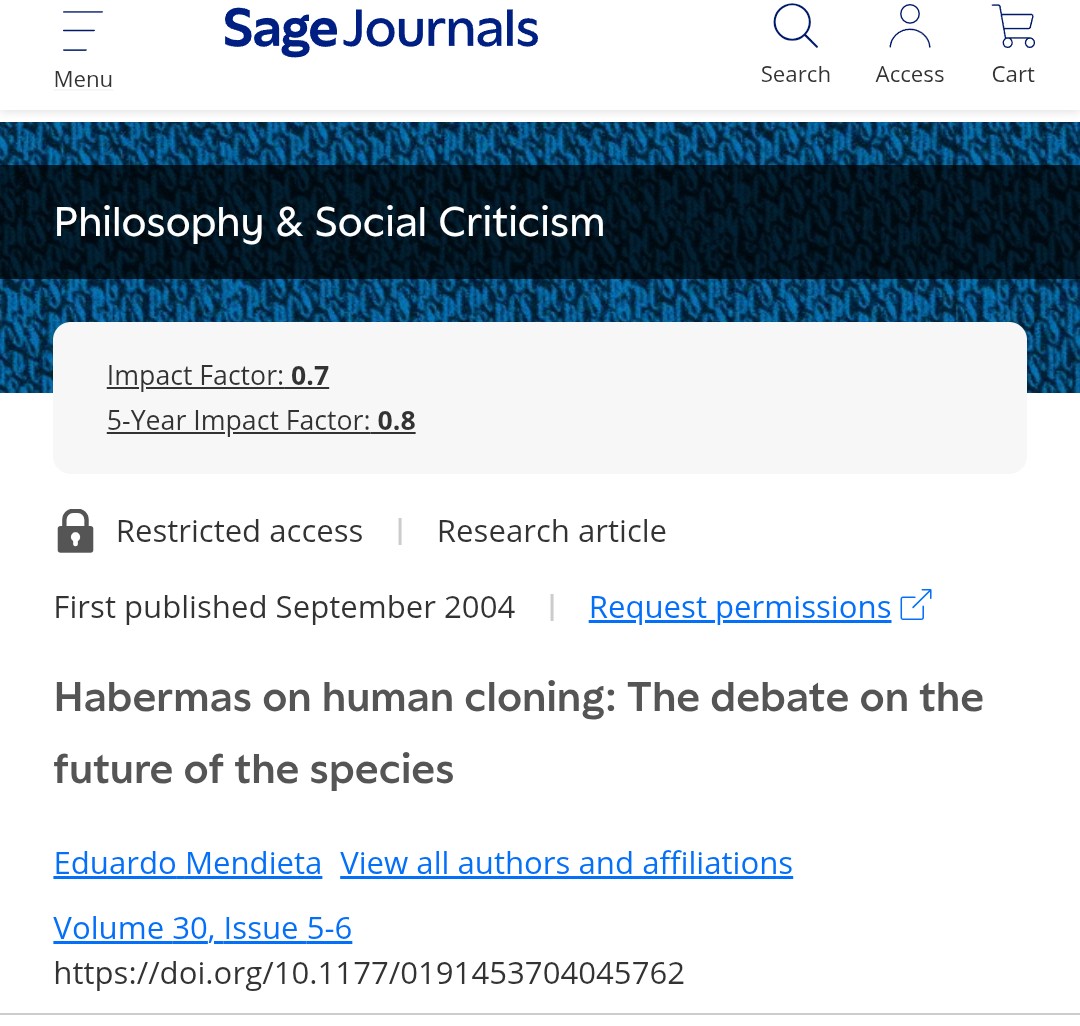
Most recently, debates within radical theory have also turned toward the implications of biotechnology and cybernetic transformation for emancipatory politics. The concept of the cyborg and the broader technological imagination surrounding human enhancement have been recognised as posing new challenges to traditional political frameworks. This shift raises important questions about whether technological transcendence is replacing collective political projects. Within science and technology studies as well, the political implications of technoscientific innovation have been widely debated. It is in this context that Jürgen Habermas’s reflections in The Future of Human Nature (2003; originally 2001 in German) acquire renewed significance. Habermas approaches genetic engineering not primarily as a technical question but as a problem concerning the moral self-understanding of the human species. As Eduardo Mendieta observes in his discussion of Habermas’s work, the issue is not merely whether genetic interventions such as stem-cell research or pre-implantation genetic diagnosis (PGD) are scientifically feasible, but how such interventions may affect the ethical and political foundations of modernity—especially the conditions under which individuals can understand themselves as autonomous moral agents (Mendieta, Eduardo. “Habermas on Human Cloning: The Debate on the Future of the Species.” Philosophy & Social Criticism, vol. 30, nos. 5–6, 2004, pp. 721–743). If human genetic traits become objects of deliberate design and optimisation, Habermas warns, the symmetrical relations that underpin moral responsibility and democratic equality could be subtly transformed.
These concerns resonate strongly with debates about the posthuman condition. Habermas’s argument reminds us that technological transformations of the human body are not ethically neutral; they raise profound questions about autonomy, responsibility, and the normative foundations of political community. In this sense, his reflections on genetic engineering become crucial for understanding the ethical dilemmas of the posthuman age. Indeed, this has also been a concern that has informed my own writings on posthumanism, where the question of how technological transformations reshape our understanding of human agency and collective emancipation remains central.
The Ambiguous Universality of the Public Sphere
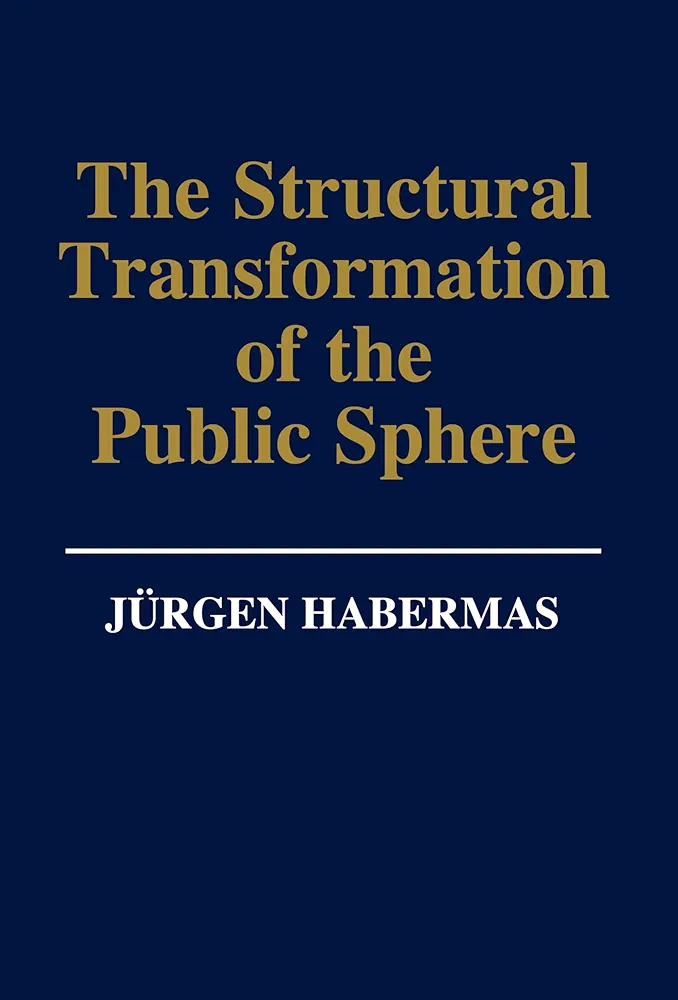
A discussion of ‘The Structural Transformation of the Public Sphere,’ by Jürgen Habermas must begin by recognising the distinctive methodological character of the concept of the public sphere that the book introduces. Habermas does not treat the public sphere simply as a normative philosophical ideal or as a purely sociological category. Rather, he presents it as a historically emergent structural formation that arose under specific conditions in early modern Europe. In Habermas’s account, the bourgeois public sphere developed in the eighteenth century through institutions such as coffee houses, salons, learned societies, and print culture, where private individuals assembled to debate matters of common concern. This sphere was neither part of the state nor merely an extension of private life; it functioned as an intermediary space in which public opinion could be formed and directed toward the authority of the state.
Habermas’s argument, however, is not limited to the rise of this sphere. The central theme of the book is its structural transformation: the gradual erosion of the critical and deliberative character of the bourgeois public sphere with the rise of mass democracy, commercialised media, and organised interest politics in the twentieth century. What had once been a relatively autonomous domain of rational-critical debate became increasingly mediated by publicity, advertising, and the strategic management of opinion. Thus the public sphere, for Habermas, is not a timeless institution but a historically contingent configuration that emerges, develops, and eventually disperses under changing social conditions.
Yet the conceptual status of the public sphere in Habermas’s analysis retains a certain ambiguity. The bourgeois public sphere he describes is drawn largely from the historical experience of Western Europe—particularly England, France, and Germany—during a specific period of capitalist modernity. In this respect, Habermas’s procedure resembles the methodological move made by Karl Marx when he treated nineteenth-century England as the “ideal average” of the capitalist system. Habermas’s account similarly relies on a historical case that functions simultaneously as an empirical description and as a quasi-theoretical model. The public sphere thus appears in the book both as a historical category rooted in a particular social formation and as an analytical category that can be extended to interpret modern democratic communication. This dual status has generated enduring debates. If the bourgeois public sphere was a historically specific phenomenon tied to the cultural and institutional structures of European bourgeois society, then the universalisation of the concept becomes theoretically problematic. The risk lies in treating a historically bounded form of political communication as if it were a transhistorical norm applicable across different societies and media environments.
For this reason, a degree of caution is necessary when invoking the concept of the public sphere in contemporary contexts, particularly in discussions of digital or cyber public spheres. While online communication undoubtedly creates new spaces of interaction and deliberation, it does not necessarily reproduce the institutional conditions that made the bourgeois public sphere possible—such as relatively autonomous print culture, shared norms of rational debate, and the structural separation between state and society that Habermas analysed. The extension of the concept to digital environments therefore requires careful qualification, lest the historically grounded category that Habermas developed be transformed into a loose metaphor for any form of public communication. In this sense, The Structural Transformation of the Public Sphere remains both an indispensable theoretical framework and a historically situated analysis whose conceptual reach must be applied with analytical restraint.
A major line of critique directed at Jürgen Habermas’s concept of the public sphere, first elaborated in The Structural Transformation of the Public Sphere, emerged from feminist, cultural, and post-colonial scholarship beginning in the late 1980s. Among the most influential interventions is that of Nancy Fraser, whose essay “Rethinking the Public Sphere” (1990) questioned the historical and normative assumptions embedded in Habermas’s model of the bourgeois public sphere. Fraser argues that the eighteenth-century public sphere that Habermas describes as a domain of rational-critical debate among private individuals was in fact socially exclusive, structured by class, gender, and racial hierarchies. Women, workers, and other marginalised groups were largely excluded from the institutional spaces—coffee houses, salons, and print networks—through which bourgeois public discourse was organised. As a result, Fraser contends that Habermas’s model risks presenting an idealised image of inclusivity that did not exist in practice.
To address this limitation, Fraser proposes the concept of “subaltern counterpublics,” referring to alternative discursive arenas created by marginalised groups in order to formulate oppositional interpretations of their identities and interests. Rather than assuming a single unified public sphere, she argues that modern societies are characterised by multiple, competing publics, each shaped by different social positions and political struggles. Similar criticisms were developed by scholars who argued that Habermas’s bourgeois public sphere ignored the existence of a proletarian public sphere rooted in working-class experience, as well as by feminist theorists who emphasised the exclusion of women from bourgeois political culture. These critiques raise an important question: to what extent does Habermas’s concept function as a historical reconstruction rather than a universal model of democratic communication? In many respects, the criticisms are well founded. Habermas’s account is explicitly based on a particular European historical experience, primarily that of England, France, and Germany in the eighteenth and nineteenth centuries. The bourgeois public sphere he describes was indeed socially limited and historically contingent. In this sense, Fraser’s argument that the public sphere must be understood as plural and conflictual rather than unified provides an important corrective.
At the same time, Habermas himself later acknowledged many of these limitations and clarified that his original analysis was intended partly as a normative reconstruction rather than a purely empirical description. The value of the concept, therefore, lies less in its historical accuracy than in its articulation of a normative ideal of rational-critical public debate that democratic societies might strive to approximate. The debate between Habermas and his critics thus reflects a deeper tension within critical theory between historical sociology and normative political theory. While Fraser and others are right to insist on the multiplicity and inequality of real public spheres, Habermas’s formulation continues to provide a powerful conceptual framework for thinking about the conditions under which democratic communication and collective self-reflection can take place.
Between Theory and Political Responsibility
In the long trajectory of twentieth-century critical theory, Jürgen Habermas stands out as the most systematic heir to the intellectual project of the Frankfurt School. While the first generation of critical theorists such as Max Horkheimer and Theodor W. Adorno developed a powerful critique of instrumental reason and the pathologies of modern capitalism, Habermas sought to move beyond their pessimism by reconstructing the normative foundations of critique itself. Through concepts such as communicative rationality, the public sphere, deliberative democracy, and the distinction between system and lifeworld, he provided a framework for understanding how democratic legitimacy and social integration can emerge from processes of rational communication rather than from economic determinism or administrative power. In doing so, Habermas preserved the emancipatory impulse that animated the tradition of Karl Marx while reformulating it for the institutional realities of late modern societies. His work represents a rare attempt to combine historical sociology, philosophy of language, political theory, and social critique into a coherent vision of democratic modernity. As a philosopher, Habermas thus not only extended the legacy of the Frankfurt School but also transformed it, reorienting critical theory toward the possibilities of democratic communication and collective self-reflection in an increasingly complex and technologically mediated world.
I have never followed Jürgen Habermas uncritically, despite my deep appreciation for the philosophical and political contributions that his work has made to contemporary thought. Like many readers of his work, I have also often found myself in disagreement with certain aspects of his theoretical and political positions. His sharp critique of postmodernism, sometimes dismissing it as a form of cultural or philosophical conservatism, was itself a subject of debate. More recently, as I have already noted, his public statements on the Jewish question and the war in Gaza have raised difficult questions about the implications of his own arguments on communicative reason, moral universalism, and the delicate relationship between state power and civil society. These interventions, for some observers, appear to sit uneasily with the normative commitments that underlie his theory of deliberative democracy and the ethics of public reasoning.
Yet intellectual legacies cannot be assessed through isolated moments or through the fragmentary controversies of particular political conjunctures. Habermas’s work represents a vast and sustained effort to rethink democracy, rationality, and emancipation in the modern world. Even where one disagrees with him, his arguments continue to provoke reflection and debate. For that reason, his intellectual legacy must be evaluated in its totality rather than through selective fragments, recognising both the tensions and the enduring contributions that have made his work one of the most important bodies of thought in contemporary social and political philosophy.










सकते हैं:
“A thoughtful reflection on theory and politics in a fractured world after Gaza.”
Sir, I really enjoyed reading this article because of the ways in which it discusses the theoretical positions of Habermas to engage with the contemporary world. Regards, Lakshmi Sukumar.
Well delineated thoughts on a wide range, but all relevant to the counter progrom being unleashed by Israel. The depth of content justifies the long article. Compliments.