


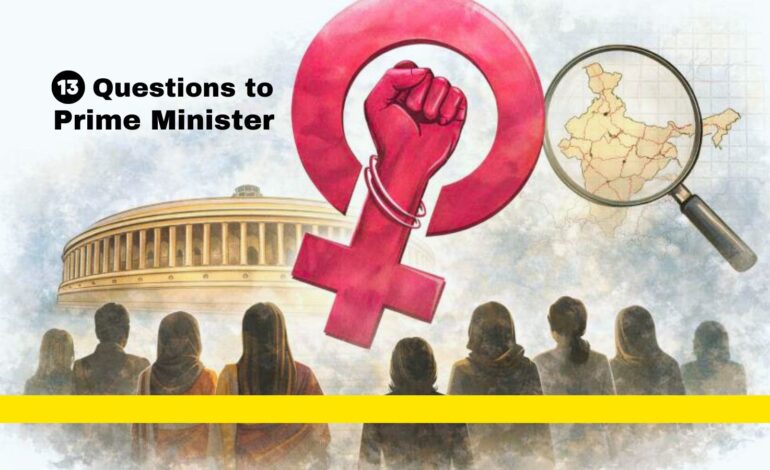
Writer and Social Activist Shivasundar decided to frame these 13 questions after watching Prime Minister Narendra Modi’s dramatic performance on national television after the failure of his Government to push through the so called Women’s Reservation Bill in parliament.
These 13 questions – sharp, insistent, and impossible to brush aside – cut through the carefully crafted and cunning narrative on women’s empowerment projected by Narendra Modi and his government. Shivasundar is not merely interrogating policy; he is challenging the very intent, timing, and political calculus behind this charade of a law
Through this Shivasundar exposes how the women’s reservation issue has been transformed from a long-awaited democratic reform into an electoral instrument — announced with fanfare, deferred with design, and deployed in moments of political convenience. Here are the questions. Read On.
Question #1
After amending Article 334A of the Constitution in 2023 with unanimous support of all parties and making women’s reservation a law, what was the need for another constitutional amendment?
Question #2
As demanded unanimously by opposition parties in 2023, why was 33% reservation not implemented within the existing 543 seats? Why were unnecessary conditions added—such as implementing it only after delimitation based on the 2026 census—making it impossible to enforce women’s reservation until 2034?
Question #3
Why was the Act, passed in both Lok Sabha and Rajya Sabha in 2023, approved by the President and gazetted, not notified until April 16, 2026?
Question #4
If the intention of bringing the 2026 constitutional amendment bill was to implement women’s reservation quickly, why were manipulative sub-conditions like delimitation based on the 2011 census included?
Question #5
Even knowing that adding highly controversial delimitation conditions would prevent securing a two-thirds majority in Parliament, why was this process initiated?
Question #6
Even now, why is your government unwilling to call a special session and introduce a simple amendment to provide 33% reservation within the existing 543 seats?
Question #7
In 2023, you introduced a women’s reservation bill that could not be implemented until 2034—just one year before elections.
Now, during ongoing elections in five states, despite clearly knowing the bill would fail (due to delimitation conditions), you deliberately introduced and ensured its defeat. You have also started a false and divisive campaign blaming opposition parties for this failure.
Was this bill introduced merely to defame the opposition?
Does this not mean you have consistently betrayed women’s reservation for petty electoral gains?
Question #8
Since 1996, proposals for women’s reservation have been repeatedly introduced in Parliament by Congress governments, United Front governments, your own Vajpayee government, and later the UPA government. One major reason as to why they were not passed was the objection that there was no sub-quota for OBCs within women’s reservation.
Why did even the Vajpayee government not attempt to implement women’s reservation with an OBC sub-quota, like other governments?
Why does the 2026 bill you introduced also not include an OBC sub-quota?
Question #9
One of the reasons why attempts between 1996–2014 failed was coalition governments. But in 2014 and 2019, the Modi government had a full majority. Why did you not use that to pass women’s reservation without delimitation conditions, as you did for EWS reservation for upper caste?
Instead,
a) In 2023, you ensured it could not be implemented until 2034
b) In 2026, you added malicious delimitation conditions and ensured the bill’s defeat
Does this not make the Modi government the most anti-women and opposed to women’s reservation?
Question #10
If the BJP truly has commitment to women’s empowerment, why not voluntarily give 33% tickets to women in Lok Sabha and Assembly elections without waiting for a law? Except for TMC, why does BJP—like most other parties—still limit women’s tickets to around 12–15%?
Question #11
After the bill’s defeat, Prime Minister Modi allegedly misused government machinery and, acting like a BJP leader, delivered hate-filled election speeches falsely branding opposition parties as anti-women. Since institutions like the Election Commission and Supreme Court are not acting against this, does this not further prove that the bill was introduced just to label opposition parties as anti-women and gain women’s votes?
Question #12
In yesterday’s speech, Prime Minister Modi called himself a protector of women.
But over the past 11 years, in cases like Manipur, Kathua, Unnao, harassment of women wrestlers, and honoring of Bilkis Bano case convicts by BJP leaders—why has he remained silent, even when BJP MPs and leaders themselves were accused of crimes against women? Why protect such perpetrators instead of speaking out?
Question #13
Modi compared the failure of women’s reservation to female foeticide. Female foeticide reduces the proportion of women in society compared to men.
In reality, why do states like Gujarat (long ruled by BJP), and Haryana and Uttar Pradesh (with strong BJP and Sangh influence), have among the lowest female-to-male ratios in the country?
Conversely, why do states like Kerala, Tamil Nadu, Karnataka, Telangana, and West Bengal—where BJP influence is relatively weaker—have higher female population ratios compared to “Hindi-Hindu” states?
Just asking.






“A sharp and thought-provoking piece raising crucial questions on Women’s Reservation. Such issues deserve transparent answers, not silence. Real empowerment will come only when intent matches action and accountability is taken seriously.”