In portraying the 1937 abridgement as a cause of Partition, the government resurrects a Vande Mataram debate that Gandhi, Netaji, and others had long resolved—shifting focus away from pressing national crises that demand serious discussion.
One hundred and fifty years after Vande Mataram first stirred the soul of a colonised nation, India finds itself debating the national song once again — this time not on the streets of freedom movements, but at the very heart of the Republic: Parliament. As the Lok Sabha prepares for a special discussion marking its 150-year legacy, Prime Minister Narendra Modi has reignited the national imagination by calling Vande Mataram “a mantra, a dream, a resolution and an energy” — a symbol that, in his telling, carries the spiritual voltage of India’s civilisational confidence. Yet his sharper claim — that the 1937 trimming of the song “sowed the seeds of Partition” — has thrust the anthem into the centre of contemporary political contestation.
What emerges, therefore, is not merely a commemoration, but a revealing moment: a cultural artefact and a national germ is transformed into an apple of intense discord. Vande Mataram has a long and contested history from 1870 to the present day. Sabyasachi Bhattacharya writes in Vande Mataram: The Biography of a Song (2003): “Through the 1930s and 1940s the Muslim League persisted in their opposition to the song while the Hindu enthusiasm in its favour increased proportionately. From 1947, Vande Mataram became a communal war cry in the perception of some Indians while some others perceived it as a legitimate symbol of national cultural identity, thereby leading to conflicts on the status of the song. Thus, the political appropriation of Vande Mataram transformed its meaning time and again”.
Aesthetic and political shocks
Ananda Coomaraswamy explicated the Buddhist aesthetic concept of Samvega. In a short essay published in a Harvard journal in 1943, he translated it as “aesthetic shock”. He explained it: “The Pali word samvega is used to denote the shock or wonder that may be felt when the perception of a work of art becomes a serious experience.” The aesthetic shock has two stages: the first emotional, the second cognitive. The first delivers a sensation; immediately thereafter, the second conveys meaning and purpose. It is like a horse being whipped — first comes the physical impact, and then the horse recognises that it must run faster.
Vande Mataram has always had the capacity to trigger this aesthetic shock (samvega). Its enchanting poetic value inspired Indian revolutionaries — mostly those of Hindu lineage — during the freedom movement. After Independence, the Hindu Right Wing chose it as their war cry to mobilise the idea of Hindu nationalism. For them, Vande Mataram has functioned more as a whip and a dog whistle than a soothing musical offering. Their current romance with the national song aims to use it as ideological fodder and to settle old scores with Jawaharlal Nehru and the Congress.
Who is the Mother?
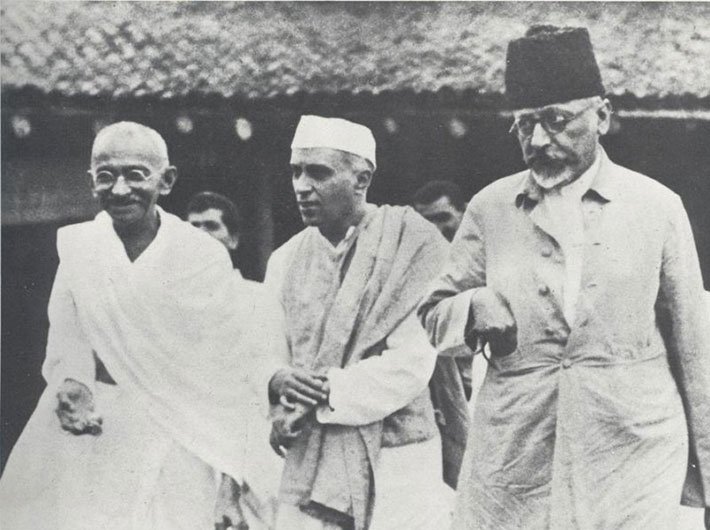
Parts of Vande Mataram were selected as the national song in 1937 by the Indian National Congress, after a committee led by Jawaharlal Nehru recommended its adoption while the party pursued independence from colonial rule. The entire song was not selected, in order to respect the sentiments of non-Hindus. The gathering agreed that anyone should be free to sing an alternate “unobjectionable song” at a national event if they did not want to sing Vande Mataram for personal reasons.
According to the leaders present — including Rabindranath Tagore — the first two stanzas contained an unexceptionable evocation of the beauty of the motherland, while the later stanzas contained references to the Hindu goddess Durga. The All-India Muslim League and Muhammad Ali Jinnah opposed the song. Thereafter, with the support of Mahatma Gandhi and Jawaharlal Nehru, the Congress adopted only the first two stanzas as the national song, and the remaining verses referring to Durga, Lakshmi, and Saraswati were expurgated.
The song opens with the line: “Mother, I bow to thee!”. But who is this Mother? Mother India or Goddess Durga? If it is Mother India, what are her attributes? Abanindranath Tagore’s 1905 Swadeshi-era painting Bharata Maata offers an answer. His Mother India has four arms carrying grain, cloth, a manuscript, and a rosary — representing food, clothing, education, and spirituality for a starving nation. Traditionally, the Mother Goddess Durga has eight arms carrying weapons, wears a necklace of skulls, and rides a lion. Abanindranath’s Mother India is a nurturing figure, not a ferocious goddess. We need a Bharat Maata who does not trample anyone underfoot, does not frighten with terrible wrath, and does not wield weaponry to slay her own.
Rabindranath Tagore had long warned against the political misuse of cultural symbols, a caution powerfully embodied in Ghare Baire through the character of Sandip. In the novel and Satyajit Ray’s film adaptation, Sandip deploys “Vande Mataram” not as a hymn of love for the motherland but as a tool of seduction, manipulation, and coercion. He uses the emotionally charged slogan to inflame communal passions, mask his opportunism, and draw the vulnerable Bimala into his orbit. Tagore’s portrayal exposes how even the most sacred national symbols can be weaponised for personal ambition—an eerily relevant reminder in today’s orchestrated revival of the Vande Mataram debate. We must assimilate the aesthetic nationalism of Abanindranath Tagore and cosmopolitanism of Rabindranath Tagore, and reject the religious nationalism of Bankimchandra Chattopadhyay if the Republic is to remain truly secular and pluralistic.
Netaji’s Choice
Not only Nehru and the Congress, but Netaji Subhas Chandra Bose too preferred an inclusive anthem over Vande Mataram. Bose chose Subh Sukh Chain (also known as the INA anthem or Qaumi Tarana of the Azad Hind Government) as the anthem for the Indian National Army and the Provisional Government of Free India.
The primary reason for this choice was inclusivity. Vande Mataram contains significant Hindu metaphors and imagery that made some Muslim members of the movement uncomfortable. Subh Sukh Chain — a Hindustani adaptation of Tagore’s Jana Gana Mana by Captain Abid Hasan Safrani, with music by Captain Ram Singh Thakuri — was deliberately secular, designed to unify all communities within the INA. Bose’s decision reflected his commitment to secularism and national unity. The anthem was sung at all major events of the Azad Hind Government.
Lari’s Clarification
Zahirul Hasnain Lari — a Muslim League left-winger, Uttar Pradesh MLA from Gorakhpur, and later a member of the Constituent Assembly — dismissed the Vande Mataram controversy as an unnecessary fuss. He found nothing in the first two stanzas objectionable to Islamic principles. Lari’s statement, made after the 1947 Partition, echoed his belief that the Muslims should move beyond their communal mindset.
Z.H. Lari’s clarity — that the first two stanzas of Vande Mataram contain “nothing objectionable or repugnant” to Islamic principles — ought to have settled the debate with finality in the early years of the Republic. The continued recycling of this controversy, decades later, reveals not cultural concern but political convenience. To invoke Vande Mataram today as a litmus test of patriotism is to willfully ignore its textured history, its negotiated inclusions, and the pluralistic instincts of leaders from Tagore to Nehru to Netaji. Persisting with this kitschy, unnecessary debate while the nation confronts real emergencies — the flawed SIR, the Delhi blast, toxic air pollution — is akin to Nero playing the fiddle while Rome burns. A mature republic must outgrow symbolic skirmishes and instead defend the inclusive, secular nationalism that animated our freedom struggle.