


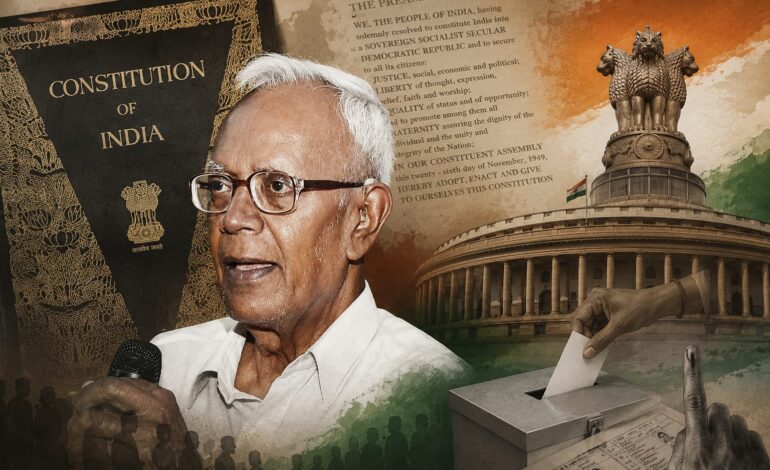
In Part 2 of this series drawn from Parakala Prabhakar’s Father Stan Swamy Memorial Lecture, made at St. Patrick’s High School, Secunderabad on 11 July 2026.
The renowned political and economic affairs expert delivers a sweeping indictment of what he describes as the systematic dismantling of India’s secular, plural and constitutional order.
Linking the Special Intensive Revision (SIR) of electoral rolls to a larger project of majoritarian nation-building, Prabhakar warns that the battle is no longer merely over elections or representation, but over the very meaning of citizenship, belonging and the idea of India itself.
Dismantling Secular, Inclusive India
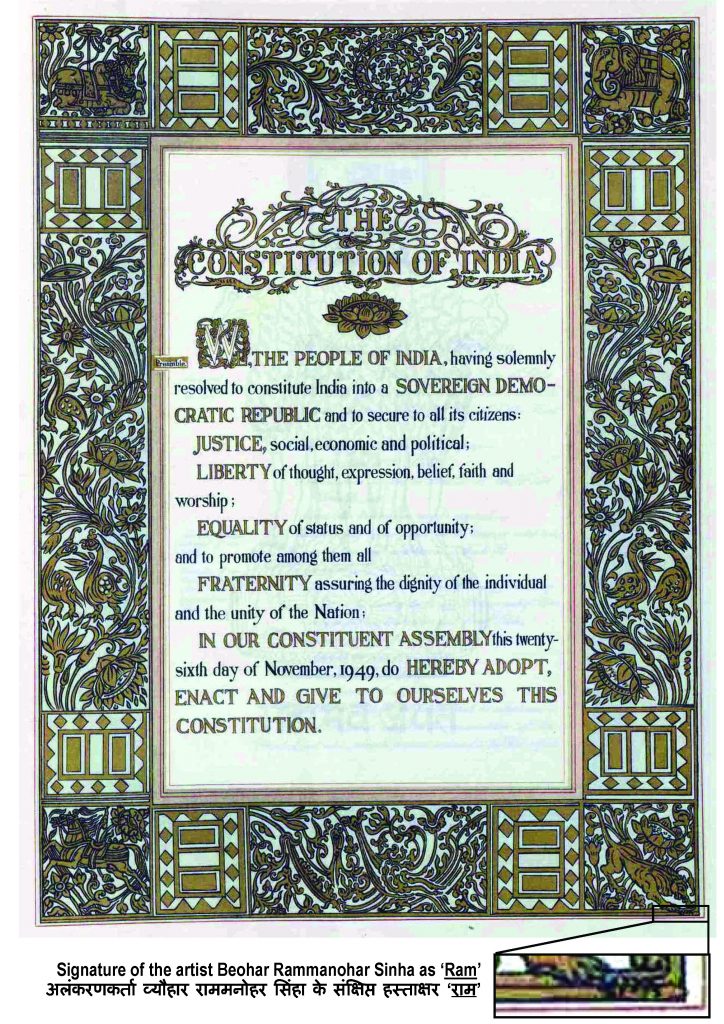
The present dispensation is relentlessly working to dismantle the idea of India as a secular, plural and federal state that pledged itself to delivering liberty, equality, justice and fraternity to its people, while fostering a humane society. The idea of India embedded in our 1947 Tryst with Destiny and the political compact enshrined in our Constitution of 1950 are today in mortal danger.
The secular, plural and democratic conception of India has been the target of unrelenting assault by this dispensation and several other obscurantist platforms that glorify a mythical past. They have openly and doggedly championed an unequal social order. Their project seeks India’s future in its imagined past; to recover from that imagined past a fabricated, pristine glory; and to transform the secular democratic Republic into a culturally, linguistically and religiously homogenised nation.
The idea that Indian civilisation is a synthesis—a palimpsest shaped by countless cultures and traditions—is abhorrent to them. Their project seeks to erase the country’s rich diversity of cultures, languages, lifestyles, food habits, sartorial practices, modes of worship and traditions of syncretism.
A flattened India is their conception of a “civilisational” state. That is the goal of the present dispensation.
The Special Intensive Revision (SIR) of the electoral rolls is one crucial element in a larger project that seeks to assert the exclusive ownership of the Indian nation by Hindus, to make that Hindu-owned nation the sole rightful inhabitant of the territory of the Indian state, and ultimately to transform it into a Hindu nation-state—a Hindu Rashtra. It seeks to redefine the country’s identity as a “Hindu nation-state”. In this formulation, the “savarna” character of the project is deliberately muted and rendered invisible, for the time being, for tactical reasons.
Eventually, once those constraints are removed, it will be unveiled as a full-blooded, unapologetic, wall-to-wall Savarna Hindu Rashtra. Make no mistake.
Bloodless Political Genocide
When we became a Republic, our founding parents made it a home for everyone who lived within its territory. Membership of the Republic—and citizenship—was not predicated on religion, caste, gender, language, culture, region, colour, economic status, educational qualifications or any such attribute. Everyone who chose India as their home was a citizen, a voter and, therefore, a full member of the country’s political community. Denominational identities did not privilege one group over another as the rightful owners of the nation. Everybody belonged. Janmabhoomi was the sole criterion. We did not entertain Punyabhoomi as a criterion for citizenship or membership of our political community.
Europe underwent a very different historical experience during the formation of nation-states. There were those who rightfully belonged and those who were regarded as “others” or minorities. That became the basis of European nation-states. Majorities and minorities were defined not politically, but by birth, race, religion, language and culture. The continued residence of minorities depended upon their becoming acceptable to the majority. European countries, and others that adopted this model of nation-building, either subjugated minorities, expelled them from their territories or, in extreme cases, exterminated them. From the cleansing of the Iberian Peninsula in the fifteenth century to the ethnic cleansing being carried out in our own times, history bears witness to numerous bloody attempts to forge homogenised nations. The Nazi gas chambers were the most monstrous consequence of this project.
India’s founding leaders and freedom fighters consciously chose a different path. They designed our collective life in such a way that the state gave room to everyone, despite their diversity, to live together and flourish.
However, ideologies in India that draw inspiration from the inhumane European concept of the nation-owned state seek to transform our Republic into a state owned by one nation—the Hindu nation. The present dispensation belongs to that ideological tradition. In its conception of the Republic, the “others” must either be assimilated to the point where their identities disappear, pushed out of the territory of the nation-state, or exterminated through genocide.
Remember the ideological formulation articulated by the present ruling dispensation some years ago? It proposed three ways of dealing with minorities: Tiraskar (Rejection), Puraskar (Appeasement), and Samskar (Reform and Assimilation).
At a time when the country’s secular consensus remained relatively strong, it argued that rejecting such a large minority was impractical. Tiraskar was therefore set aside. At the same time, it maintained that Puraskar, or appeasement, was equally undesirable. Instead, it advocated Samskar—the gradual assimilation of minorities into the Hindu fold until their distinct religious identities and other markers disappeared altogether.
You may have heard remarks from majoritarian voices such as: “He is a Christian, but a good person,” or “She is a Muslim, but a good individual.” The implication is that, despite being Christian or Muslim, they are “like us” and are therefore acceptable. That seemingly harmless sentiment marks the beginning of a formulation in which others must first become “tolerable” before they can earn the right to belong.
After years of unsuccessful experimentation with this approach, the ruling ideology eventually restored the option it had once set aside. With the weakening—and in many places the collapse—of the secular consensus, Tiraskar has returned to the forefront of its political agenda.
Today, Rejection has evolved into Ejection—ejection from the country’s political community.
Today, look at the political reality in our country. For the first time in the history of independent India, the Union Council of Ministers has no representative from either the Muslim or the Christian minority community. A few weeks ago, even the token Christian presence in the Union Cabinet was dispensed with. The ministry is now composed exclusively of persons belonging to the so-called Indic religions. The task of exclusion from political representation in the executive has, more or less, been accomplished.
But what could be done about the political community? In present-day India, both the physical expulsion and extermination of unassimilated minorities are politically impractical.
However, another form of extermination is possible—a political one.
Instead of exterminating the citizen, citizenship itself can be exterminated. The ongoing Special Intensive Revision (SIR) is the instrument forged for that purpose. It extinguishes the citizenship of those deemed undesirable by extinguishing their franchise. Without the right to vote, citizenship becomes hollow and devoid of substance. Disenfranchisement hollows out citizenship.
Therefore, SIR is nothing less than a bloodless political genocide. It exterminates citizenship, expels people from the country’s political community, and renders them effectively stateless while they continue to live within the borders of the Indian state. What the CAA-NRC could not accomplish, SIR is now intended to achieve.
The idea of India as a state-nation—in contradistinction to a nation-state—that is home to diverse peoples, cultures, languages and religions is being dismantled at a frightening pace.
Stan Swamy’s Words Once Again
This is the moment when we need to recall the key words I drew from Father Stan Swamy’s statement just before he was taken into custody on 8 October 2020.
Let me repeat them once again:
Adivasis; Dalits; the marginalised; ruling powers; struggle for a life of dignity and self-respect; dissent; solidarity; the Indian Constitution; validity; legality; justness; deshdrohi; silent spectator; pay the price; face the consequences.
Many studies have already established that it is the Adivasis, the Dalits, the marginalised sections and, in particular, women among them who are being systematically targeted for deletion in the ongoing process of the SIR.
Father Stan Swamy would have stood with them.
Today, millions in both rural and urban India are battling for a life of dignity and self-respect.
Father Stan Swamy would have helped them wage those battles.
He would have offered them the solidarity they so desperately need.
Our country’s social compact—built upon secularism, plurality, federalism, diversity, justice, fraternity, equality and liberty—is today in mortal danger.
Father Stan Swamy would never have remained a silent spectator in the face of an assault on these foundational values of our Constitution.
He would have risked being called a deshdrohi and spoken out in their defence.
Indeed, he was already called one.
He would not have minded being called a deshdrohi a thousand times over if that was the price he had to pay for expressing his dissent and standing by his convictions.
He would have accepted the consequences, whatever they might be.
I am certain he would want us to do the same.
Father Stan Swamy never made noise. He worked quietly in the remote and neglected corners of the country.
Yet the present dispensation was afraid of a frail, ailing octogenarian.
It was afraid because he personified the very values our country needs today—values that are precious to us but fundamentally inimical to the project of those who wield power in Delhi.
Thank you for your attention.






“Parakala Prabhakar’s concluding part presents a powerful reflection on citizenship, constitutional values, and the future of Indian democracy. Whether one agrees with every argument or not, it compels readers to think deeply about inclusion, rights, and the responsibility of safeguarding democratic institutions. An important and thought-provoking read.”