
Coaches, Commanders and The Four-Quarter Revolution

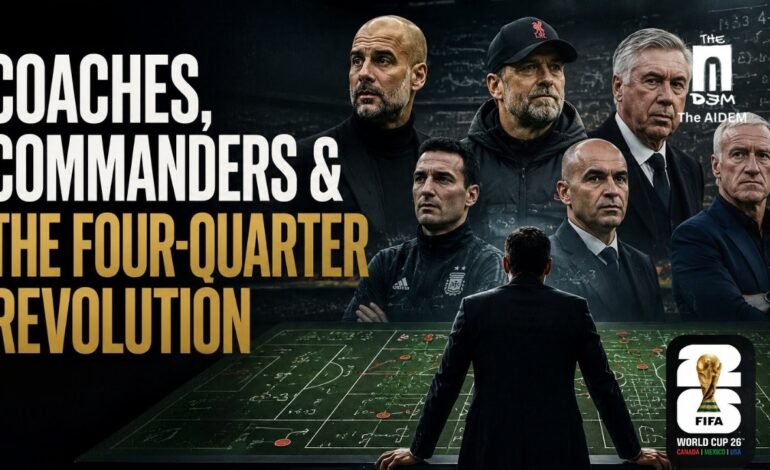
The AIDEM’s countdown to the FIFA World Cup 2026 continues with a look at the role of the ubiquitous twelfth man – or the coach – whose animated reactions from the sidelines often flash on the screens. Also, the 2026 edition has a hydration break in each quarter. What is it going to supply the teams besides the much-needed electrolytes? Could this go down in history as one of the most significant rule changes?
Modern international football is increasingly rewarding managers who can combine tactical coherence, emotional regulation, collective identity, and adaptive pragmatism. The old archetype ‘great tactician’ is no longer enough. The successful World Cup manager today is a combination of systems architect, a military field commander, and a national psychologist. They do not merely organize teams; they organize collective emotional energy under extreme uncertainty.
Evaluation of the managerial system resembles the analyses of military commands. It is how military historians evaluate generals like Erwin Rommel, George S. Patton, or sGeorgy Zhukov, Sam Manekshaw, and others? Not through one metric; but through factors like operational adaptability, morale effects, tempo control, logistical management, crisis handling, and enemy reactions. Football managers are analogous.
In modern international football, the manager matters far more than assumed. Not only because he ‘coaches patterns’; but, he manages emotional energy, tactical adaptation, dressing-room hierarchy, tournament pacing, and crisis control. The international manager is closer to a wartime field commander than a club coach.
Let’s consider this strategic assessment of the managers (or likely 2026 managerial structures) of the 12 teams discussed.
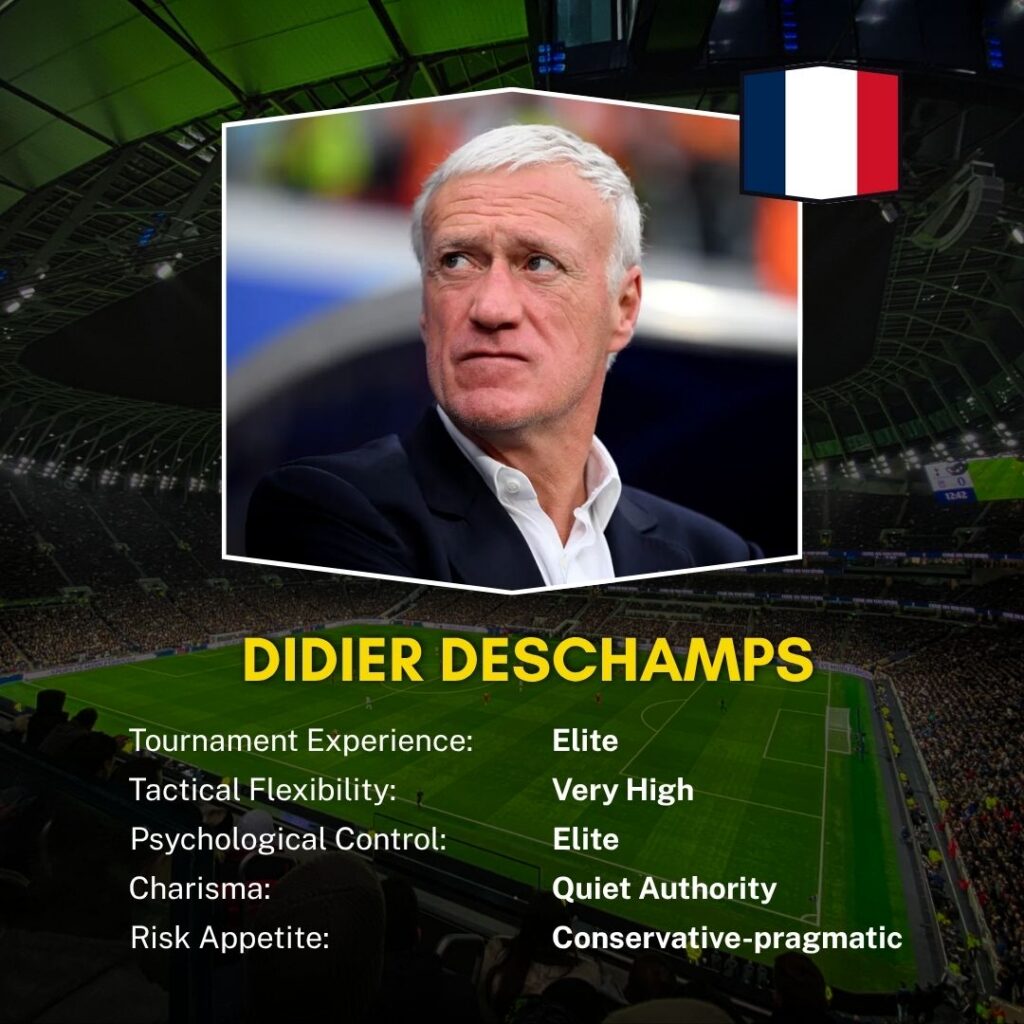
Possibly the best tournament manager in world football, Deschamps understands tournaments are survival exercises. He is not ideological. He sacrifices beauty for control when necessary. Most importantly his players trust him under pressure. He resembles a cold, experienced general who knows wars are won by logistics and discipline, not glory.
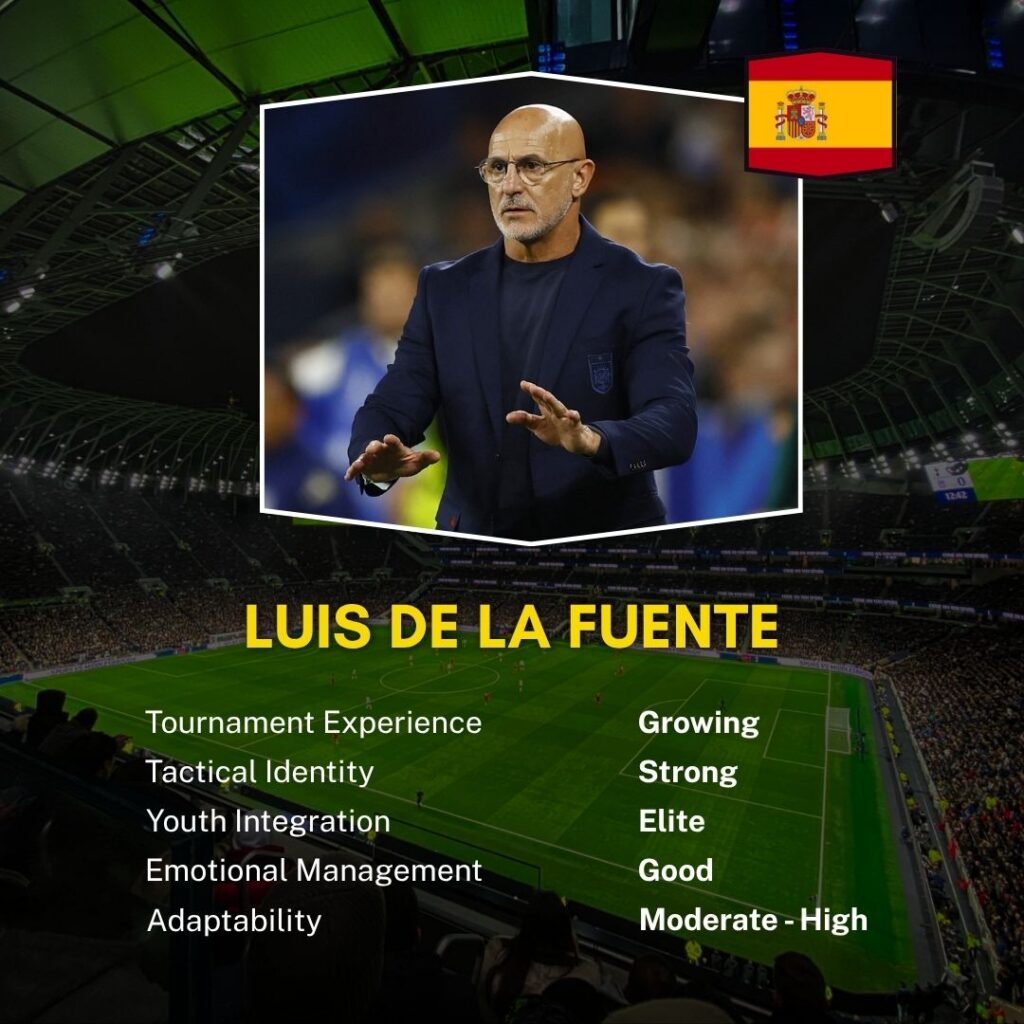
De La Fuente’s biggest achievement is that he has restored emotional simplicity to Spain. After the tiki-taka era, the Spanish team had become over-theoretical. He made them faster, more direct, less dogmatic. But, can he adapt when Plan A fails in knockouts?
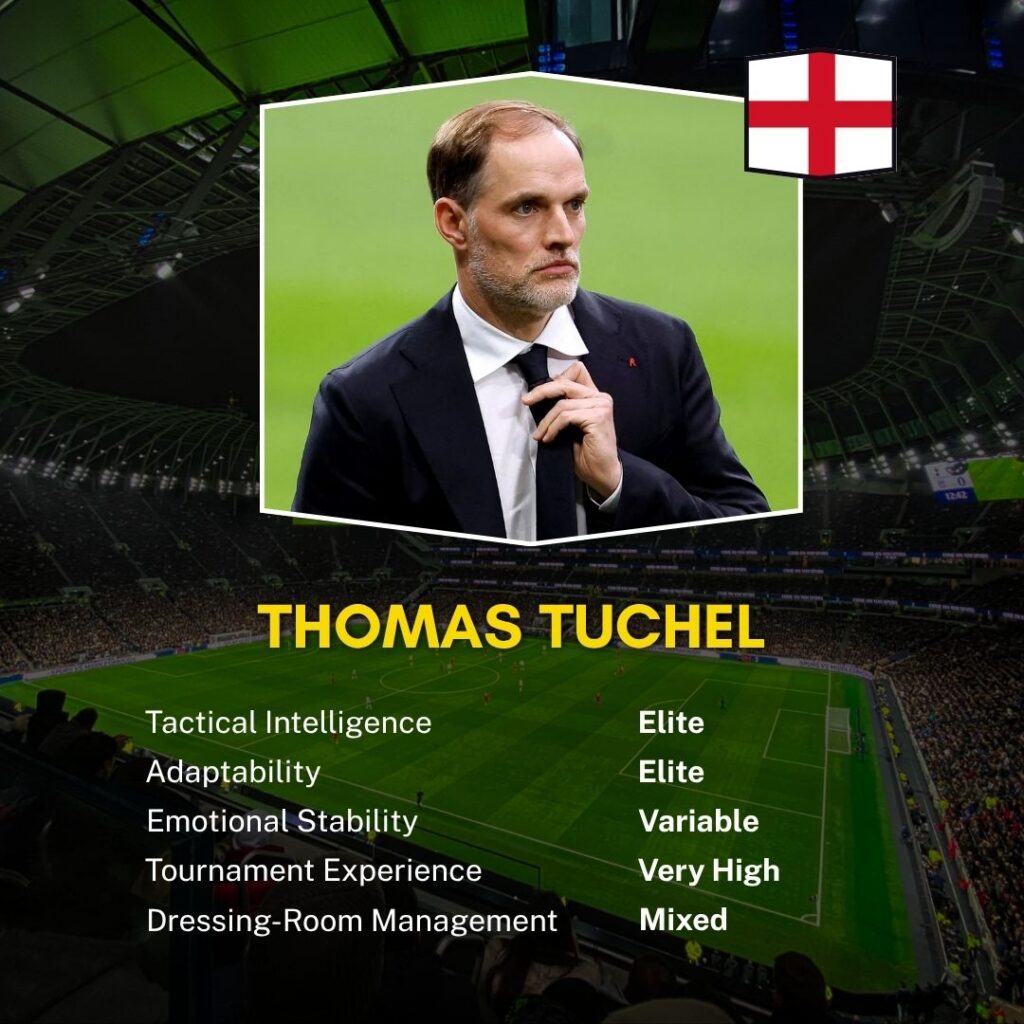
Tuchel may be England’s most tactically sophisticated manager in decades. He can change systems mid-game, solve tactical puzzles, and prepare knockout plans. But at times he creates emotional turbulence. If England can remain calm, they can be dangerous. But, if pressure spirals, Tuchel’s intensity can amplify chaos.
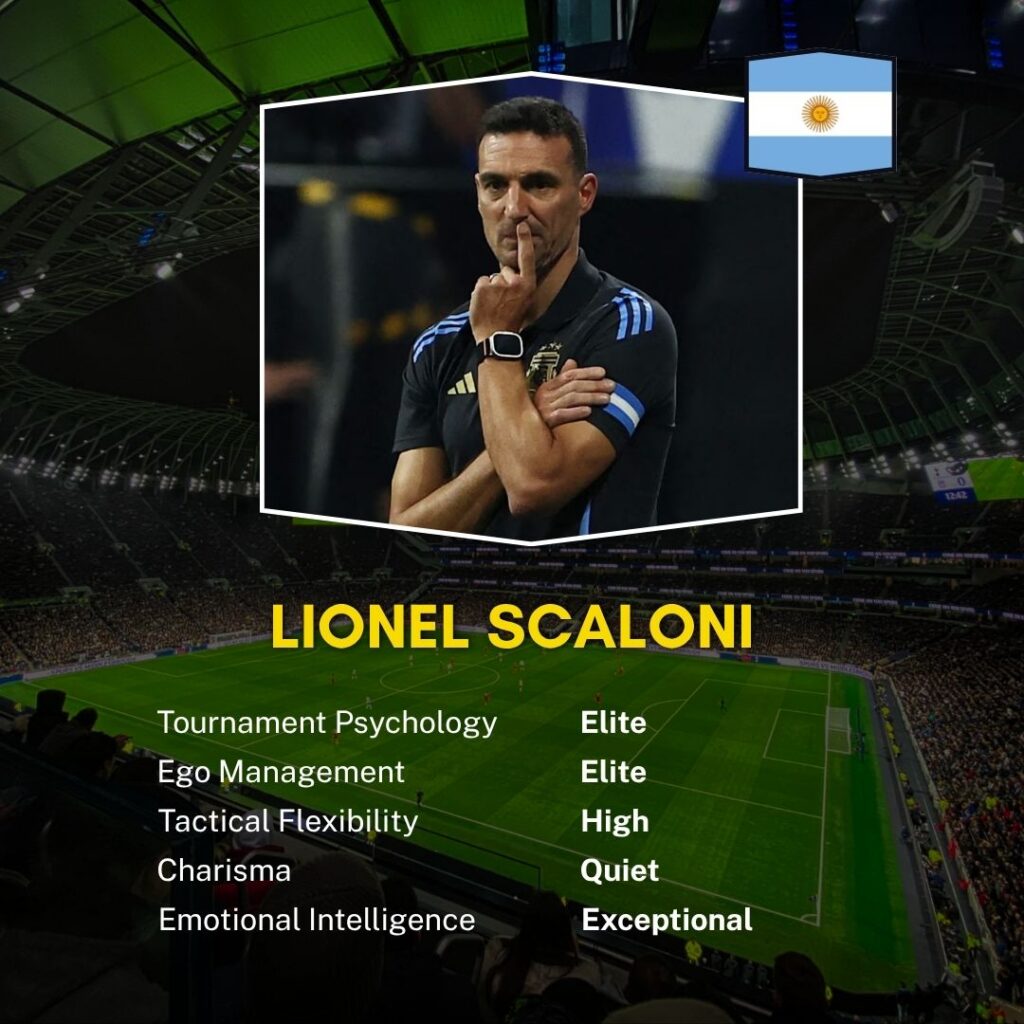
Scaloni’s genius is underestimated. He transformed Argentina from a neurotic, Messi-dependent, and emotionally fragmented team into a cohesive, resilient, and selfless one. He created emotional equilibrium; that is extraordinarily rare.
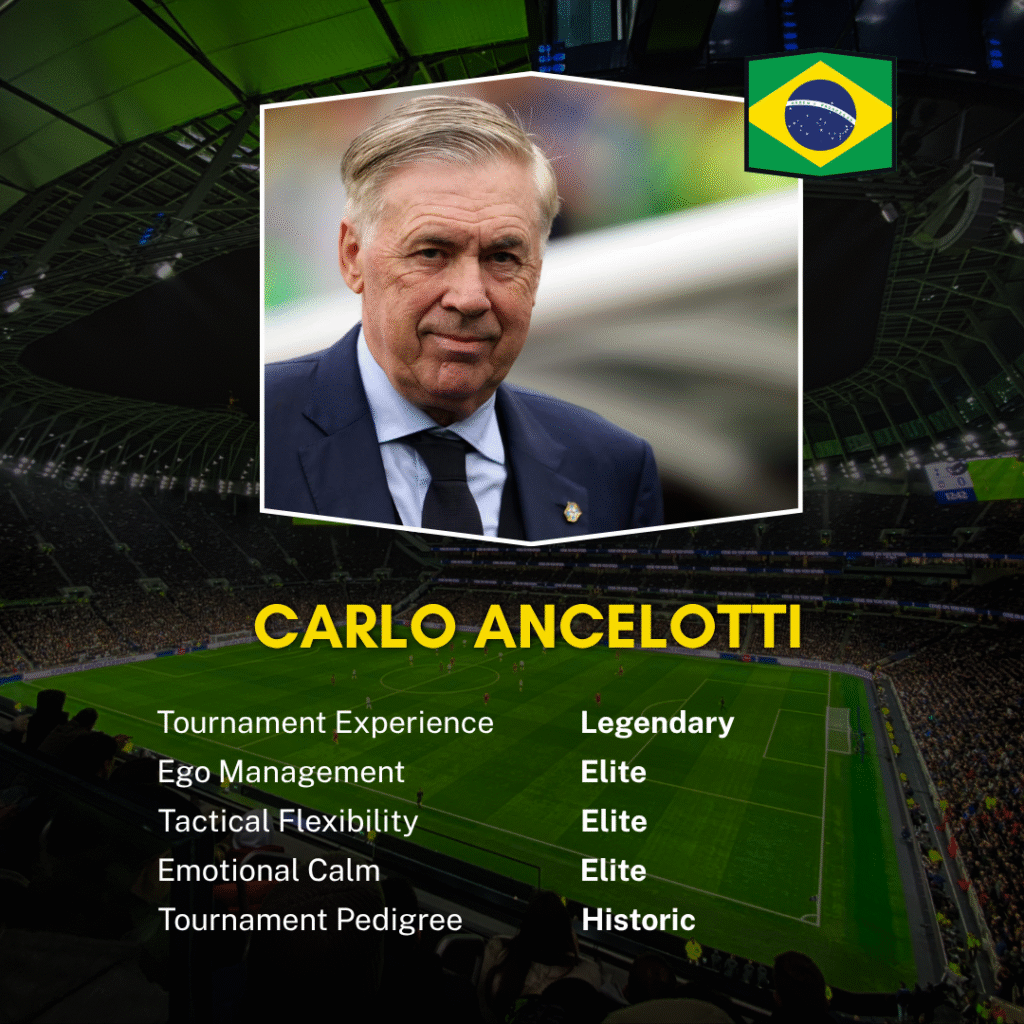
If Ancelotti fully settles into Brazil, it could change Brazil dramatically. For years Brazil has lacked emotional serenity. Ancelotti brings calm, hierarchy, tactical realism, and dressing-room authority. He may finally Europeanize Brazil tactically without killing Brazilian creativity. A very dangerous combination.
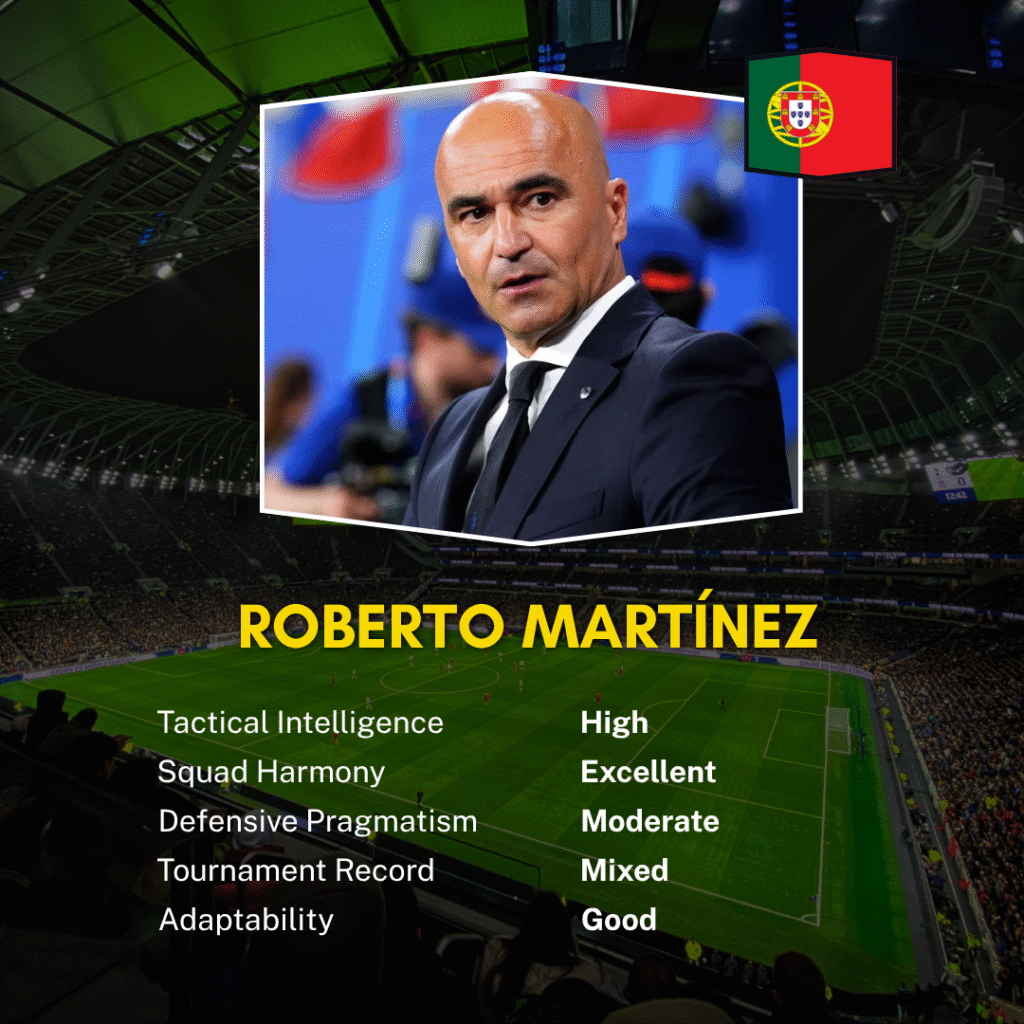
Martínez is excellent at maximizing technical squads, building positive dressing rooms and creating fluid attacking football. But, critics question whether he possesses ruthless knockout pragmatism. Portugal’s ceiling may depend on whether Martínez can be more cold-blooded tactically.
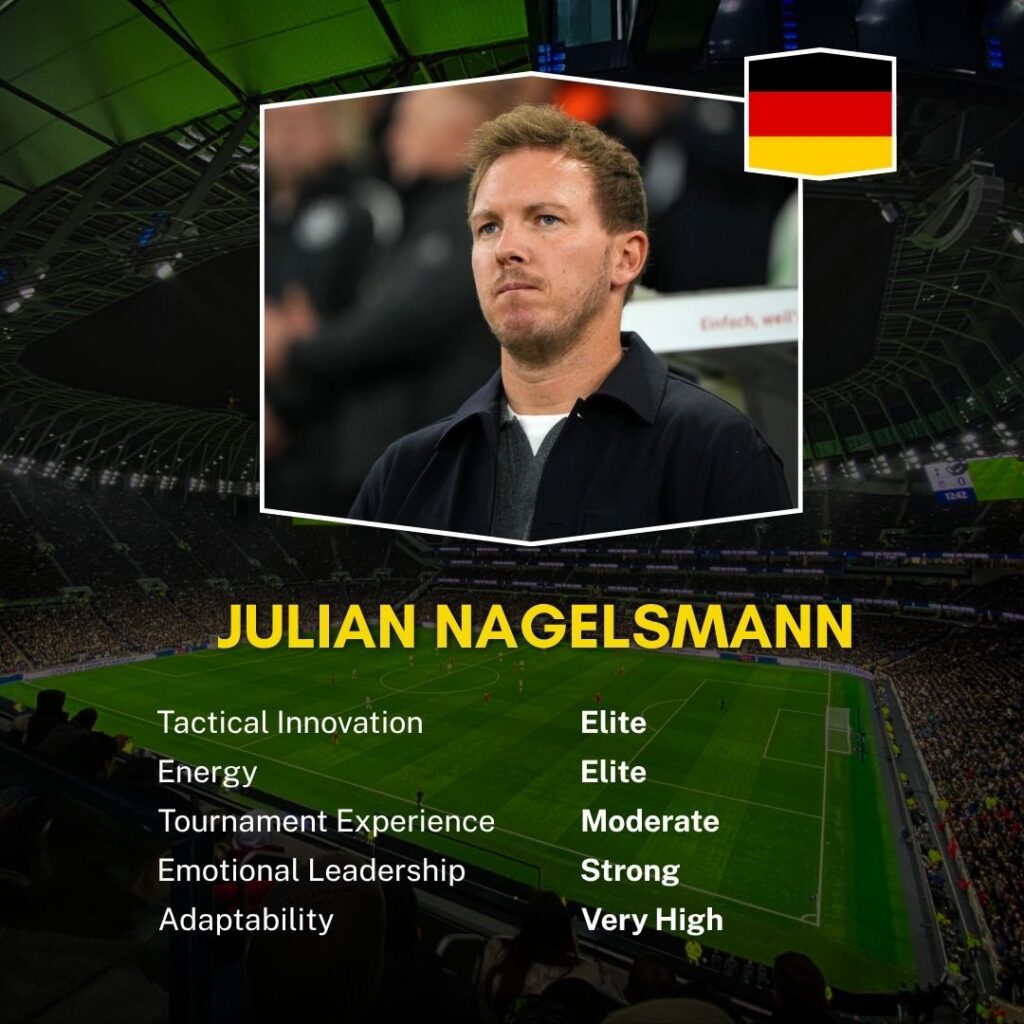
Nagelsmann represents the Germany trying to reinvent itself. Brilliant tactically and flexible. Modern. Fearless. But World Cups are psychologically different from club football. One may question if his intellectual complexity can translate into tournament simplicity, but his influence may be enormous.
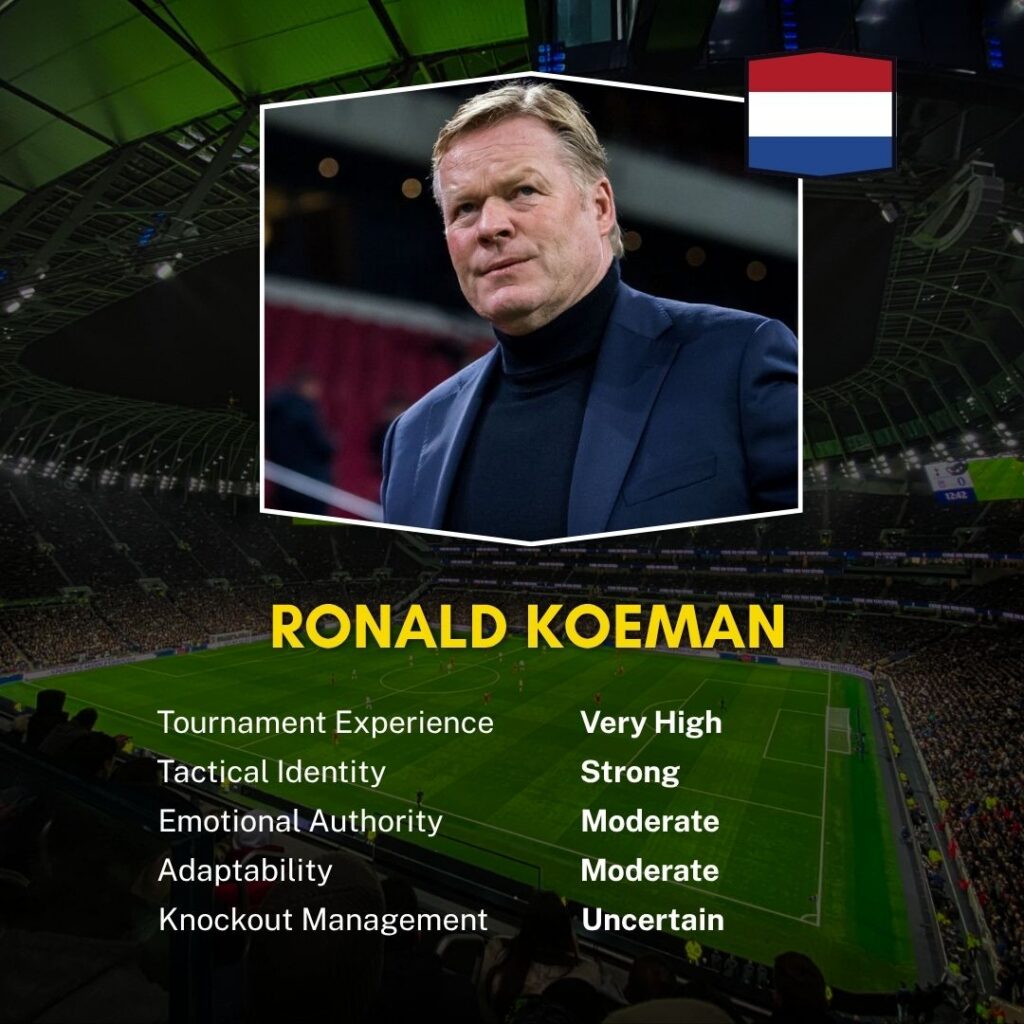
Koeman brings calm, Dutch continuity, and experience to the team. The Netherlands often needs emotional hardness, not tactical clarity. Koeman stabilizes, can he transform? Can he elevate the Dutch psychologically?
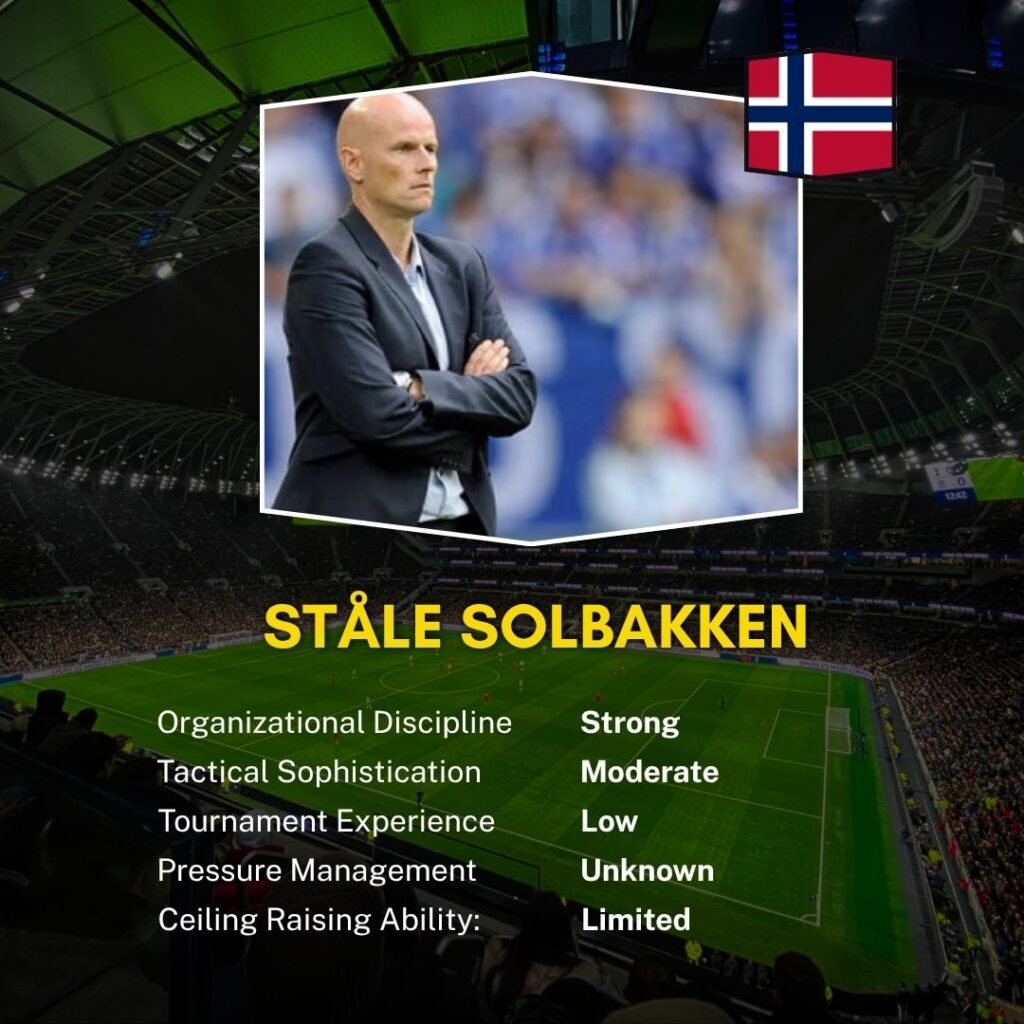
Norway’s issue is not coaching alone. It is lack of tournament institutional memory. Solbakken is competent, but Norway is a talented team, that is not yet hardened tournament battle hardened.
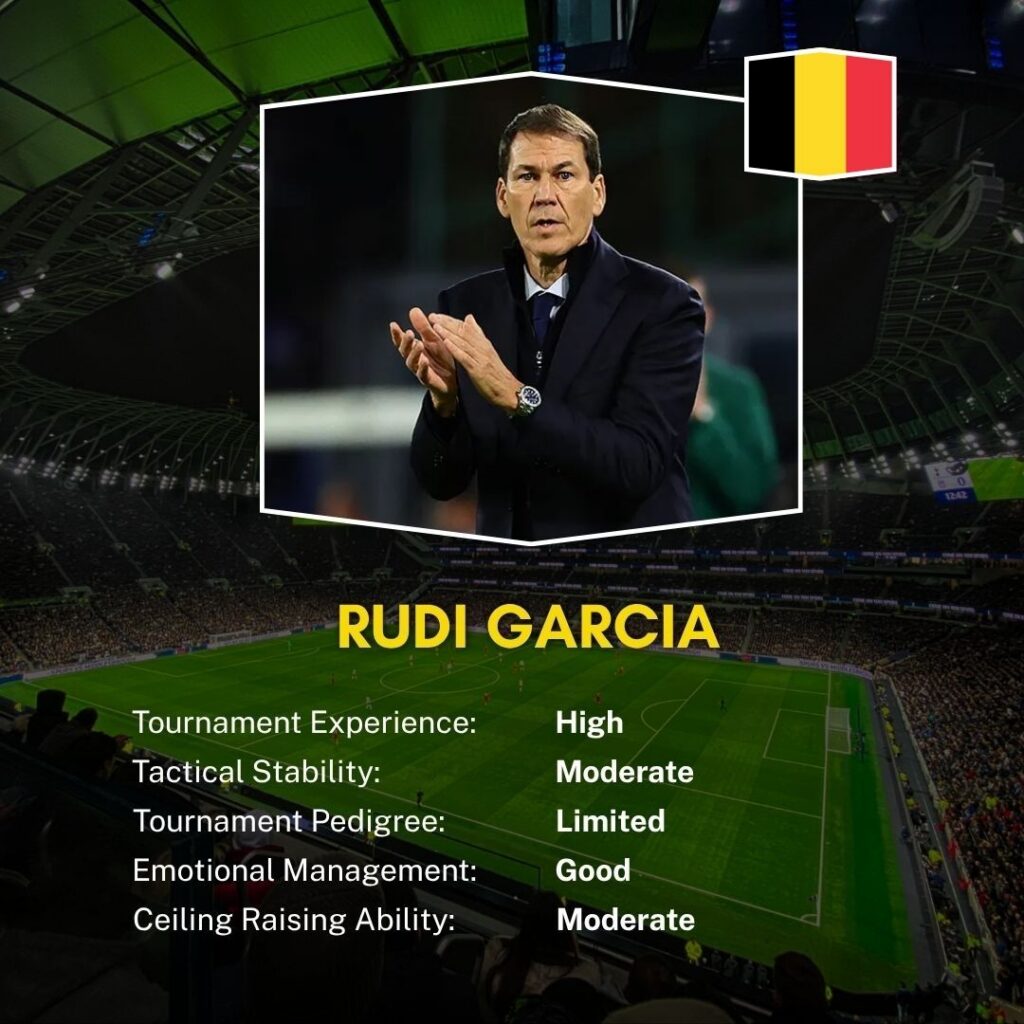
Structural transition is Belgium’s key concern. Garcia can stabilize, but can he recreate the lost golden generation’s peak? Currently Belgium appears to be between eras.
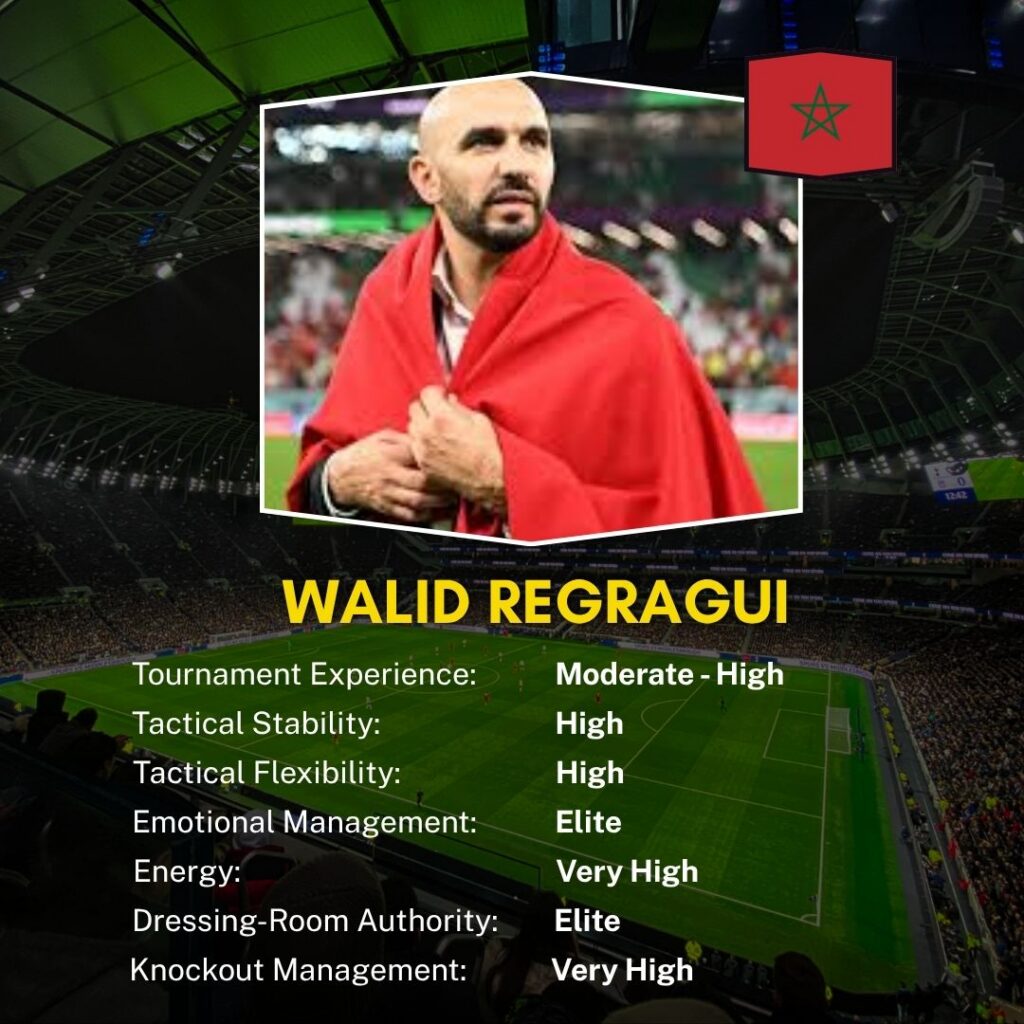
Regragui may be one of the most underrated international managers in world football. What he achieved in 2022 was not merely tactical, it was civilizational emotional mobilization. Morocco did not play like a Cinderella team or a temporary underdog; it played like a deeply unified organism. That is the product of extraordinary emotional leadership. Regragui created emotional cohesion, tactical discipline, collective sacrifice, without losing creativity, speed and spontaneity. That balance is rare. Many underdog teams become over-defensive and fearful; Morocco remained emotionally fearless.
Morocco under Regragui compresses space superbly, transitions extremely quickly, defends collectively, and adapts intelligently to stronger opponents. Most importantly the team is psychologically comfortable to suffer without panic. That is a hallmark of elite knockout teams. Can it repeat the emotional peak? Underdog runs are easier when expectation is low, energy is pure, and nobody fears failure. In 2026, Morocco enters with expectation.
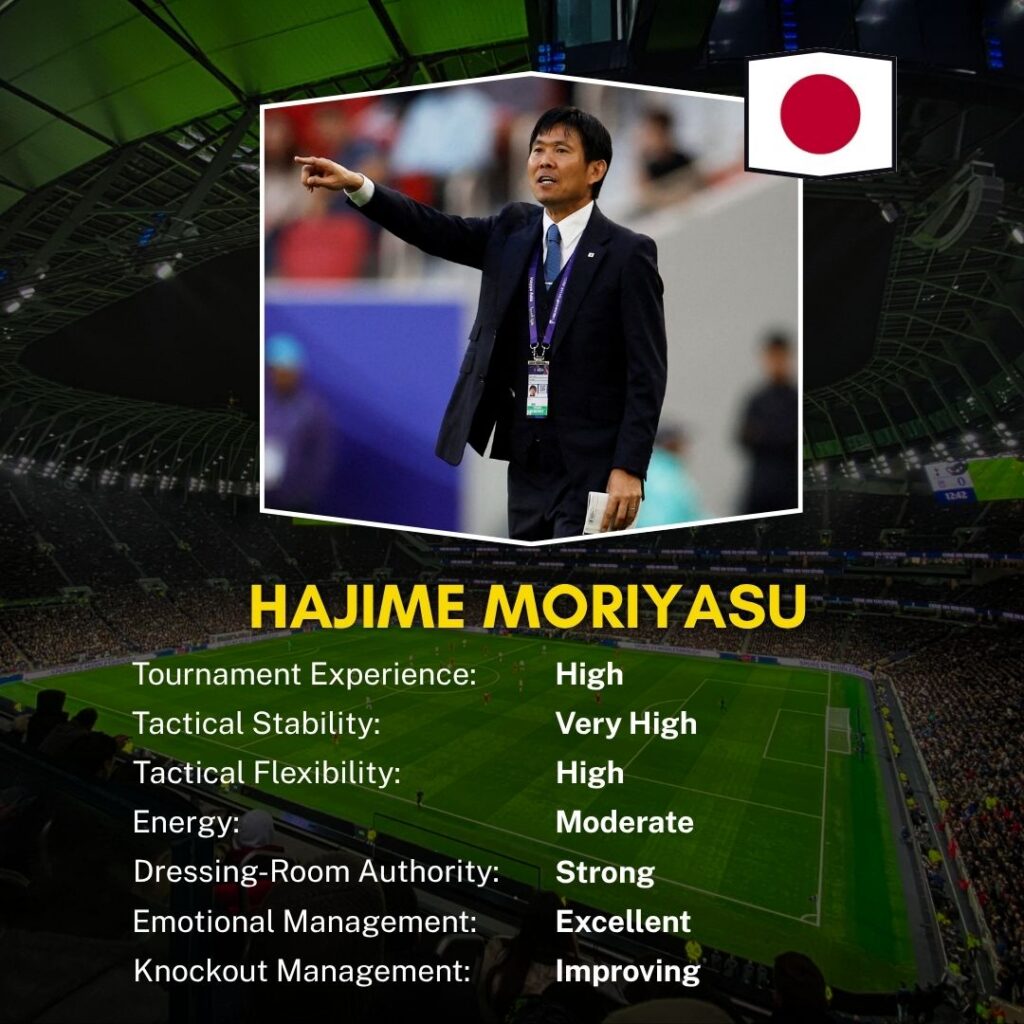
Japan may be the most systematically improving football nation outside Europe and South America. Moriyasu represents disciplined evolutionary modernization. Japan’s football project is patient, organized, and institutionally coherent; it improves incrementally and sustainably. Under Moriyasu, the team is tactically disciplined, physically organized, transition-efficient, and technically clean. Historically Japan struggled against elite athleticism, physical chaos, aerial battles. That gap is narrowing rapidly.
Moriyasu’s biggest strength is emotional management. Japan rarely implodes emotionally. Under pressure too, it maintains structure, discipline, and collective. The emotional steadiness is culturally reinforced.
Occasionally though, Japan lacks the ruthless knockout instinct. They can dominate phases of matches, yet fail to kill games, manage chaos, and weaponize emotional disorder. The Croatia loss in 2022 reflected this partially and that changes psychology entirely.
Managerial Power Ranking in the Tournament Context:
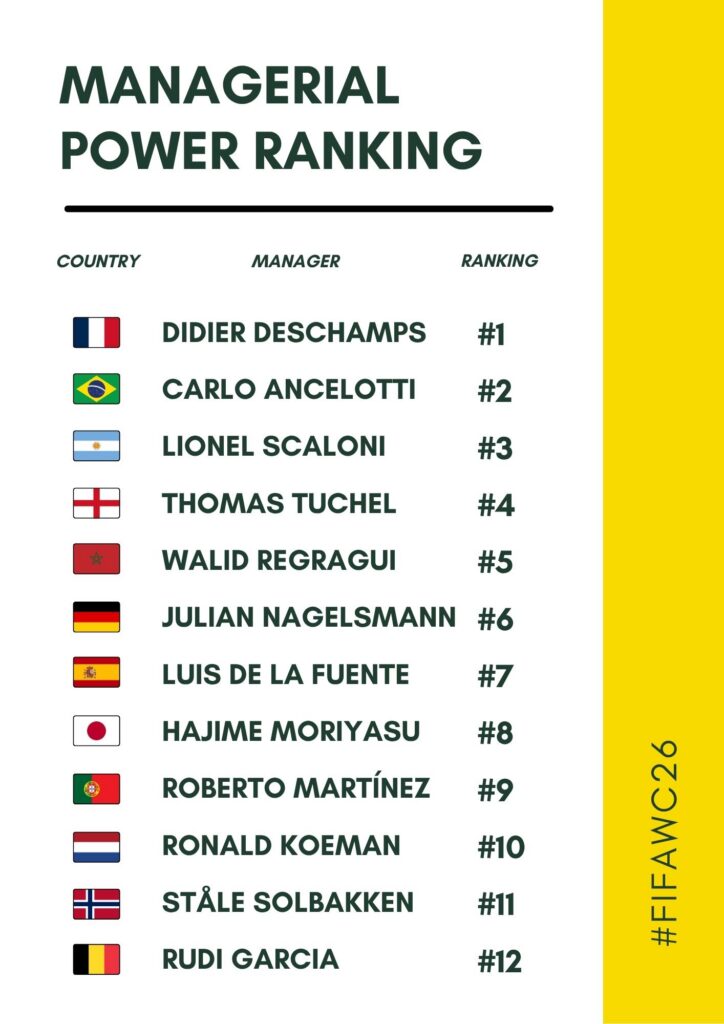
Club football rewards tactical sophistication, training-ground detail, system repetition. World Cups reward emotional regulation, simplification, adaptability, authority, trust. That is why some brilliant club managers fail internationally, while pragmatic tournament commanders thrive. Deschamps is the perfect example. He may not produce the most beautiful football, but he understands that the World Cup is not a philosophy seminar. It is controlled chaos under extreme emotional pressure, one has to operate under the ‘fog of war’.
Hydrate… and Communicate?
For the World Cup 2026, FIFA cited extreme heat and tough travel conditions to introduce a mandatory hydration breaks at the 22 minute mark in both halves. While these do not exactly break the game into four quarters, the hydration breaks have added another edge (or, should we say two edges?) to the role of the managers. Effectively they create four playing segments, with coaches getting two additional opportunities to communicate with the players. This seemingly minor change could be one of the most fascinating tactical developments of World Cup 2026 and have disproportionate consequences.
Historians of football may look back on it as more significant than many rule changes.
For 150 years football has possessed one unique characteristic among major team sports – once the match begins, the coach largely loses control. Football coaches traditionally have only halftime, substitutions, and touchline instructions. This is one reason why football produces so much uncertainty. The coach launches the aircraft; the players fly it.
With the hydration breaks the World Cup can be seen divided into four segments:
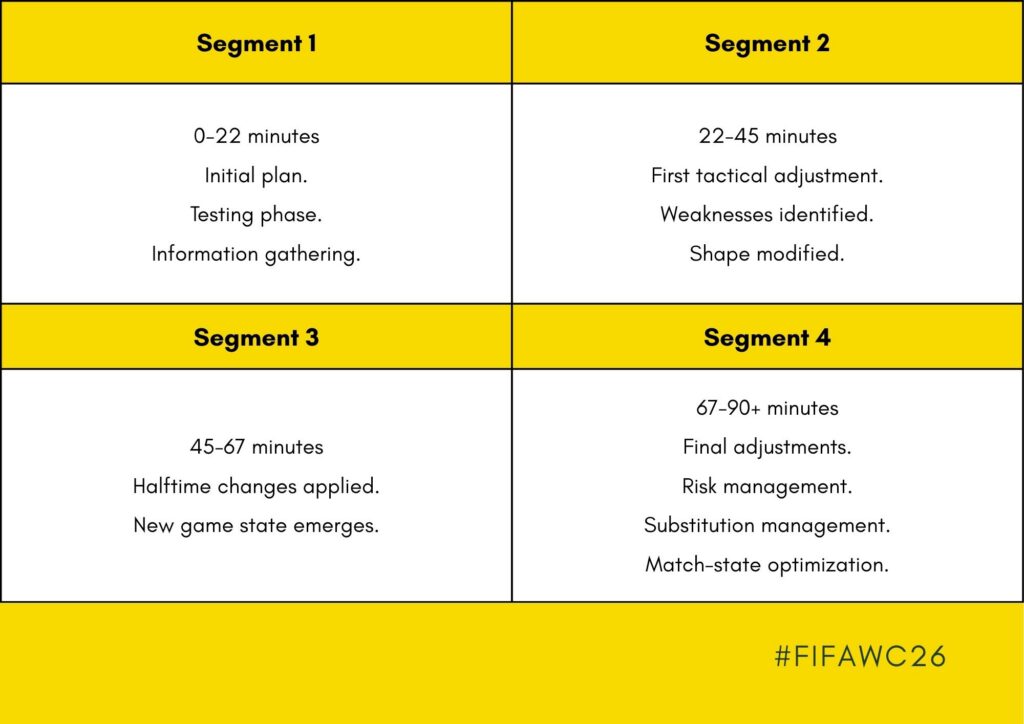
In effect coaches now receive four decision cycles. If we apply our World Cup model, the biggest beneficiaries of this new rule will be Spain, Germany, England, Portugal, and Japan and the sufferers Brazil and Morocco.
By the quarterfinal stage it will be evident that the fittest teams, or the most talented teams will not be the beneficiaries; the teams with the clearest tactical identities, the strongest coaching staffs, and the most adaptable systems. The World Cup 2026 may be the most coach-influenced World Cup in history.
So, What is the Forecast?
Rather than relying on a single forecasting system, let’s broaden our forecast by combining several layers of analysis, where each illuminates a different dimension of the tournament success.
The first layer is structural football capacity, where Klement’s model is most useful. Certain countries repeatedly produce elite footballers regardless of generation. France, Spain, Germany, Argentina and Brazil do not merely possess talented squads; they possess football ecosystems. They have academies, coaching systems, football culture, institutional continuity and a long tradition of producing world-class players. Football greatness is not entirely random; much of it is manufactured.
The second layer is current competitive strength. Here FIFA rankings and related rating systems remain valuable. History matters, but current form matters too. Germany’s past achievements cannot score goals in 2026.
But, is Germany today strong enough to compete with Spain, France, or Argentina? Rankings may not fully capture tournament dynamics but they provide a useful snapshot of present capability.
The third layer is statistical probability. This is the domain of analytical models such as. Such systems ask a simple question: if the tournament was played ten thousand times, how often would each team win? These models strip away sentiment and reputation and consider the elements of rigor and discipline. They remind us that football is a game of probabilities; yet the best simulations struggle to quantify confidence, fear, momentum and collective belief.
The fourth layer is market intelligence. Prediction markets and bookmakers aggregate the views of thousands of observers. They incorporate injuries, rumours, form, sentiment and emerging narratives. Markets are often remarkably efficient because they gather dispersed information that no individual analyst can fully possess. Yet markets have their own distortions. They can herd around fashionable stories. They can overvalue glamour nations and undervalue disciplined outsiders.
The fifth layer is managerial influence. Modern international football places enormous importance on leadership. Unlike club managers, national team coaches have little time to install complex systems. Their real task is to organize collective belief. Thus, their experience, tactical stability, tactical flexibility, emotional management, dressing-room authority, and energy has been examined earlier. Managers such as Deschamps, Scaloni, Ancelotti and Regragui repeatedly demonstrate that leadership can add tournament value beyond the quality of the squad itself.
The sixth layer is tournament psychology. This may be the most underestimated variable in football forecasting. How does a team respond when it concedes first? How does it handle penalties? How does it react when a nation expects victory?
Argentina’s recent success, Croatia’s repeated over-achievement and Belgium’s disappointments all suggest that psychology matters as much as talent. Some teams seem comfortable in chaos. Others become prisoners of expectation.
The seventh layer is knockout resilience. League football rewards dominance; tournament football rewards survival. The best knockout teams know how to win ugly. They manage game states, absorb pressure, control tempo and remain calm when matches become messy. France and Argentina excel in this regard. Their players seem to understand that tournaments are rarely won through beauty alone.
The eighth layer is age profile. Every successful World Cup team must balance energy with experience. Too young, and a team risks emotional volatility. Too old, and physical decline becomes a concern. Recent champions suggest that the ideal range lies somewhere between twenty-six and twenty-eight years of age. France, Spain, Portugal and England all sit close to that sweet spot.
The ninth layer is injury dependency. Not all stars are equally replaceable. France could lose Mbappé and still field an extraordinary squad. Norway losing Haaland would fundamentally alter its prospects. Spain losing Rodri would transform the way they play. Understanding which players hold entire systems together is essential to evaluating tournament risk.
The tenth and perhaps most controversial layer is the ‘Big tournament DNA’. It is difficult to measure, yet impossible to ignore. Certain nations appear to inherit tournament competence. Germany remains dangerous even during weaker cycles.
Argentina repeatedly finds ways to survive adversity. Brazil enters every World Cup carrying generations of accumulated confidence. These countries do not simply possess talent. They possess memory. Their players grow up expecting to compete deep into tournaments. That expectation becomes part of the football culture itself.
On the basis of these parameters, we can arrive at each team’s probability to make it to the Quarter Finals:
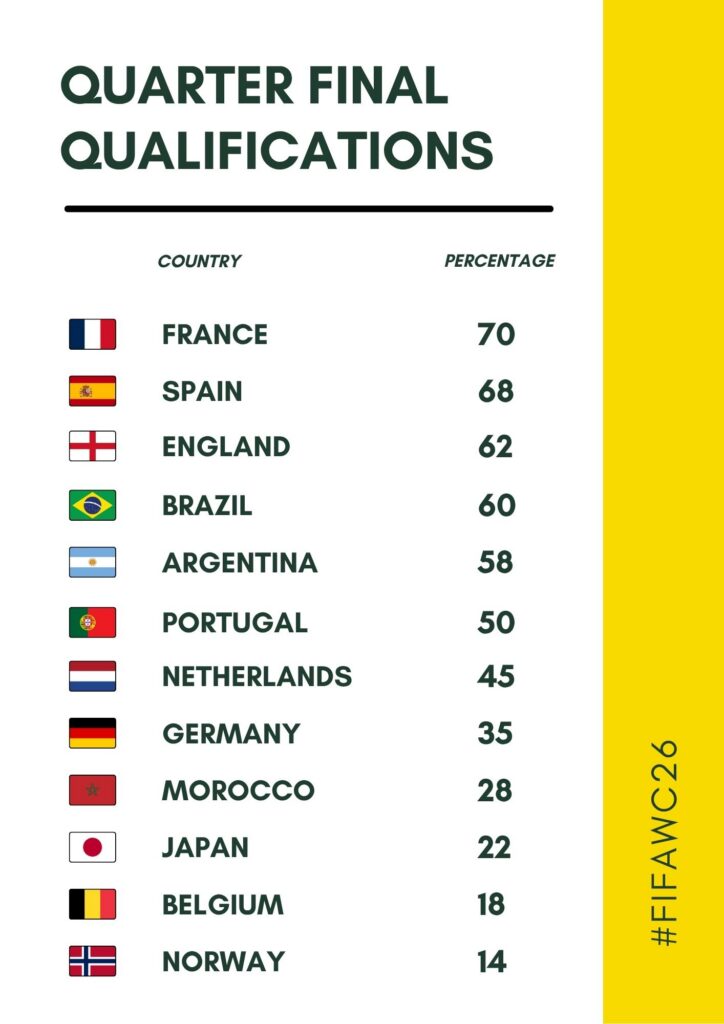
Fine tune it further, and the tiers may look like this:
Tier 1 – The Great Powers: France, Spain, Argentina & Brazil
France, Spain, Argentina and Brazil appear the most complete tournament organisms. They combine structural strength, elite talent, managerial competence, psychological resilience and institutional memory.
Tier 2 – Fully Capable of Winning: England, Portugal, Netherlands & Germany
England, Portugal, Germany and the Netherlands form the next tier. Each possesses championship potential but also carries a specific vulnerability—whether psychological, tactical or structural.
Tier 3 – Dark horses: Morocco, Japan, Belgium
Morocco and Japan represent the most interesting challengers. They may lack the depth of the traditional powers, but they compensate through organization, identity, discipline and increasingly sophisticated football cultures.
Tier 4 – High-End Disruptors: Norway, USA, Uruguay, Croatia
Belgium, Norway, and the other disruptors listed here remain dangerous outsiders. Their talent is undeniable. Their challenge is whether talent alone can compensate for weaknesses in tournament inheritance and structural depth.
A World Cup is not merely a competition between football teams; it is a contest between systems.
It tests academies, managers, institutions, cultures, leadership structures, emotional habits and collective memory. Talent matters enormously, but talent alone is rarely enough.
Ancient Chinese military general and strategist Sun Tzu, wrote – Everything in war is simple, but the simplest thing is difficult.
Football tournaments obey a similar logic. The strongest side on paper rarely proceeds untroubled. Friction intervenes. Injuries intervene. Pressure intervenes. Chance intervenes. Thus this model does not attempt to predict who is strongest. It attempts to identify which nations possess the greatest capacity to survive seven consecutive encounters amidst the uncertainty. Ultimately, that is what winning a World Cup requires.
Check in tomorrow for our next essay in the series leading up to the World Cup 2026.
This series is essentially a concise version of the author’s long format Substack series on the World Cup. The Substack series can be read here.
Related Stories: FIFA World Cup 2026




World Cup 2026 will showcase not only football stars but also the tactical brilliance of the coaches guiding them from the sidelines. ⚽🌍
The main reason is not hydration – it is Ads. FIFA WC is not selling to the Asia continent because advertisers are not able to recover the huge amount asked by FIFA with only one break halftime . So the breaks like basketball breaks give more options to sell airtime and thereby the channels will bid for the show.