
World Cup 2026: The Politics, Predictions and Perils of Forecasting Football


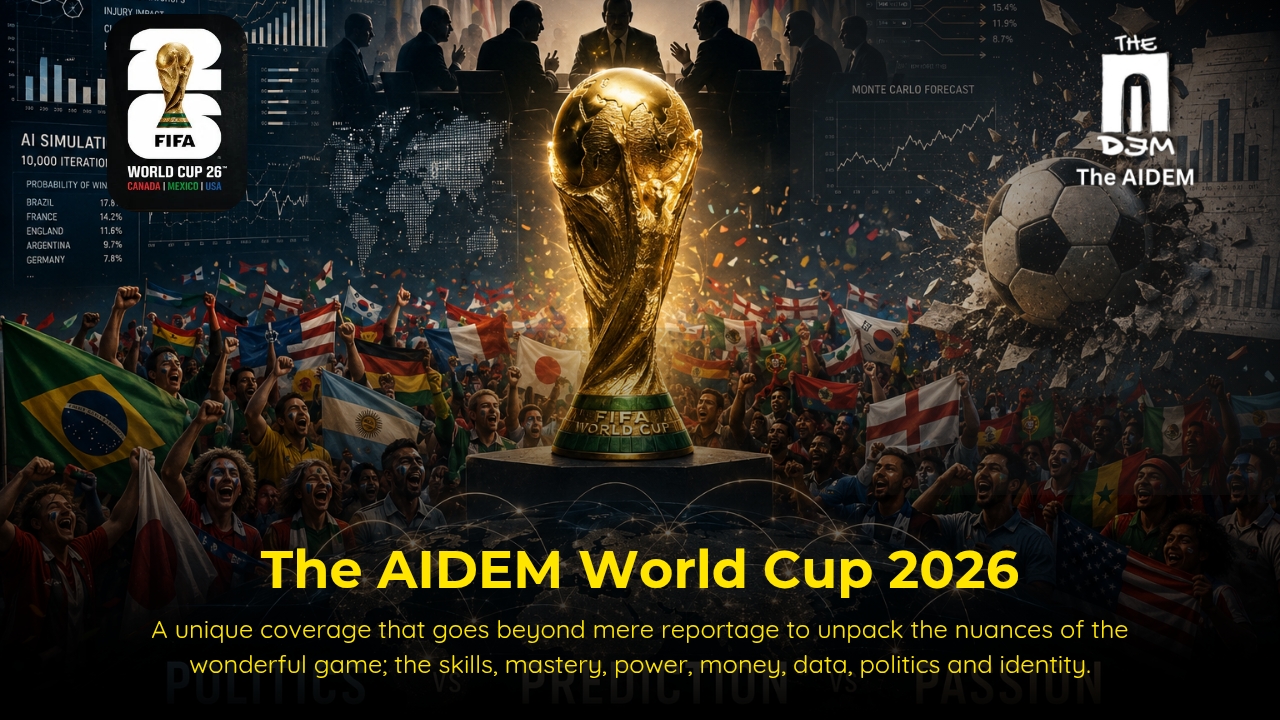
The AIDEM’s countdown to the FIFA World Cup 2026, kicks off with this series examining the forces shaping football’s defining global contest. This opening essay explores the geopolitical battles that led to the tournament’s expansion from 32 to 48 teams, the continuing debates over regional representation, and the competing analytical models that attempt to predict the eventual champion.
From FIFA’s power politics and football’s shifting global geography to the inherent unpredictability of the game itself, the article argues that no statistical model can fully account for the blend of skill, psychology, chance, and drama that defines a World Cup.
“An astonishing void: official history ignores football. Contemporary history texts fail to mention it, even in passing, in countries where it has been and continues to be the primary source of popular passion and identity.” – Eduardo Galeano, in his book ‘Soccer in Sun and Shadow
In the FIFA World Cup 2026, 48 teams will compete for the coveted trophy; the previous tournament had 32 teams taking the field. A 50% expansion in the size of the tournament. This increase in the number of teams is the result of a decade-long geopolitical debate.

In 2015, as FIFA navigated major corruption scandals, a proposal to expand the tournament from 32 to 40 teams was floated. During initial talks, representatives from the Asian Football Confederation (AFC) and the Confederation of African Football (CAF) strongly supported the move.
They argued that their massive and rapidly growing football regions had long been underrepresented, at the expense of European and South American nations. UEFA (Europe) rebutted that diluting the tournament would undermine the competition’s sporting quality.
When FIFA eventually decided to expand the tournament to 48 teams starting with the 2026 World Cup, the focus of the controversy shifted from ‘were they giving enough spots?’ to ‘is the geographical distribution of spots fair?’
The official slot breakdown for the 48-team tournament is:
- UEFA: 16 teams (approx. 33% of the total spots)
- CAF: 9 direct spots (nearly double from the previous 5)
- AFC: 8 direct spots (nearly double from the previous 4.5)
- CONMEBOL & CONCACAF: 6 spots each
- OFC (Oceania): 1 guaranteed spot
Though the CAF and AFC almost doubled their representation, some critics and regional federations expressed dissatisfaction. Detractors pointed out that Africa is the most demographically populous and country-rich continent, yet it accounts for less than 21% of the total spots.
The ball is round, the game lasts ninety minutes, this much is fact, and everything else is theory. – Sepp Herberger, Footballer
These arguments may continue to rage in boardrooms among suited officials and administrators, but for the true-blue football fan kitted out in their team’s colours, the only debate, often heated, is their team’s chances of lifting the trophy. This discussion covers multiple parameters, from what the heart wants to what the stats say to expert predictions.
The additional complexity brought on by the enlarged tournament size and the resulting changed tournament format makes meaningful analysis—let alone predictions—very difficult.
German economist Joachim Klement’s prediction model has been on point with a 100% record in predicting the World Cup winner since 2014.
Yet, he maintains, “Let’s be very clear: If you take this model and these forecasts seriously, you are deluding yourself. If you bet money on the World Cup because of this model, nobody can help you, and you shouldn’t be surprised to lose money.”

Klement’s model is intellectually fun because it combines deep structural variables—wealth, population, climate, football culture—with current strength. That can catch durable footballing capacity better than hype. But it is weak at the precise things a World Cup requires: knockout-path fragility, penalties, injuries, tactical match-ups, squad form, and one bad red card. His three-in-a-row record may be more of a lucky fund manager than a football predictive genius.
His confident prediction for 2026, once again, is rather bold: The Netherlands.
Klement should be considered a useful anti-consensus signal, not a forecast to follow blindly. If FIFA rankings, Polymarket, Ladbrokes, and OPTA Analyst cluster around France, Spain, England, Argentina, and Brazil, and Klement says the Netherlands, the sensible conclusion is that the Netherlands is a plausible dark horse, not the most probable winner.
But the best analysis in a sport like football must leave 50% to luck, as Klement says.
Every football match, especially when high-quality teams with similar skills and quality play each other, will depend on variables like the form of the day, a referee’s call, or a piece of luck, such as hitting the post versus the ball going in. Things that are completely unpredictable.

The World Cup is a hybrid phenomenon: structural, emotional, stochastic, tactical, financial, psychological. No single analytical model captures all layers. More than economics, a World Cup resembles war. The strongest army rarely wins automatically. Football forecasting models often fail because they assume capability translates linearly into victory. Between strength, intention, and execution lies friction—the fog of war—the intangible factors. And, the World Cup encompasses all these variables in a compressed, thirty-day-long high-voltage drama.
Consider the predictions of various experts on 29th May 2026. Polymarket gave Spain the highest chance of winning at 16%, as did OPTA at 16,95%. And Ladbrokes predicts equal odds for Spain and France as winners. Klement, on the other hand, sees both crashing out at the Quarter Finals level, with Portugal as runners-up, and the Netherlands claiming the Cup. While all analysts fall in a similar region of predictions for most teams, there are some surprising forecasts. For instance, Klement predicts Norway not qualifying for the knockout stage, whereas the others envision a better performance from the Norwegians. Also, let’s not forget that Polymarket, Ladbrokes, and OPTA predictions will fluctuate daily.

Keeping the above in mind, a useful critique is less about ‘who is right’ and more centered on ‘what bias each method imports’. Klement’s is a structural realism bias, FIFA is a bureaucratic institutional ranking, and Polymarket is a market bias model. Ladbrokes’ bookmaker odds pricing is risk-biased, whereas the OPTA Analyst model relies on a large database of football data.
In the next essay in this series, we take all the above analyses and add these six weightage parameters – tournament psychology, squad age profile, knockout resilience, tactical flexibility, injury dependency, and historical big tournament DNA, and see how the teams shape up.
This series is essentially a concise version of JP Santhanam’s long-form Substack series on the World Cup. JP Santhanam is a veteran army officer, and former footballer who played for Services and Madras state. He was also captain of Madras University team. His longform Substack series can be read here: Substack.
Related Stories: FIFA World Cup 2026




“An insightful and engaging read. The article goes beyond football to show how politics, expectations, and uncertainty shape every World Cup. A thoughtful perspective on a global phenomenon.”