

The Search for Football’s Lost Synthesis

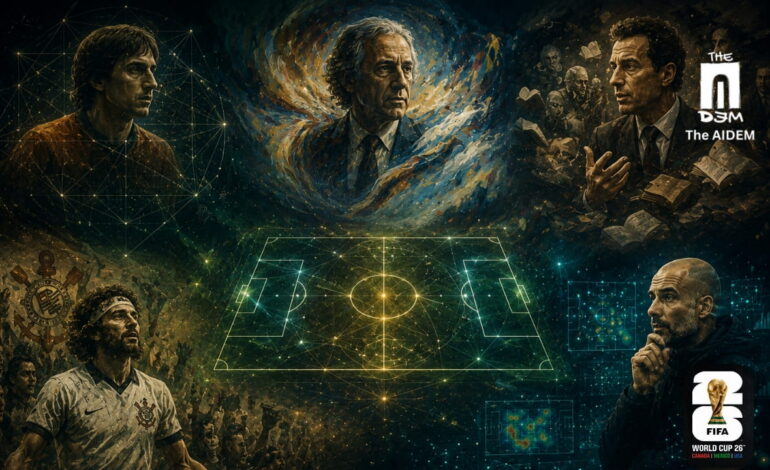
The AIDEM’s countdown to the FIFA World Cup 2026, we delve deeper into football’s intellectual history concerns. It explores the differing ideologies of historians, observers, football players, and managers who study the sport. Are they as conflicted as they appear, or are they dancing in tandem?

Must football choose between numbers and imagination? Must football choose between systems and creativity? Or can it emerge from their union ? The search for an answer leads first to a Uruguayan writer who never managed a football club, never designed a pressing system, and never constructed an expected-goals model. Yet he may have understood football better than most analysts.
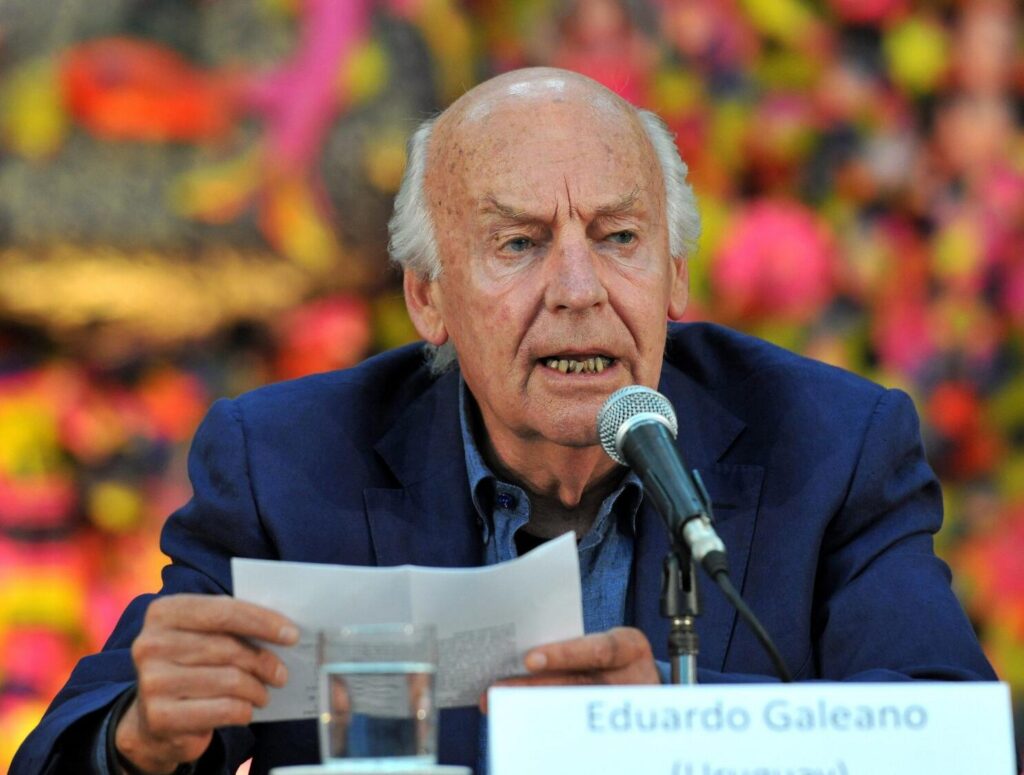
Tell me how you play, and I will tell you who you are. ~ Eduardo Galeano, Writer & Journalist
Galeano was suggesting that styles of play reveal something deeper about societies. Brazilian improvisation, German organization, Italian realism, Dutch spatial imagination, and Argentine creativity were not simply tactical choices; they emerged from historical experiences and cultural dispositions. Football became a language through which societies expressed themselves.
His complaint was that official history ignored football. Historians wrote about constitutions, wars, elections, ideologies, and economies, but paid scarce attention to an activity through which millions expressed identity, belonging, and collective emotion. How could countries like Brazil, Argentina, Germany, Spain, or England be viewed without the lens of a ritual through which these societies imagined themselves? Football, Galeano argued, is culture made visible. Styles of play reflect ways of being. The same pass and tactical system acquire meanings based on the culture that adopts it. Football is not merely behaviour; it is interpretation.
The analyst may count the pass. The historian asks what the pass signifies. This distinction becomes crucial as football enters its modern tactical age.
Football has a script; the actors, if they’re great actors, can interpret the script and their lines according to their creativity, but they still have to follow the script. ~ Arrigo Sacchi, Manager
Sacchi’s ambition was to create conditions under which creativity could become more effective. Structure was not the enemy of freedom. Structure was freedom’s precondition.
Sacchi is often remembered as a tactical revolutionary; true, but incomplete. He represents football’s organizational imagination. Great teams possessed great players. Organization existed, but it frequently served the individual genius. Sacchi reversed the equation. He transformed football from a collection of positions into a theory of relationships.
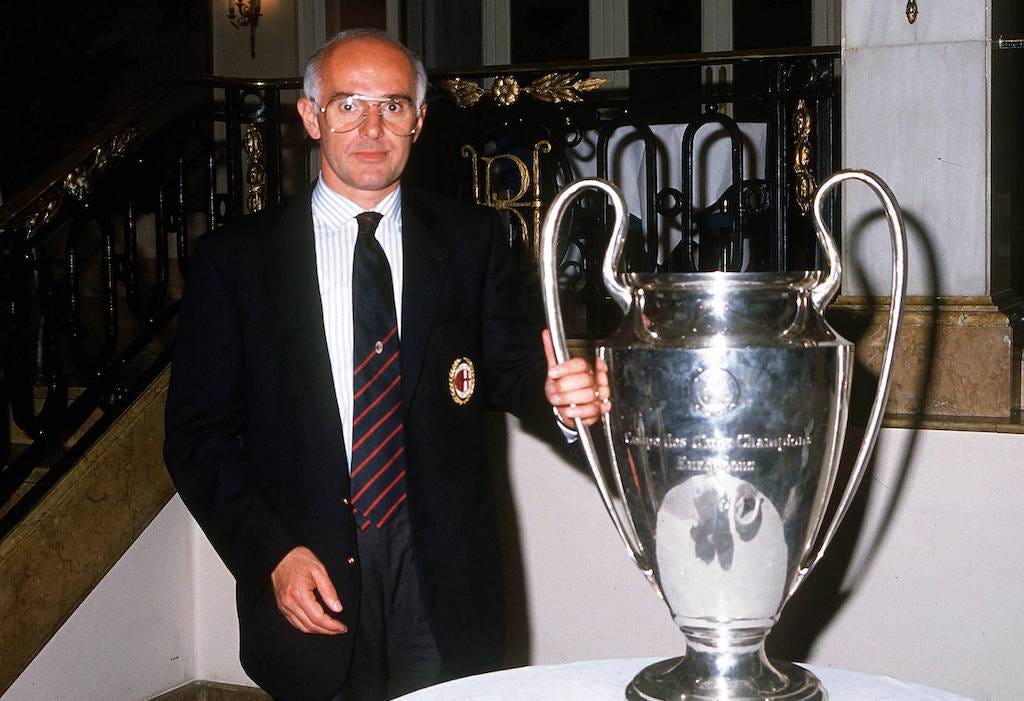
His AC Milan side compressed space relentlessly. Distances between players became almost obsessive concerns. Defenders stepped together. Midfielders shifted together. Pressing became coordinated rather than individual. The team behaved as a single organism.
According to Sacchi, players need to express themselves within the parameters laid out by the manager. The manager has to fill their heads with as many scenarios, tools, movements, as much information as possible. Then the player makes decisions and does so quickly, based on the scenario on the pitch.
He said, “I didn’t want robots or individualists. I want people with the intelligence to understand me, and the spirit to put that intelligence to the service of the team.”
Modern societies often oscillate between two errors. One imagines that freedom emerges in the absence of constraints; the other imagines that order can be imposed through control. Sacchi’s football suggests a third – the highest forms of freedom emerge within intelligently designed structures. Too little structure produces chaos. Too much structure produces rigidity. Excellence requires balance.
Running is for animals. You need a brain and a ball for football. ~ Louis Van Gaal, Footballer & Manager
If Sacchi was football’s system builder, Van Gaal became its engineer. Few coaches have thought more deeply about space. To many observers, football appears to concern the ball, not Van Gaal. Football is concerned with the management of space. The ball revealed where space existed. Long before contemporary analysts began speaking about pitch-control models and influence maps, Van Gaal was teaching players to think spatially. Numerical superiority, positional superiority, and spatial superiority became the foundations of his football philosophy.

Modern analytics increasingly confirm his intuition. Researchers now use tracking data to model the phenomena Van Gaal described decades earlier. Mathematical representations of pitch control frequently validate principles that coaches once understood through experience. Football’s scientific and tactical traditions were beginning to converge. What analysts measured and what coaches sensed often pointed toward the same reality.
The game was not fundamentally about possession; it was about space. Not about passes, but about relationships. Not isolated actions, but systems. At this point, one might imagine that the analytical tradition had triumphed. Football had become measurable, modelable, and increasingly understandable.
Creating something new is the difficult part. To make it, build it, and get everyone to follow? Amazing.~ Pep Guardiola, Manager
The closer football approached scientific certainty, the more it rediscovered human unpredictability. No figure embodies this tension more completely than Guardiola. He is often portrayed as football’s supreme rationalist, an understandable image. His teams appear meticulously organized. Their positional structures are extraordinarily sophisticated, and every movement seems calculated.
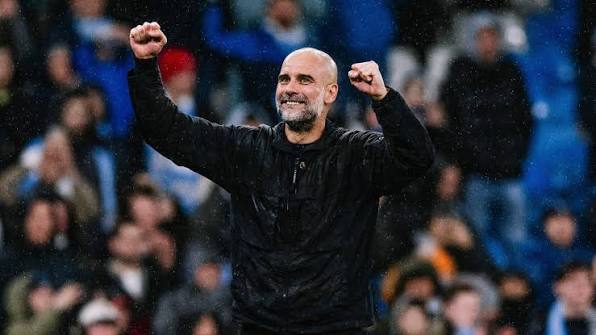
Yet the interpretation misses something essential. Guardiola’s football is not an attempt to eliminate creativity. It is an attempt to manufacture the conditions under which creativity becomes possible. This distinction changes everything. Observers see structure. Guardiola sees freedom. Observers see systems; he sees possibilities. The purpose of positional play is not to create robots. It is to create superior choices. Players positioned correctly encounter more options. More options generate better decisions. Better decisions create moments of invention.
The relationship between science and art is therefore not antagonistic. It is symbiotic.
There is room for all theories, but individual expression on the pitch is something I don’t think we can give up. The brain of one manager can’t compete with the infinite possibilities of eleven thinking brains on the pitch. Ultimately, while the concept of team is very important, you need individuals to go to the next level. ~ Jorge Valdano, Footballer
What Guardiola achieves tactically, Valdano seeks to explain philosophically. The best teams are not those that suppress individuality or celebrate individuality without limits. The best teams achieve something far more difficult. They transform individual talent into collective intelligence.
This is the leadership challenge that Valdano explores in his bestseller, Los 11 Poderes del Líder. He repeatedly returns to qualities that resist easy measurement: trust, credibility, communication, enthusiasm, humility, generosity, and courage. These may sound suspiciously soft to modern management cultures obsessed with metrics and optimization. Yet football repeatedly demonstrates their importance. A dressing room poisoned by mistrust can destroy extraordinary talent, whereas a unified dressing room can elevate ordinary talent. No expected-goals model currently measures belief. No machine-learning system fully captures morale. No tracking camera records trust. Yet coaches and players repeatedly testify that these factors influence performance.
The humanist tradition therefore persists not because it rejects evidence but because it recognizes evidence’s limits. The analyst can identify probabilities. The leader must still inspire people.
The model can estimate outcomes. The team must still perform. The data can describe behaviour. It cannot entirely explain motivation. Consider the philosophies of the various thinkers of the game, and they may appear distinct, almost in conflict with each other. Measurement versus meaning. Science versus art. Numbers versus humanity. But perhaps this framing is mistaken. Football’s history reveals not a conflict, but a partnership.
Reep discovered that football contains patterns. Valdano reminds us that people inhabit those patterns. Lames demonstrates that uncertainty remains. Galeano explains why uncertainty matters. Sacchi builds structures. Guardiola uses structures to create freedom. Each thinker illuminates part of the same reality. Together, they reveal football to be larger than a sport. It becomes a metaphor for modernity itself. Modern societies increasingly face the same question that football does. Can excellence be engineered? Can creativity be systematized? Can leadership be reduced to technique? Can human achievement be fully measured? The temptation to answer yes remains powerful as data grows richer and models grow more sophisticated. Prediction improves, and yet football continues to resist complete reduction.
The World Cup is the most vivid demonstration of this resistance. Every four years, the finest analytical models estimate probabilities. Squads are evaluated. Managers are ranked. Tactical systems are compared. Injury dependencies are assessed. Historical trends are examined.
And then the tournament begins.
A goalkeeper produces the save of his life. A substitute scores an impossible goal. A favourite collapses under pressure. An outsider discovers belief. The models are not disproved. But they are humbled. This distinction is important. Football’s lesson is not that analysis is useless. It is that analysis is incomplete. Knowledge improves probability. It does not abolish uncertainty.
And when uncertainty cannot be eliminated, leadership acquires renewed importance. The leader’s task extends beyond optimizing systems. It is to prepare human beings to confront uncertainty together. Football’s deeper question is whether measurement alone is enough. Its history reveals the answer: no. Beyond tactics, beyond analytics, beyond models and probabilities, football remains a human drama. A contest not merely of skill but of belief. Not merely of systems but of meaning. Not merely of numbers but of souls. And that is why, despite all our technologies, the World Cup fascinates us. It reminds us that human excellence can be studied and improved. It can be predicted, up to a point. But it can never be reduced to numbers alone. And the fate of teams, nations, and civilizations often turns on states of mind as much as on measurable facts.

Check in tomorrow for our next article in the series leading to the FIFA World Cup 2026.
This series is a concise version of a long-format Substack series on the World Cup by JP Santhanam. The Substack post can be read here.
Related Stories: FIFA World Cup 2026





“Football is at its best when data and creativity work together. Numbers can guide the game, but human imagination still makes it beautiful. A thoughtful and engaging read.” ⚽👏