
Samras Panchayt in Gujarat (part 1)-“Aren’t Dalits like chappals? Does anyone carry the chappal on their head?”


As India observes yet another anniversary of the formulation of our Constitution, which is founded on the principals of social justice and equality , writer and journalist KA Beena revisits a grassroots case study on Dalit lives she recorded from the hinterlands of Gujarat . This is part of a series of grassroots case studies that won Beena the prestigious Statesman award for Rural Reporting . The AIDEM presents this case study in two parts . This is part 1.
Jadav Neruben Vikram Singh has immersed herself in the moment. She is soaking up her liberation, however short-lived it might be.

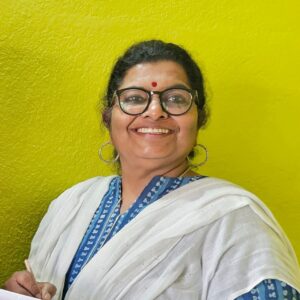
Neruben Vikram Singh
“My daughter-in-law who is far younger than me is still holed up at home. She has to pay obeisance to the ghunghat (akin to a veil). Considering that, the freedom I am enjoying is big deal even if it is for a brief while,” Neruben Patel explained.
“Ghunghat – that is the one-word in shorthand that seeks to define women in most of northern India.
The first thing that Neruben shared with me when I met her was her delight at the freedom 0f shunning the veil while stepping out of her home and spending time with others. The realization that her liberty would not last long has not diluted Neruben’s joy at all.
What she was referencing was nothing but the manifesto that kept many women, especially in northern India, shackled in the country.
It was women’s reservation that gifted the Neruben in this story the chance to meet others without being hemmed in by the veil for the time being.
Neruben is the sarpanch (the village head) of Kanij panchayat, located in Mehdabad block of Gujarat’s Keda district but she is not aware of the power and prestige of the post. Giggling and preoccupied with readjusting the sari pallu that kept slipping off her forehead, Neruben cut a figure of innocence and harbored an attitude that silently conveyed that she did not have any big statements to make.
Her demure visage gave the impression that she was grateful for having achieved at least this much in life. Neruben concludes almost all her sentences with a signature sign-off: “By God’s grace (dev kripa)”. With divine help, the panchayat administration is running its affairs, she repeated several times.
Neruben belongs to the Darbar section, which falls between Brahmins and Dalits in Gujarat. Kanij, which Neruben runs, is an all-woman panchayat, which is not rare in India. In Gujarat, Changa in Anand district and Kanij in Kheda are the all-woman panchayats. But Kanij is also a “consensus (samaras)” panchayat.
“Consensus” panchayats are common in Gujarat and are a ploy to bypass elections. Under this code, no one will contest the polls but the “notable” personalities in the panchayat pick someone they prefer as the panchayat member. Everyone else will stay off the selection process, ensuring that the panchayats follow the age-old custom of prominent citizens deciding who governs the panchayat.
When Neruben had contested for the sarpanch’s post, another candidate was in the field. But the other candidate stepped aside (or was forced to step aside). Several cases have been filed in the Supreme Court against the “samaras” system of forming a panchayat without elections. But the government gives cash rewards as high as Rs 1 lakh to the “consensus” panchayats that sabotages democracy and annuls the electoral process. For such women’s panchayats, the reward goes up to Rs 5 lakh.

Illustration of a Panchayat meeting
Neruben said she has no knowledge about politics. Vice-sarpanch Sharmishtaben Patel, too, is apparently apolitical.
When I had stopped over at a tea shop at the mouth of the road to the village to enquire about the way to the panchayat office, shop owner Ram Dev had asked me: “Are you here to meet the sarpanch?”
My reply in the affirmative was greeted with a derisive smile. The question “what happened” was met with the response, “Madamji, you are on your way there, aren’t you? You can find out yourself,” while he served up mouthwatering condiments. The shop was loaded with khamam, jafda, methi vada, dokla, handu, muthiya and undiya. Helping myself to dhokla, I proceeded towards the panchayat office.
The scenery flaunts paddy fields, cotton plants, vegetable orchards – it’s green and it’s cool. After the rolling fields, the house hove into view. “These are all Dalit areas,” said Saijal, who is with the Ahmedabad-based NGO, SAHR WARU, and who is accompanying me.

The houses appear impressive. Some have been decorated while others have been embellished with drawings. The Kanij panchayat office has a building that appears fairly big. The walls are emblazoned with information about the panchayat. Saijal explained the caste system that prevails in the panchayat where Hindus and Muslims live. The village is mostly populated by shepherds such as Rabaris, Tars and Ravals, barbers like Vavar, fisherfolk like Boyis and priests such as vakharis.
Asked about the panchayat, Neruben called out and the person who stepped in introduced himself: “I am the office employee, H.A. Malik.” When Neruben saw Malik, she covered her head with the pallu of her sari, probably out of habit. “He has been working here as the employee for 40 years. He knows everything. You can ask him,” Neruben said.

Neruban with the Ghunghat (veil)
That was enough to deduce that the panchayat is run by Malik. In his demeanor and attitude, it was writ large that he called the shots there. Adopting a condescending tone, he started to reel out information about the sarpanch.
“The husband is a farmer. Neruben’s father-in-law was sarpanch here from 1983 to 1987. The panchayat has 18 members; three are Dalits and one Adivasi. One Muslim seat used to be there. A Hindu is the member from that seat now. The Muslims stepped aside. The panchayat meets once every month.”
Earlier, the Patels and the Darbars used to quarrel and attack each other. Now, the hostility has subsided. The employee praised the woman sarpanch, pointing out that she has guided the panchayat to the path of peace.
“A borewell has been dug in the village. Pipelines, reinforced concrete roads and markets have also been built. Neruben, who studied till Class VII, has quickly mastered how to administer the panchayat, the clerk testified.
“My husband helps me handle the panchayat affairs,” Neruben chipped in, adding that it is her husband who goes to Ahmedabad to take care of administrative matters that require to be taken up there.
“By God’s grace”, she can read the files that are in Gujarati, sarpanch Neruben said, beaming with pride. Neruben has five siblings. The brothers are well-educated, one is an agriculture officer while the other is a college teacher. But the three sisters, like Neruben, have studied only till Class VII.
The sarpanch said that not much thoughts about women had crossed her mind. But she knows dowry is widely prevalent in the village.
“I and my daughter are sacrificial goats of the dowry system,” Neruben said.
Neha, who was accompanying us, asked the sarpanch about the scarcity of water and electricity at “nagari” where Muslims are living cheek by jowl.
“Nagari? I don’t know whether such a place exists in this panchayat. I have not been there. Isn’t this a big panchayat? Is it possible for me to reach everywhere?” Neruben asked.
Neha explained to Neruben that the place lacked water taps and power connections.
Neruben then launched into a tirade against Muslims. Communal and hateful remarks flowed freely, threatening to spin the situation out of control.
Saijal lost his temper. “Aren’t you the sarpanch? Like a mother, aren’t you supposed to look after everyone in the village? Is it correct to speak like this?”
Neruben ignored Saijal, and fully covered her face with her sari.
“May I take your photo,” I asked. She nodded in agreement.
Photograph snapped, Neruben resumed the conversation.
“Drinking is a big problem,” the sarpanch said, growing vocal about the moonshine-making in the village. She lamented that the illicit liquor, called “deshi potti”, is made mostly by women.
Then she lowered her voice and muttered under her breath: there is male domination everywhere.
The sarpanch does not have a mobile phone; her house has six mobile phones but neither can she gain access to one, nor does she know how to use one. “Why do I need a mobile phone. The husband takes care of the work outside the house. Let him use it.”
She said she can write her name and sign, joyously picking up a paper to demonstrate the two skills.
Asked if she had heard about Kerala, the sarpanch said she did not know about the state. She also did not know about the rest of southern India. I told her about Kerala and the literacy rate among the women in the state, and asked her whether she would consider launching literacy classes for the women in her village.
“No one has time for that. Everyone is tied up in the kitchen,” Neruben said.
What was the best thing she did as a sarpanch? I asked her.
“This Shivrathri, a Dalit woman went to a temple of the upper caste villagers to pray. The upper caste villagers did allow her to enter the temple, kicked up a ruckus and drove her away. I supported them (the upper caste villagers). That night, some people set out to demolish her house. I offered them (the attackers) the necessary support too.”
Shocked, I asked in disbelief: “Aren’t you an elected representative? Is it all right to do such things? Should you say these are good things?”
“What’s wrong with saying so? Aren’t Dalits like chappals? Does anyone carry the chappal on their head? (Dalit toh joota jaisa hain na? Sir mein koyi pehnega?) If the chappal is placed on your head, will you forgive? Then how will God forgive?”
Neruben kept jabbering. Saijal and Neha were retorting in Gujarati. Annoyed, I left the panchayat office and told Saijal: “I want to see that girl.”
“Which girl?”
“The Dalit girl who was not allowed to enter the temple and was driven away.”
“Let us search.”
Part 2 will be published tomorrow.