
“Subtitle is the Only Common Language in Joshy’s Films”

A Conversation between M. S. Banesh and C. R. Parameswaran on the Cinema of Joshy Joseph
Filmmaker Joshy Joseph, known for his hybrid docu-fictions that blur the boundaries between the personal and the political, occupies a rare space in contemporary Indian cinema. His works—introspective, ethically charged, and steeped in moral paradox—bring together autobiography, memory, and social critique in equal measure. In Walking Over the Water, Joshy turns the camera inward, exploring the emotional battlefield of his own marriage against a larger canvas of global unrest and creative alienation.
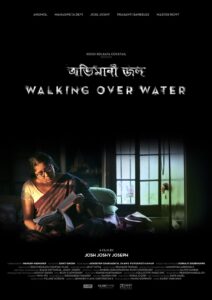
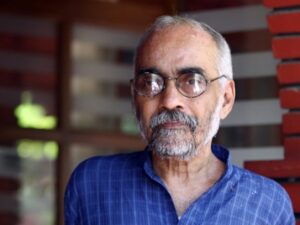
Engaging with this haunting film are novelist and political thinker C. R. Parameswaran and poet-novelist M. S. Banesh—two voices from Kerala’s literary landscape whose works have persistently examined the conflicts between art, ideology, and intimacy. In their dialogue, they peel open the film’s layers of meaning—its metaphors of bridges and distances, its quiet moral storms, and its resonances that reach far beyond one fractured household. What unfolds is not merely a discussion of a movie, but a reflection on the uneasy coexistence of love and art, faith and rebellion, and the silences that subtitling alone cannot bridge.
The Conversation
M. S. Banesh:
The film unfolds in a Bengali household where Joshy Joseph’s Malayali wife, Bency, sees movies as what she calls “sin scrolls.” What was your overall impression of how this theme was handled?
C. R. Parameswaran:
Many of us live carefree, oblivious to the world’s simmering crises. But many others are deeply, fiercely committed to their passions—whatever those might be. It doesn’t have to be film or literature. Sports, politics, science, travel, even accumulating wealth—any of these can become an obsession. Walking Over Water takes as its subject the collision between such a passion and the person you’ve married. In our age, the solitude an artist requires to do the work becomes impossible when a partner’s needs and anxieties enter the frame. It’s worse than ordinary marital discord.
Banesh:
The film uses a powerful double metaphor: Kolkata and the new Howrah Bridge as “parallel lines that never meet” for the marriage, and Vidyasagar Bridge’s “level meeting issue” for the parents’ arguments, as recalled by the director’s son. What do you make of the particular conflicts that surface in creative lives?
Parameswaran:
The film unfolds through the eyes of Ozu (named after the Japanese director). He’s on the cusp of adolescence—the age where you know much more than you let on. His existential crisis operates on a different plane. When Mahasweta Devi asks Ozu about the family’s attitude toward his filmmaker father, he dodges, playing innocent. But later, talking with Prashanti against the backdrop of those bridges, he opens up about the friction between his parents.
Three unusual images caught my attention. First, the “flying scroll” from the Book of Zechariah. Both his parents read from the same Bible, but their takeaways are worlds apart. For the filmmaker father, his work is a calling. For the mother, the film reels that travel from theater to theater are those flying scrolls—vectors of danger and moral annihilation.
The second image: the golden records NASA placed aboard Voyager 1 and 2. Those records carry pictures of Earth and greetings in more than fifty languages, meant for any alien civilization that might stumble across them light-years from now. Ozu thinks his father’s autobiographical film is a message for his mother, who might as well be living light-years away on some different mental plane.
The third: a cup Ozu has saved from being smashed during his parents’ fights. It has the word “Director” printed on it. Prashanti tells him how indigenous technology was used to finally join the Vidyasagar Setu bridges. The image of bridges that refuse to connect becomes a recurring motif, crystallizing the unrest at home.
Banesh:
After seeing the film, you said that creativity can be an “illegitimate affair,” and hinted that many artists’ families are like war fronts. Could you elaborate on that?
Parameswaran:
Some artists manage to balance the demands of their work with the emotional needs of a family. But as Tolstoy observed, every unhappy family is unhappy in its own way. When one spouse lives in the world of art, things get exponentially more complicated. Creativity is hard work. So is marriage. An artist in love with the work will forget vows about love and support and wander off on some wayward path. Meanwhile, a spouse might try to police the creative soul. In that conflict, everything that makes a relationship viable—shared goals, patience, respect—begins to evaporate.
The deceptions multiply. They begin to doubt if their marriage was founded on lust. And the artist’s path is no bed of roses; it’s an inevitable fate. An adult cannot live in amniotic fluid. The Malayalam poet Vailopilly, in his poem Kannerpadam (Field of Tears), described the artist’s heart as a muddied groove. Decades ago, I stumbled upon an award ceremony for a Kannada poet. He said, “The light decorations at the Brindavan Gardens get all the praise, but the power generating that beauty, deep within the Krishna Raja Sagara dam, is a place of cold and darkness.” The crown the artist wears—or that his fans place on him—is often mocked by the partner, just as Baudelaire noted.
The film’s center of gravity is Anumol’s performance as Bency, the director’s wife. She acts at a slow pace. Dialogue is sparse. But she captures brilliantly the simmering sexual jealousy Bency feels toward her husband’s love affair with cinema. In that toxic atmosphere, creativity can’t survive.

Banesh:
Have you noticed the friction between creative and spousal commitments? Is this a necessary tension for art?
Parameswaran:
How could a creative history exist if such friction were a daily, debilitating affair? Examples of passion interfering with family life are everywhere. The splits in Hollywood or Mollywood are rarely about “creative differences” in the pure sense; they’re about fame, narcissism, money, insecurity.
In creative partnerships, mutual support is rare. Tolstoy and his wife had problems, but not over his art. Their rift opened when Tolstoy, in his later years, became obsessed with utopian Christian socialism and decided to give away his possessions. Sofia had tolerated Tolstoy’s sexual chaos early in their marriage. She copied the manuscript of War and Peace seven times by hand. Virginia Woolf, Shelley, Kafka, Sartre, Nabokov—their partners were crucial supports. Nabokov, like Kafka, had no confidence. He would have burned Lolita if not for his wife Vera. Simone de Beauvoir, high priestess of feminism, would even seduce her acolytes and deliver them to Sartre’s bed.
But if you examine the pre-modern era, the artists who stole the limelight were almost always representatives of a patriarchal society. The women in their households were often forgotten. The Overton window shifts in modernity. As avant-garde cinema emerges, along with modernist literature and music, the family conflicts become intense and even show up in the art itself. I think again of Vailopilly’s Field of Tears. As a counterpoint to that collection, there’s Sparrows, then Epochal Change, then Vision, then Savitri—all bearing traces of this tension between commitment to art and everything material it demands you abandon. When Vailopilly writes, “Partner, come closer,” he doesn’t mean his wife. He means his poetry.
Banesh:
The film is trilingual (Malayalam, English, Bengali). Has Joshy Joseph’s distance from Kerala worked to the film’s advantage?
Parameswaran:
There have been plenty of Malayalam films set outside Kerala, but most are superficial. It’s hard to escape the “God’s Own Country” bubble. But Joshy’s films—as the title of one suggests, A Poet, a City, and a Footballer—preserve Kolkata at their core. That’s originality, similar to the way Anand has meditated on Kerala over the past fifty years while being, at the same time, an Indian writer. All of Joshy’s films are trilingual. Subtitles are the only common language.
Banesh:
In the film, the director goes to Mahasweta Devi to complain about his son, who now refuses to watch movies. He even attempts suicide, thinking his son has sided with his mother. With the director playing himself, how do you see his effort to voice his concerns through a figure like Mahasweta Devi?
Parameswaran:
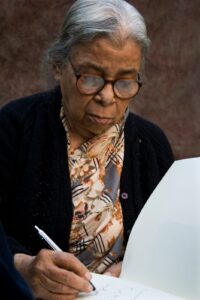
Bency believes fictional movies are a sin, which may reflect a deeper conflict. Ozu sides with his mother not because her concerns are logical, but because he doesn’t want her to feel left out. The filmmaker, whose voice we only hear, is so passionately in love with his art and so desperate to bring his family into his creative process that his frustration boils over into suicide. He asks Mahasweta Devi, whom he calls the “mother of fiction,” to intervene—to make his family understand his medium. Yet this symbol of revolutionary creativity fails in this small, domestic mission. She, who experienced creative and marital conflict firsthand—her two marriages to progressive, creative men both ended—can only watch with a sympathetic, but ultimately nonchalant, air.
Banesh:
Though cinema is his first love, the film also develops through the wife’s perspective. He never condescends to her or even implies she’s wrong. Autobiographical filmmakers tend toward self-aggrandizement. Isn’t it hard to escape that trap?
Parameswaran:
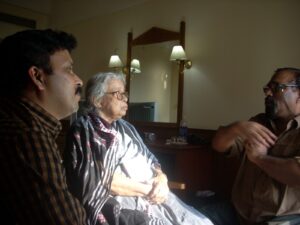
Joshy’s docu-fictions dare to tread uncharted territory. He is willing to break open his own heart to bare the truth. In One Day from a Hangman’s Life, Joshy includes scenes where he and other media people circle the executioner, amplifying his trauma. The hangman tries to push him away, and Joshy leaves it in, even though it reflects poorly on himself.
A Poet, a City, and a Footballer documents the poet and film figure Gautam Sen, who never received his due. Sen’s existential crisis, despite being in the fourth stage of cancer, is about finishing a documentary on the footballer P. K. Banerjee. Joshy films Sen’s last reflections on poetry, philosophy, his revolutionary past, and the incomplete documentary. More than the ethical dilemma of training a camera on a dying man, what concerns Joshy is the question of what would be lost if he didn’t document it.
So, even if his wife hates his first love—movies—with every fiber of her being, Joshy never shows her in a poor light. Compromise, patience, and mutual respect are the foundations of marriage, but they are violated when an artist loves his films more than his spouse. This movie is a meditation on that helplessness, never an act of self-aggrandizement. He can’t help but see the crisis through his wife’s eyes as well.
Banesh:
The film opens with an announcement of the Pope praying for flood-devastated Kerala. That same Pope later appears blessing Donald Trump at his inauguration, followed by Mahasweta Devi’s long, loaded silence. As the Pope and Trump exchange pleasantries, Joshy says in Bengali what M. N. Vijayan once said in Malayalam: “No point in reciting poetry where you’re supposed to swear.” The wife, who doesn’t understand Bengali, asks someone over the phone what Joshy just said. The director echoes James Baldwin, who said, “America is not God’s gift to humanity. If it is, its days are numbered.” When Americans protested the police killing of George Floyd, Trump sent cops to attack the protesters, then posed with a Bible in front of St. John’s Episcopal Church—an image widely condemned. Is this film a family story told against the backdrop of the world at large?
Parameswaran:
Joshy tells this story of creative conflict on a global canvas. Without that context, the film would risk being a hyperbolic family drama. In all his films, we move through raw, exhausting visuals of cities, waterways, roads before arriving at the universe of Bency or Gautam Sen or any of his characters. In our small worlds, the larger world unfolds—unedited, uninterrupted, cacophonous. That’s what Joshy’s films remind us. The personal narrative gets interrupted by streams of larger thought. In his cinematic universe, unjoined bridges appear, wide seas, the Pope, Trump, flying scrolls, the Voyager spacecraft carrying golden records to preserve Earth’s story in case of nuclear annihilation, M. N. Vijayan, and Mahasweta Devi—they all enter the frame. I think these images nourish the central premise and give it weight. That said, as a person who perceives literature in all things, I feel a deeper analysis is a task best left to film students and serious critics.