



Have you ever paused while pulling a note from your wallet to wonder why Mahatma Gandhi smiles back at you from every single denomination? For most Indians, his face is a constant companion, tucked into wedding envelopes, passed over shop counters, tucked away inside temple donation boxes or handed out as pocket money. This bespectacled smile is so familiar that we rarely pause to consider how it came to be there, what it signifies, or why it has never been replaced.
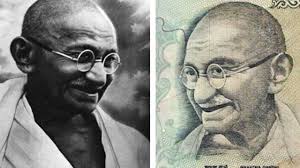
For a child growing up in India, the first encounter with Gandhi often comes not through textbooks or history lessons, but through money. Long before one reads Hind Swaraj or hears the stories of Champaran and Dandi, Gandhi greets us in the crumpled ten-rupee note handed over at the local kirana store. For countless families, the notes passed down as weekly pocket money carry not just economic value, but a quiet introduction to the nation’s most enduring face. The smile is not one of exuberant laughter, it is gentle, restrained, perhaps even knowing. It seems to say that this currency is more than paper, it carries the promise of a country.
Currency in India has long been a medium that reflects both value and authority. Before coins and notes, trade was conducted through barter, with goods exchanged directly between parties. As societies expanded, the need for a more standardized medium of exchange became inevitable. India gradually adopted metal coins made of gold, silver, and copper, which facilitated easier transactions while also representing the ruler’s authority and the region’s wealth. Over time, however, the limitations of metal coins, their bulkiness, storage challenges, and the difficulty of transporting large sums, led to the introduction of paper currency. Under British rule, private banks initially issued banknotes, but the landscape changed significantly in 1935. The establishment of the Reserve Bank of India centralized this authority, making it the sole issuer of currency. The shift from metal to paper marked a decisive step in the evolution of India’s financial system, bringing greater convenience, standardization, and security to trade and commerce.
After Independence in 1947, India faced an urgent symbolic task, removing colonial imagery from its currency and replacing it with symbols of sovereignty. The portrait of King George VI was replaced by the Ashoka Lion Capital at Sarnath, India’s national emblem. Banknotes began to feature cultural and architectural landmarks such as the Konark Sun Temple, the Brihadeeswara Temple, and the Gateway of India, celebrating the country’s civilizational depth and diversity.
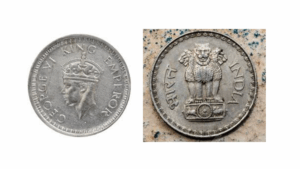
Yet, the RBI soon noticed a limitation. Inanimate symbols, while culturally rich, were easier to forge than human faces. This practical concern, combined with the desire for a unifying national image, gradually paved the way for the inclusion of Mahatma Gandhi on Indian currency.
Gandhi first appeared on Indian banknotes in 1969, marking the centenary of his birth. The one-rupee note featured a standing Gandhi, while other denominations showed him seated against the backdrop of Sevagram Ashram, an image that emphasized simplicity, service, and moral discipline. This series, known as the Mahatma Gandhi Centenary Series, was a commemorative beginning rather than a permanent decision. A decisive shift came in 1987, when a smiling Gandhi appeared on the ₹500 note.
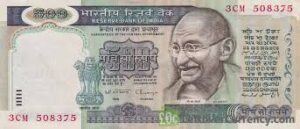
The portrait was based on a 1946 photograph taken outside Rashtrapati Bhavan and captured an approachable, almost intimate expression. By 1996, the RBI introduced the “Mahatma Gandhi Series,” replacing earlier designs and establishing Gandhi as the permanent face across all denominations. The choice was neither accidental nor merely emotional. Human faces are significantly harder to forge than monuments or patterns, making them more secure for currency design. More importantly, Gandhi embodied qualities that transcended political contestation: integrity, simplicity, moral authority, and an unparalleled role in India’s freedom struggle. He was widely regarded as the one leader who rose above regional, linguistic, caste, and religious divisions, an ideal figure for something as universal and intimate as money.
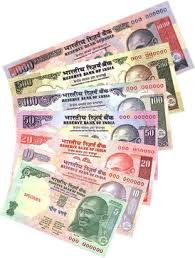
Consider the contexts in which Gandhi’s face appears every day. A farmer sells produce in a mandi and counts a stack of notes. A bride’s parents carefully tuck crisp hundreds into envelopes for wedding rituals. A beggar at a traffic signal receives a crumpled ten. A priest arranges donation notes before placing them at a deity’s feet. In each of these transactions, sacred and profane, intimate and public, Gandhi is present, silently observing and silently smiling. This ubiquity grants Gandhi a unique intimacy in Indian life. Unlike statues, which can be ignored, vandalized, or removed, currency passes endlessly from hand to hand. Whether admired or resented, Gandhi is unavoidable. One cannot transact in India without touching him. This physical proximity creates a psychological link between the citizen and the state’s values.
Despite his iconic status, Gandhi’s exclusive presence on Indian banknotes has not been free from controversy. In 2015, a Public Interest Litigation filed in the Allahabad High Court sought his removal, the court dismissed it as frivolous. In 2017, another petition in the Calcutta High Court proposed replacing Gandhi with Netaji Subhas Chandra Bose, this too was rejected. In 2022, freedom fighter Haren Bagchi Biswas urged the inclusion of Netaji’s portrait alongside Gandhi’s, but the plea met the same fate. Beyond courtrooms, debates have surfaced on social media and in political discussions. Suggestions have ranged from Dr. B. R. Ambedkar and Rabindranath Tagore to A. P. J. Abdul Kalam. Periodically, rumours circulate that the RBI plans to redesign currency and remove Gandhi’s image. Each time, the RBI has clarified that Gandhi’s presence is neither temporary nor accidental, but the result of a considered institutional decision rooted in national consensus. The Reserve Bank of India has remained unequivocal. Gandhi, it argues, is the most inclusive symbol of the Indian nation, one who embodies truth, non-violence, and moral authority. His image transcends caste, region, language, and religion, offering a unifying reference point in a deeply diverse society. Having appeared on banknotes continuously since 1969, Gandhi has become a visual anchor of India’s post-Independence identity.
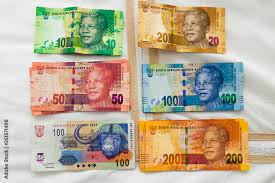
India’s choice is not unique in the global landscape. Across the world, currency serves as a canvas of national identity. The United States features its founding fathers and presidents, George Washington, Abraham Lincoln, Benjamin Franklin. The United Kingdom places the monarch on its notes, symbolizing the continuity of the Crown. South Africa offers a particularly striking parallel. Once adorned with images of the “Big Five” wild animals, its currency was redesigned in 2012 to feature Nelson Mandela on every denomination. Like Gandhi, Mandela represents reconciliation, struggle, and moral authority. Japan highlights educators and cultural icons, Canada honours former prime ministers, and each choice reflects a nation’s history as well as its aspirations. Seen in this global context, India’s decision to feature Gandhi reveals how the country sees itself. Rather than projecting military might or royal lineage, India chose moral leadership. Gandhi represents not only the past, but a set of values, truth, simplicity, non-violence, that the nation continues to aspire toward.
Gandhi’s portrait on currency is more than an image, it is a message. It suggests that wealth must be anchored in values, not merely numbers. It signals integrity in an era frequently scarred by corruption scandals. It binds a vast and diverse population under one familiar face, one restrained smile, one moral reference point. Even during moments of disruption, such as the 2016 demonetization, Gandhi’s presence remained constant. As new ₹500 and ₹2,000 notes entered circulation, millions handled Gandhi’s image anew. Social media filled with photographs of crisp notes, selfies with Gandhi in the background, and observations that his smile seemed unchanged despite the economic turbulence.
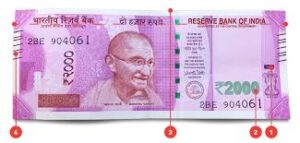
These moments revealed that Gandhi’s presence on currency is not static, it interacts with lived experience, shaping perceptions of trust, continuity, and authority. The durability of the image reflects the durability of the ideas he stood for, serving as a reminder of the foundational principles of the Republic.
Mahatma Gandhi’s portrait on Indian currency is far more than a decorative feature. First introduced in 1969 during his birth centenary, his image, evolving from a standing figure to the now-familiar smiling portrait, has become a permanent fixture across denominations. Courts have repeatedly dismissed petitions seeking his removal, and the RBI has consistently affirmed his symbolic permanence. Gandhi’s presence on money is not an accident of history but a conscious national choice, rooted in unity, security, and symbolism. Every time a note is spent, whether on a grand purchase or a humble cup of chai, Gandhi’s smile travels with it. To remove him now would be more than a design change. It would represent a rupture in continuity, an erasure of a long national conversation, and the removal of a face that has come to embody India’s moral imagination.
Whether celebrated or contested, revered or criticized, Gandhi remains the one figure this nation cannot avoid. And perhaps that is the truest measure of his legacy: long after statues fade and anniversaries pass, Gandhi still smiles from our wallets, reminding us of a republic that continues to seek truth, justice, and unity. This enduring presence ensures that even in the most mundane acts of commerce, the spirit of the Mahatma remains woven into the very fabric of Indian life.
Gandhi’s evergreen face and the contentions with introducing any change would thus not just be an aesthetic or merely symbolic decision. It would force the nation to confront its present symbols of morality and unity, and ask us to confront our present, with 77 years as a Republic, has India managed to produce another such symbol? Does Independent India have a face or a symbol to replace the responsibility endowed upon Gandhi’s face?









What a beginning . The AIDEM should translate this article into all languages . Thank you Aidem for this series
Looking forward to all the articles