We are accustomed to the image of Mohandas Gandhi as a man of formidable silence, a stoic figure in homespun white, whose life was a series of rigorous fasts and grave political confrontations. He is considered the philosophical figure of history, a man defined by grit and gravel. It is almost impossible for the modern mind to imagine him cradling a violin in a London flat or humming a Scottish tune to keep his spirits afloat. Yet, to perceive Gandhi without his music is to see a portrait in black and white when the original was in full, melodic color.
The realization of a “Sonic Gandhi”, the man who sought rhythm as much as he sought righteousness, dawned upon me after listening to an informative talk by Dr. Teresa Joseph of Alphonsa College, Pala during the solitary days of the 2021 Corona pandemic. Her insights opened a window into Gandhi who was not just a political strategist but an artist, by heart and led me to explore how Gandhi viewed music not as a luxury, but as his very source of an inspirational living.
It was in the year 1924, when an interviewer commented that he was under the impression that Gandhi was against all art including music, Gandhi exclaimed: “I, against music!” He is also reported to have stated that “if there was no music and no laughter in me, I would have died of this crushing burden of work.”
In his autobiography, Gandhi recounts a phase of his life that was almost comical in its meticulous vanity. During his student days in London, he was consumed by the desire to “merge” with the local community by becoming an “English Gentleman.” He invested three pounds, a significant sum at that time, in a violin and paid for a series of music and dance lessons and believed that to be a success in the West, he needed to master its social rhythms.
However, Gandhi soon faced a profound internal conflict. Despite paying the full fees and acquiring the instrument, he confessed that he “could not enjoy it.” He felt he was chasing a shadow. This realization led to a sudden “awakening.” He realized that his true “music” lay elsewhere, far from the polished wood of a Western instrument. As scholar Anthony Parel has observed, a comprehensive understanding of Gandhi is impossible without situating his meticulous engagement with the arts within his broader political framework. Gandhi’s aesthetics were not intended to flourish in the “palace garden of a few,” rather, they were cultivated for the Sarvodaya, the universal uplift of the masses.
He fundamentally rejected the decadent insulation of the “art for art’s sake” movement. In a 1945 letter to K.M. Munshi argued that if the objective of art were merely to be “interesting,” then even the most grotesque violence or profound untruths could claim artistic merit. Instead, Gandhi championed a functionalist view of beauty. He famously explained to the musician Dilip Kumar Roy that “an art is to be valued only when it ennobles life… Art is acceptable to me only to the extent that it tends to the welfare of the people at large.”
His philosophical stance was forged through a rigorous study of Leo Tolstoy’s What is Art? and John Ruskin’s Unto This Last.
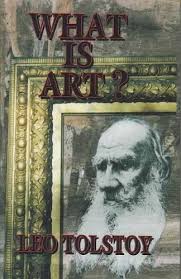
Leo Tolstoy’s book “What is Art”
Tolstoy, whom Gandhi held in high esteem, posited that the primary function of art is the communication of emotion to foster human unity, if art failed to be comprehensible to the common man, it failed in its moral duty. Gandhi resonated so profoundly with this democratization of beauty that he meticulously translated Tolstoy’s treatise into Gujarati, ensuring that the “Common Good” of artistic expression was accessible to the Indian vernacular heart. To Gandhi, created beauty was only legitimate when it acted as a conduit for “uncreated beauty,”which he identified as Truth.
Gandhi was aggrieved by this exclusionary nature of music. He envisioned a process of “democratization of Music,” where melody served as a bridge rather than a barrier. In his 1936 address to the Gujarat Literature Society, he made a definitive choice. He favored the simple Bhajan over Sanskrit chants, as he believed that while Sanskrit was the language of the learned, the bhajan was the language of the millions.
Gandhi considered the entire educational system incomplete without music. Speaking at the Second Gujarat Educational Conference in 1917, he mourned, “Nowhere do I find a place given to music… It exercises a powerful influence over us… Music must get a place in our efforts at popular awakening.”
Upon establishing the Sabarmati Ashram in 1915, one of Gandhi’s first institutional priorities was the appointment of a resident music teacher – Pandit Narayan Moreshwar Khare, a distinguished disciple of Paluskar. Under Gandhi’s guidance, music was integrated into the very fabric of daily life in the Ashram life. By 1922, Pandit Khare and Gandhi meticulously compiled approximately 250 devotional songs from diverse linguistic traditions into the Ashram Bhajanvali. This collection became the spiritual backbone of the morning and evening prayers at the ashram. While the Bhajanvali was initially Hindu-oriented, it remained a living, pluralistic document. Responding to the living pulse of the community, Gandhi included Shabads from the Guru Granth Sahib at the suggestion of the Sikh community, as well as hymns from Christianity, Islam, and the verses of Guru Nanak and Kabir.
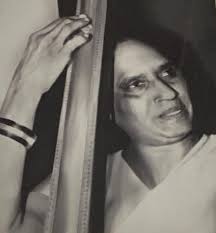
Pandit Narayan Moreshwar Khare
During his imprisonment in Yerwada Jail in 1930, Gandhi’s commitment to these songs deepened as he translated them into English. This ‘labor of love’ was later adapted by John S. Hoyland and published in 1934 by George Allen and Unwin under the evocative title Songs from Prison. At the heart of Gandhi’s daily prayer meetings were two specific favorites that served as his moral compass – Narsinh Mehta’s Vaishnava Janato Tene Kahiye Je and Tulsidas’ Raghupati Raghav Rajaram.
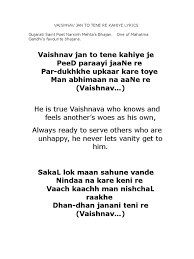
Translated excerpt from “Vaishnava Janato Tene Kahiye Je”
The fifteenth-century hymn ‘Vaishnava Janato’ held a special place in Gandhi’s heart, primarily due to Narsinh Mehta’s revolutionary disregard for the prejudices against “untouchables” during the Bhakti movement. For Gandhi, the song was not just a prayer but a checklist of ethical conduct, defining a true devotee as one who feels the suffering of others as their own. However, it was the Raghupati Raghav Rajaram, popularly known as the Ramdhun, that became the rhythmic pulse of the freedom struggle. As historian Vinay Lal observes, the “Ram Ram” greeting was already woven into the folk fabric of North India. When Pandit Paluskar set a repetitive, meditative tune to the traditional verses of Tulsidas, Gandhi found the result deeply appealing.
The most transformative moment for this hymn occurred in the fires of 1947. While many attribute the inclusion of the words “Ishwar Allah Tero Naam” to Gandhi himself, Rajmohan Gandhi clarifies that the Mahatma was likely the propagator rather than the author. In the midst of the Noakhali riots, it was his grand-niece Manu Gandhi who sang this universalizing couplet at a prayer meeting. Recognizing its potential for communal healing, Gandhi insisted that Manu sing it every day henceforth.
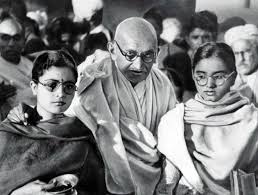
Manu Gandhi (extreme right)
By equating Ishwar and Allah, Gandhi turned the bhajan into a manifesto for Hindu-Muslim unity. Despite his prayer meetings being boycotted by extremists, he refused to stop the practice, calling it his “lifeline.” He clarified that his “Rama” was the eternal, unborn God who belonged equally to all. According to Lakshmi Subramanian, the Ramdhun served a dual purpose: it was both a spiritual invocation and a strategic tool used to calm volatile crowds, orienting them toward a discourse of non-violence and mutual respect.
For Gandhi, the true essence of music was its ability to uplift, he firmly asserted that in genuine melody, there was “no place for communal differences and hostility.” Yet, the 1920s and 30s saw music transformed into a visceral political weapon. Gandhi’s response to these “sonic riots” provides a window into his meticulous balancing of religious identity and national unity. Between 1923 and 1928, India was scarred by 112 communal riots, nearly a third of which were ignited by Hindu processions playing music outside mosques during prayer. While Hindus claimed the “right” to play music as an essential religious observance, Muslims argued for the “right” to silence during communion with God.
Gandhi’s intervention was startlingly direct. In a 1921 speech, he stripped the practice of its religious necessity, stating “Hindus may take it from me that it is no part, no essential part, of Hinduism that we should play music at any time… passing by a mosque.” He advocated for a “Unity of Hearts” over a “Unity of Laws,” suggesting that true religion lay in the voluntary sacrifice of one’s rights to avoid hurting a neighbor. He wrote in Young India in 1921 that if unity was the goal, each community must be prepared to perform an “adequate measure of sacrifice.”
After a while, a similar tension surrounded Bankim Chandra Chatterjee’s Vande Mataram. Initially, Gandhi viewed the song purely as a secular “hymn to the glory of the motherland,” often ending his letters with the phrase. However, as the 1930s wore on, the song’s Hindu cultural imagery began to alienate the Muslim community. Gandhi’s meticulous pragmatism eventually took precedence over his personal affinity for the song. By 1939, he lamented the “evil days” that had turned a battle-cry against imperialism into a source of sectarian friction. His instruction was absolute. He said, “I would not risk a single quarrel over singing Vandemataram at a mixed gathering.” He believed that if even one person in a crowd felt excluded or pained by the melody, the music should be dropped in favor of peace. Gandhi’s intervention suggests that the moral weight of any anthem is lost the moment it becomes a tool of coercion. By prioritizing the “sacrifice of the ego” for communal peace, Gandhi’s approach argues that the health of a democracy is measured not by the loudness of its anthems, but by the sensitivity of its silences.
In the 1940s, Gandhi’s prayer meetings became a site of dual resistance. Extremists from both sides boycotted his sessions, some objecting to the Ramdhun and others to readings from the Koran. Yet, Gandhi refused to compromise. He defended the invocation of Ram as a reference to the “all-pervasive God,” not a sectarian figure. He argued that his nightly reading of the Koran alongside the Bhagavad Gita was a necessary sonic bridge. To Gandhi, the harmony of a pluralistic society required more than just the absence of noise, it required the active, courageous synthesis of diverse sacred sounds.
The year 1933 marked a significant expansion in Gandhi’s musical horizon. While in London for the Second Round Table Conference, he eschewed luxury to stay at the Kingsley Hall Community Centre. There, he engaged deeply with the local culture, even famously dancing to the Scottish tune “Auld Lang Syne.” When fellow representatives expressed reservations about such “frivolity,” Gandhi’s retort was meticulously pragmatic. He argued that the essence of leadership was to “connect with the people,” and music was his primary bridge.
Immediately following the conference, Gandhi visited the Nobel laureate Romain Rolland in Switzerland. Their discussions on art were profound. Gandhi specifically requested Rolland to play a piece by Beethoven on the piano. This encounter transformed his view of Western classical music. While he had confessed in 1932 that he “used to get bored when listening to European music,” he later found deep resonance in it, describing Beethoven’s music as “good spiritual food.”
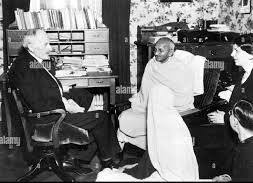
Nobel laureate Romain Rolland and Mahatama Gandhi
Gandhi often discussed music as a regulatory discipline. He believed that “even as pranayama is necessary for the regulation of breath, so is music for disciplining the voice.” This culminated in the “music of the spinning wheel.” The charkha was his rhythmic solution for social inequality, a tool that “murmurs sweetly that we are all one.” In his final, loneliest days, Tagore’s “Ekla Chalo Re” became his constant refrain. As he walked the “blood-lined tracks” of Noakhali, the song’s call to “ignite thy own heart” when others fail to answer provided his ultimate spiritual sustenance.
However, a startling tension emerged in Gandhi’s philosophy during the final year of his life. In May 1947, amidst the encroaching shadows of Partition, Gandhi made a statement that appeared to contradict a lifetime of musical advocacy. He declared that if he were Prime Minister, he would “prohibit music and dancing which tend to pervert the minds of young men and women” and would actively stop the sale of gramophone records. To the modern reader, this sounds like a puritanical reversal. Yet, when viewed through the lens of his earlier aesthetic philosophy, the logic becomes clear. Gandhi was not attacking music itself, but its commodification.
Mahatma Gandhi’s engagement with music was a rigorous extension of his philosophy of Satya. He repositioned music as the “pranayama” of a healthy democracy, a regulatory force that brought order to chaos. From his early violin lessons in London to the “music of the spinning wheel.” Gandhi sought to make his entire life “sweet and musical like a song.”
His journey proves that true Swaraj or self-rule cannot be achieved through noise and discord. He died as he lived, showing that a life attuned to the rhythm of peace and the welfare of the “common man” resonates far beyond the silence of history. In today’s polarized world, Gandhi’s “Sonic Satyagraha” remains a vital reminder that the strings of the heart must be in tune before a nation can truly sing in unison.