

Travelling through the Pages of ‘Suitcases, Sandcastles, and Little Anvi’

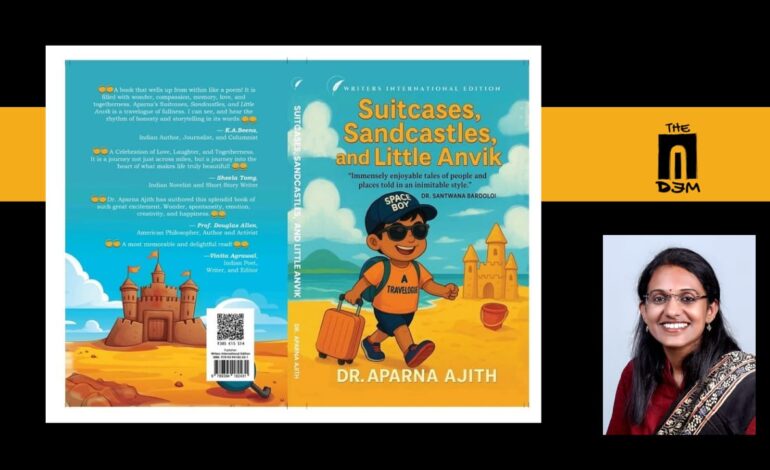
The birth of a child marks the beginning of a mother as well. A new journey of life begins here. A mother’s aspirations and aims gradually shift toward the life of her darling baby held close to her. The child becomes the focus of her journeys. In this process, the mother often finds her own life taking a quieter, supporting role. The journey with a baby companion can feel more precious and meaningful than any trips enjoyed before. In the warmth of these moments, a mother experiences the world anew through her child. Suitcases, Sandcastles, and Little Anvik, published by Writers International Edition, is a book that captures the travel stories of one such mother and her adorable baby, Kunjapp, also known as Anvik Sujeeth.
Every journey recounted in this travelogue is engaging and relatable, much like the inviting title. As the veteran Malayalam writer M.T. Vasudevan Nair once said, “The readability of work makes it a great one.” This quality is certainly evident in Dr. Aparna Ajith’s travelogue. These are real-life journeys that reveal both the outer world and the inner experiences of a mother and child. This transformation defines the course and nature of the book. Yes, it metamorphoses into a true travelogue. The detailing unfolds in two forms — journeys both inward and outward — and that duality becomes the forte of this travelogue.
Aparna’s writing style, unfurled in the travelogue, affirms the dictum, “Discover the world, discover yourself”. From the spring of the mother’s womb to the moments spent exploring new places with little Anvik, the book follows a family embracing the world around them. With Sujeeth also joining the travels, they visit places such as Kanyakumari, Kodaikanal, Kolkata, and beyond. By the age of four, Kunjapp had already experienced Goa, Chennai, Bengaluru, Kodaikanal, Hyderabad, the Andaman Islands, Kolkata, and more. Aparna’s narrative has the effect of making readers feel as though they are traveling alongside little Anvik, holding his tiny hand.
“Some journeys in life are not all about the destinations for me. They are purely for marking milestones, slicing memories, and weaving a medley of firsts that the three of us will look back on forever. Our flight to Goa, taken when Kunjapp was just 0.8 years old (eight months), was one such journey. It was not just a trip but a gentle leap into the unknown, hand in hand with my little one.” The charm of Aparna’s writing also shines through here: “This was not a mere trip for both of us. It was my first flight as a mother, and Kunjapp’s first flight as a tiny human just beginning to discover the world. We were Goa-bound, hearts full of astonishment.”
I am elated to say that the very sensation of “full of astonishment” is the overwhelming emotion of Aparna’s book. Aparna presents travel as a way to appreciate life, teaching her child early lessons about curiosity and exploration. This is not only a travelogue but also an exquisite documentation of little Anvik’s childhood days. The words of the American modernist poet Wallace Stevens — “The most beautiful thing in the world is the world itself” — echo in the gestures of a mother and father here. The travelogue also captures Kunjapp’s early birthdays and milestones, making it both a record of adventures and a chronicle of childhood.
In Aparna’s narrative, readers are reminded that the essence of travel is not just in the destination. Even with a tiny child, she writes thoughtfully about the landscapes they encounter, reflecting on their beauty and the meanings we bring to them. Even then, she realises that, as Nicolas Helmbacher wrote, “The mountain offers us the scenery. It’s up to us to invent the story that goes with it.” Aparna elegantly writes about how to reflect the aesthetics and mysteries of nature in one’s life: “Nature, like a mountain, grants us a beautiful, raw, and silent landscape. It presents a setting, but does not tell us what it means or how to feel about it. That part is up to us. As human beings, we bring meaning, emotion, memory, and imagination to the experience. We may turn a mountain into a backdrop to a family memory.”
True travellers flow like a river. Every trip renews and refreshes them. The history and course of the world are led, directed, and rewritten by those who are on the move. Movement is the law of nature, and change is all the more natural. Man’s mind and body are aptly framed for this act. Whatever history is known and taught to us has been created by man who has travelled across the earth from the African continent. A life without journeying grows stagnant — like still water that soon turns foul. This is why, in the Aitareya Brāhmaṇa, Indra counsels Rohita: “Rohita, those who do not travel find no true joy. To remain rooted in one place, even among the virtuous, leads to decay. In such comfort, even the noblest of men may slip into sin. Therefore, travel. The feet of a traveller are like blossoms; where they tread, life blooms. His soul expands, and the trials he endures on the road cleanse him of all sin. So, go forth.”
Aparna, too, echoes this sentiment in her writing, affirming that the road, though hard, is a sacred teacher. In movement, we shed the dust of complacency; in every step forward, we reclaim wonder, growth, and inner clarity. “Each moment, like a seed, fosters the surety of becoming something extraordinary through the tunes, travels, and times well spent. What bestows it with the touch of unforgettable happening is not just the event itself, but the meaning it holds in the hearth of emotion, the brilliance of colour, and the warmth of connection it brings into our lives.” These words substantiate her feelings.

Every place a traveller visits can feel like a dream spot. A writer’s real skill lies in drawing readers into such experiences through the power of words, and Aparna does this with ease. Travelogues can reflect the self of the writer, and this book is rich with that: thoughtful observations, well-presented ideas, and careful attention to detail. What makes it even more special is Aparna’s ability to write simply yet warmly. While not every travel writer may possess grand talents, the genuine love and sharing in this book give it its true charm, making it unique and memorable.
Aparna tells her stories with sincerity and ease, inviting readers to travel along with her. From the debut story, where Kunjapp appears as a fluttering butterfly, to the last, where little Anvik learns to catch fish with his father and sleep in a tree hut, the book traces his growth and experiences. The words of Augustine of Hippo—“The world is a book, and those who don’t travel read only one page of it”—seem fitting here, as Aparna and Sujeeth give their son many pages from the book of life, encouraging him to embrace its experiences.
True travellers make time for journeys, even amidst busy routines. Aparna is a dear friend, though younger in age, and her curiosity, love for reading, passion for writing, childlike nature, and eloquence shine through this work. Her travelogue reflects all these qualities: it is full of warmth, memory, love, and togetherness. Suitcases, Sandcastles, and Little Anvik is a thoughtful, heartwarming travelogue, inviting readers to share in the small wonders of life.
I wish Aparna and her Suitcases, Sandcastles, and Little Anvik all the best. The travelogue offers readers a gentle glimpse into the journeys of a mother and her child, capturing moments of love, curiosity, and connection.