

When Women Rise Against “Loot Meters”: The Unravelling ‘Power Play ‘ in UP

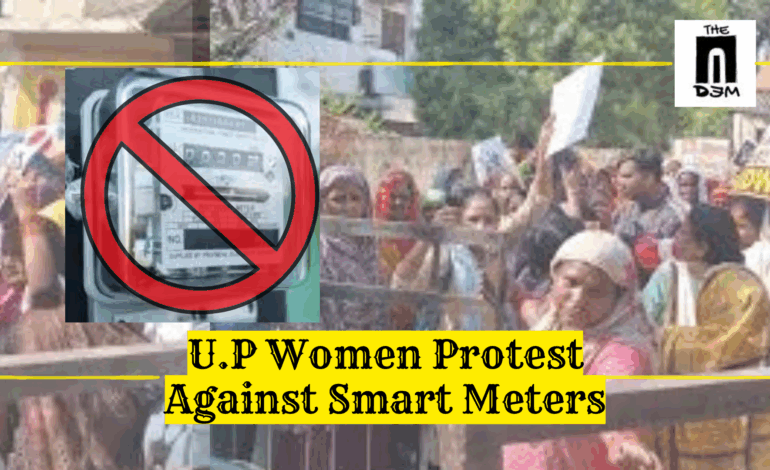
A new axis of resistance is taking shape in Uttar Pradesh, and it is being led, unmistakably and unapologetically, by women. Across towns and districts, women who have long been confined to managing the invisible economics of household survival are now stepping into the public sphere, confronting state officials, and challenging a coercive technological regime. Their collective defiance against prepaid smart electricity meters marks the emergence of a new women-led political energy that refuses to be sidelined, silenced, or systemically exploited.
What is unfolding across Uttar Pradesh today is much more than a mere protest against technological upgrade—it is a grassroots rebellion against a system that has repeatedly treated citizens as captive consumers rather than rights-bearing participants. The eruption of demonstrations, led overwhelmingly by women, against prepaid smart electricity meters exposes a deeper crisis: one of coercion, opacity, and institutional arrogance embedded within the state’s power distribution machinery.
Across districts, from Lucknow to Aligarh, Jalaun to Firozabad—women have stepped out in large numbers, surrounding electricity offices, confronting officials, and in some instances, physically removing newly installed meters from their homes. What triggered this wave of anger is not simply the introduction of smart meters, but the manner in which they were imposed—often “bina pooche,” without consent, consultation, or clarity.
A “Reform” Without Consent

Destroyed smart meters
The Uttar Pradesh Power Corporation Limited (UPPCL) has aggressively pushed prepaid smart meters under the Union government’s Revamped Distribution Sector Scheme (RDSS), aiming to replace crores of conventional meters. In theory, this shift promises efficiency, transparency, and reduced losses. In practice, it has meant unilateral installations, confusing billing systems, and a technological regime that places the burden of risk squarely on consumers.
Residents across the state have reported that their existing postpaid meters functioning without issue—were forcibly replaced. This is despite the Union Power Ministry clarifying that prepaid meters are not mandatory and cannot be imposed on consumers without consent. The contradiction between policy and practice has laid bare a familiar pattern: administrative overreach backed by bureaucratic impunity.
The Limits of a Strong-Arm State
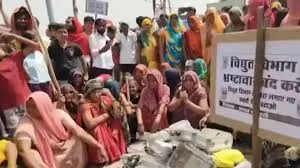
Scenes from the Protest
For nearly a decade, the governance model under Yogi Adityanath has been defined by a visibly centralised and often heavy-handed administrative style—one that privileges speed, spectacle, and control over consultation. Whether in matters of law and order, urban clearances, or bureaucratic enforcement, the state has relied on top-down directives backed by coercive authority, frequently sidestepping dialogue with those most affected.
This approach has, in many instances, created an image of efficiency and decisiveness. But the smart meter rollout reveals its structural limits. Unlike policing or demolition drives, where resistance can be contained through force, the everyday nature of electricity consumption makes coercion far more difficult to sustain. When the site of conflict shifts from public spaces to individual households, and when those most affected are women managing daily survival, the state’s conventional playbook begins to falter.
The attempt to push prepaid meters through administrative pressure—ignoring consent, dismissing complaints, and initially downplaying protests—reflects this entrenched mindset. Yet, the widespread backlash has forced the government into an unfamiliar position: retreat. The pause on implementation is not merely a policy adjustment; it is a sign that a governance model built on unilateralism is struggling to negotiate with a socially rooted, decentralised resistance.
From Billing Shock to Digital Disempowerment
The most immediate flashpoint has been the sudden spike in electricity bills. Households that once paid modest monthly amounts found themselves staring at inflated charges running into several thousands. For working-class and lower-middle-class families, this is an existential shock.
Compounding this are technical failures: malfunctioning apps, inaccurate consumption data, and unexplained deductions. Consumers report being unable to track usage or balance, effectively turning a supposedly “smart” system into an opaque black box.
Even more alarming is the automated disconnection mechanism. With prepaid meters, electricity supply is cut the moment the balance dips below zero—often without adequate warning. In several cases, even consumers with positive balances have faced sudden outages due to technical glitches.
A History of Faulty Infrastructure and Withheld Data
This crisis did not emerge overnight. The smart meter rollout in Uttar Pradesh has been dogged by persistent allegations of technical flaws and lack of transparency. As early as 2024–25, central agencies flagged serious deficiencies in the system—ranging from incorrect power factor readings to clock errors and faulty installation practices.
More tellingly, distribution companies failed to share crucial performance data from “check meters” that were meant to independently verify the accuracy of smart meters. This withholding of data raises uncomfortable questions: if the system is reliable, why the opacity? And if it is not, why the haste in scaling it up?
The state’s own acknowledgment of the problem came when it announced plans to replace over 11 lakh faulty smart meters, effectively admitting that the infrastructure underpinning the reform is deeply flawed.
Women at the Frontlines of Resistance
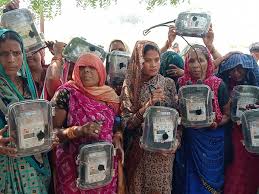
Women posing with the uprooted smart meters
What distinguishes this moment is the character of the resistance. Women—often the primary managers of household budgets—have emerged as the most vocal and visible opponents of the prepaid regime. Their protests are not merely reactive; they are rooted in a sharp understanding of how the new system destabilises everyday life.
From chasing away officials to blockading substations, these actions signal a refusal to accept a model that converts electricity—a basic necessity—into a prepaid commodity subject to instant disconnection.
This is not just about electricity. It is about dignity, predictability, and the right to live without the constant threat of being plunged into darkness because of a failed recharge or a faulty app.
“Reform” or Revenue Extraction?
The official narrative frames prepaid smart meters as a win-win—reducing theft, improving billing efficiency, and eliminating disputes. But on the ground, the experience tells a different story: one where the risks of technological failure, billing errors, and financial strain are transferred entirely onto consumers.
The term “loot meters,” increasingly used by protesters, may sound hyperbolic—but it captures a widely felt perception that the system is designed less for service delivery and more for aggressive revenue extraction.
The Pause That Speaks Volumes
Faced with mounting protests and public outrage, the Government of Uttar Pradesh has been forced to pause the rollout and initiate a review. This retreat, however temporary, is an implicit admission that the policy has outpaced both infrastructure readiness and public consent.
But pauses are not solutions. Unless there is a fundamental rethinking grounded in transparency, accountability, and consumer rights—the underlying conflict will persist.
What Uttar Pradesh is witnessing today is a familiar story in a new technological guise: reforms imposed from above, justified in the language of efficiency, but experienced on the ground as coercion. The women on the streets are not resisting technology; they are resisting a system that refuses to listen.
And in that resistance lies a powerful reminder: no “smart” solution can succeed if it is built on the exclusion of the very people it claims to serve.










“A sharp and compelling analysis that exposes the deeper power dynamics behind everyday exploitation. The piece powerfully highlights how women’s resistance is challenging entrenched systems and redefining the discourse on justice and accountability in U.P.”