
Day 6: The Future is Not Fixed, But It Could Do With Some Fixing


What happens when what started on the “fringe” takes centrestage?
It becomes a global celebration of everything art. For 78 years, the cobblestones of the Edinburgh Festival Fringe have witnessed the move of the margin to the mainstream. …And this year, it will also give volume to the 50 curated climate narratives that refuse to stay silent.
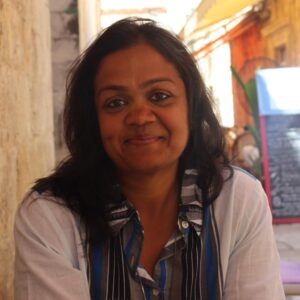
Storyteller and Arts Enthusiast Himali Kothari reports from Edinburgh.
Day 6: The first time I heard of Climate Change Theatre Action (CCTA) was in 2019, when Nikhil Katara and I put together a show featuring some of its 2019 playlist, under the Readings in the Shed initiative founded by Katara.
The CCTA concept connected with me immediately. Stories have always been my go-to place to escape from whatever else I should have been doing at the time. In the pages of my books, in the white spaces between the lines, I found solutions—or at least resonance—for whatever was swirling around in my headspace. The association with CCTA extended over the years, when the founder and the wind beneath its wings, Chantal Bilodeau, invited me to write plays for the 2021 and 2023 editions.
In its ten years of existence, CCTA has built a collection of almost 250 plays. Over time, it has evolved into a collaboration between the Arts and Climate Initiative and the Centre for Sustainable Practice in the Arts. Both organisations are driven by the pursuit of environmental balance, social equity, and a sustainable future—and by the belief in the role of the arts in achieving the same.

But the way forward is mired in a paucity of funds and support. A round table discussion between CCTA playwrights present at the Fringe, along with some who have produced and presented the plays in their communities, throws up ideas that will hopefully help pave the way forward.
In the meantime, here is an obligation-free call to action:
- Click on the following link – Get Involved – Climate Change Theatre Action
- Download the guidelines for hosting a CCTA event.
- Email ccta@artsandclimate.org for access to the plays. That’s it—just an email!
- Read the plays, choose the ones you like, and present them.
- You could be a theatre company, a school drama club, a reading group, aspiring environmentalists—anyone can GET INVOLVED.

Time to Bring Our A-Game
Playwright Zoë Svendsen credits the genesis of her play Love Out of the Ruins to multiple conversations with collaborators, which made her realise that there is no one-size-fits-all utopia. Instead, there is an ecosystem of utopias where potentialities complement and conflict.
Through her play, Svendsen suggests,
“The crucial work now is to create, imagine, build, and make—in full knowledge that we don’t, can’t, and won’t know ‘what works’ before we start, or even as we are making this attempt. I hope you will find, as we have, that imagining otherwise can offer a refuge from the ruins of the present—bearing witness to the fact it doesn’t have to be like this.”
In the other play today, Not Because We’re Good, playwright Chris Thorpe suggests that change is not necessarily borne out of inspiration or desire for the majority, but because most of us found it the easiest path to take. This lyrical text explores the idea that if the problems facing us got solved, what would it say about our role in the solution?
For Thorpe, theatre is the place we go to examine our habitual ways of thinking—ways that are usually invisible to us in daily life—and take new angles on them.
“Theatre is a good place to make visible and analyse our frameworks for reacting to the unfolding crisis, and ask if they could be a different shape—one that’s more useful not just to us as individuals, but to everyone,” he says.
When Theatre Meets Gameplay
Today’s presenter of the plays is an unusual one—Urbane Arcane Games. Some Google-digging reveals that Urbane Arcane is a role-playing games hosting company. They combine digital tools and expert game mastering with a passion for dynamic and impromptu storytelling to create adventures for players. The difference today is that the game will be viewed by an audience. I am keen to see how it will play out.
The game is hosted and manoeuvred by the game master—essayed today by Caitlin. She is flanked by two teams of three. The players take turns to roll the dice and carry out the moves as per their characters. The game master introduces the rules and their implications as the game progresses. The theme and text from both CCTA plays are woven into the concept of the game and the narrative by the game master.
A few audience members are probably role-playing gamers and don’t take long to grasp the different players’ strategies behind the moves. The banter between the gamers and their spontaneous reactions to the ups and downs add to the drama. It takes me a while to get a hang of the goings-on, but once I do, I am sufficiently hooked. Though I am not convinced about the relevance of this genre for a large audience, the novelty is intriguing.
As the game draws to an end, the game master’s words bring together the purpose of the game and the intent of both plays:
“Ashes are not the end. They are what remains when the fire passes through. And in these ashes, if we are brave enough to look, we might find solutions.”