As India observes yet another anniversary of the formulation of our Constitution, which is founded on the principals of social justice and equality , writer and journalist KA Beena revisits a grassroots case study on Dalit lives she recorded from the hinterlands of Gujarat. This is part of a series of grassroots case studies that won Beena the prestigious Statesman award for Rural Reporting . The AIDEM presents this case study in two parts . This is part 2.
I was emphatic: “I have to go.”
A few moments earlier, Saijal had dialled someone. Then, he told me: “We need to walk quite a bit till the next village. Should we go?”
That’s when I insisted that we should proceed.
We took the innumerable bylanes that crisscrossed the place. Small houses lined the bylanes; some of the houses had fetching facades, and pictures were drawn on the walls.
“These are Dalit areas. They have their own temples. Tradition demands that they pray at only these temples. This girl flouted that tradition, which is what infuriated the sarpanch,” Saijal explained.
By and by, we reached Rohit Vas village, and scouted around for some time in search of Padma, the panchayat member. Eventually, we found Padma at her relative’s, where she had gone to help out with household chores.
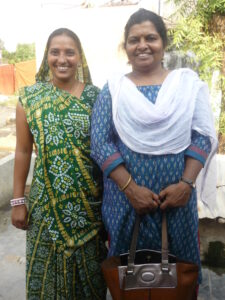
Padma (left) with KA Beena (right)
Padma turned grim when we said we wanted to meet the Dalit girl who was attacked for entering the temple in Kanij village where upper caste villagers pray. The girl’s name is Anita, Padma told. A meeting is scheduled to take place at a house next to that of Anita at noon. Padma appeared to be extremely nervous when she mentioned the name “Anita” and she dodged questions about the sarpanch. But Padma finished her work fast and accompanied us.
Throughout the way, I asked Anita about how she became the panchayat member and her life. But she avoided the questions, confining herself to the stock reply, “everything is fine”. Once Padma took us close to Anita’s house, the panchayat member said: “I won’t be going there.” Padma rushed off, telling us that Anita would also go to the meeting and we can go along with Anita.
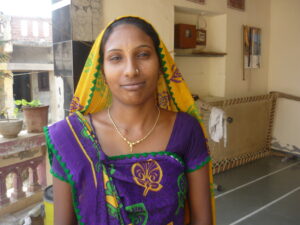
Anita
A compact house, kept clean and decorated in a pleasing manner. Wearing the sari north Indian-style and pulling the pallu over her head, Anita is ready to proceed to the meeting.
Anita is bubbly and pleasant, breaking into laughter every now and then. Her husband Kewal is a day labourer. Anita had studied till Class X in Ahmedabad. She moved to Rohit Vas after Kewal married her and, hence, was not familiar with the ways of the village.
“When I felt that I should go to the temple on Shivratri, I had gone. I did not expect such a turmoil. When they (the upper caste people) came here to attack my house, not a single Dalit resident of this village stood by me. All were berating me for going to the temple. The panchayat member Padma who accompanied you is also a Dalit. In spite of that, she kept quiet when I was humiliated and driven out of the temple. The question I faced was ‘why did you go and foment the problem?’. Everyone is scared. No one helped me. When the house was vandalised at night, only my husband and I were there to confront them.
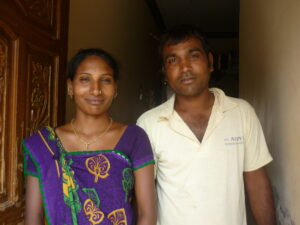
Anita and her husband Kewal
“It is hard to live here as Dalits. Dalits cannot have their hair cut in this village. The barber won’t do that. Dalits go out of the village to have a haircut. When Dalits travel by train, they are pushed out and killed routinely. Life is hell here. All these will have to change. Didi, you wait and see, it will change. Those who vandalised my house will come before me and apologise to me. Time will bring them before me. Didi, you should come here to witness that,” Anita said.
Anita’s husband Kewal has thrown his full weight behind her. But Kewal is sad that they are alone in this fight.
With Anita, we proceeded to the nearby house where the meeting is being held. All along the way, Anita kept talking about the shortcomings of the panchayat administration.
“What is going on here is dynastic rule. This is what happens when people become sarpanch in the guise of ‘consensus’ and by avoiding elections. See, how sewage is spilling and flowing here? The drainage water from the upper caste clusters is diverted towards where the Dalits live. The panchayat administration governs as it pleases, splurging money and building all facilities in their own areas. The Dalits are not given anything. They will bring people when the Gramsabha meets and ensures majority. Road, water and electricity — these are only for the upper caste residents. Are we not humans?”
Anita kept asking such questions. I kept listening, unable to give her the answers.
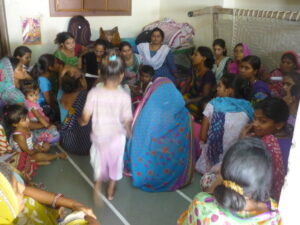
A gathering of women at the village
Several women have packed themselves into the drawing room of the house where the meeting is scheduled to be held. Among them is Padma, who said an attempt is being made to form a group to resolve the problems in the village.
At the meeting, everyone spoke in one voice: “The very first thing we have to ensure is to stop the diversion of the drainage water to our areas. We must stand together for facilities for the village, such as building roads and ensuring potable water.”
Towards the end, they asked me whether I can address them. In my rudimentary Hindi, I told them about our Kudumbasree, which was greeted by a flood of questions.
Then, I explained in detail, following which the women assured me that they would on their own try out what they heard. I told them about the literacy movement in Kerala, in particular about women’s literacy. I also apprised them of the dividends they stand to reap if they spend at least an hour everyday on learning the alphabets. Their eyes shone with curiosity and fascination. Everyone said they wished to learn to read and write.
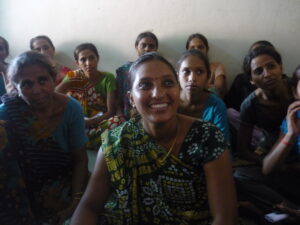
“Who will teach us?” one person asked.
I looked at Anita.
“Anita, did you not study till Class X? Can’t you teach them?”
Anita’s interest has been stoked.
“I am ready. Whoever wishes so can be taught.”
Padma’s face turned pale.
“Padma, can you make arrangements for them to study for an hour daily?”
Padma nodded in agreement.
The owner of the house where the meeting was held agreed to host the classes there. A frisson of excitement coursed through the whole gathering. Some exclaimed that even learning to sign would be a big thing. Dreams began to take wings right in front of my eyes.
Exploiting the infectious atmosphere, I wangled an assurance from them: everyone should stand by Anita.
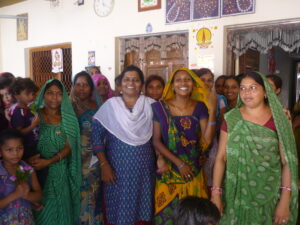 KA Beena with the Women’s group
When they chorused that Anita won’t be left to fend for herself, Anita’s eyes welled up.
“Didi, you brought relief and peace for me.”
Can she see me off while I wait for the bus to Ahmedabad? Anita asked me.
“Of course, I will be delighted. We can talk more also.”
Anita kept chattering all the way, especially about the dilemma and doubts that assailed her when she had to decide whether to leave Ahmedabad and settle down in this village.
When the bus started to move, Anita waved and signed off with affection: “Come again.”
Read Part 1 here- https://theaidem.com/samras-panchayt-in-gujarat-part-1-arent-dalits-like-chappals-does-anyone-carry-the-chappal-on-their-head/