From Cold War Defiance to Transactional Diplomacy: Four Prime Ministers and the Shifting Story of India – U.S. Relations


India’s relationship with the United States has never followed a straight line. It has zigzagged through distrust and defiance, tactical alignment and strategic partnership, shaped as much by global upheavals as by the temperaments of the leaders in New Delhi and Washington. Seen through the tenures of four Indian prime ministers — Indira Gandhi, Atal Bihari Vajpayee, Manmohan Singh, and Narendra Modi—the relationship reveals a larger story: of power, leverage, restraint, and the limits of friendship between unequal partners.
Indira Gandhi: Standing Alone in a Divided World
When Indira Gandhi returned to power in 1971 with an overwhelming electoral mandate, her political authority at home was unquestionable. Internationally, however, she was navigating one of the most unforgiving moments of the Cold War.
The Pakistani military’s crackdown in East Pakistan unleashed a humanitarian catastrophe. Millions of refugees streamed into India, straining its economy and testing its patience. Reports of mass killings and systematic violence left little doubt that the crisis would not resolve itself diplomatically.
While opposition parties demanded military intervention, Gandhi played a longer game. The monsoon delayed any immediate offensive, but it also gave her time to redraw the geopolitical chessboard. In August 1971, India signed a landmark friendship treaty with the Soviet Union—an insurance policy against American intervention.
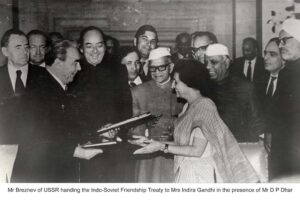
Her subsequent tour of Western capitals yielded sympathy but little support. In Washington, President Richard Nixon’s administration remained firmly pro-Pakistan. Warnings were issued. Lines were drawn. Gandhi’s reported response—that India viewed the U.S. as a friend, not a, master—captured her governing philosophy.
When war finally came in December-71, it unfolded swiftly. The U.S. sent the USS Enterprise into the Bay of Bengal; the Soviets countered with their own fleet. The superpowers stared each other down leading to a stalemate. Pakistan surrendered. Bangladesh emerged as a new nation.
But the victory carried a sobering lesson for India: nuclear power dictated global hierarchies. With an adversary like China already nuclear-armed, India could no longer rely on moral standing, alone. Its 1974 Indian nuclear test invited American-led, India-specific sanctions and decades of technological isolation by the Nuclear Suppliers’ Group (NSG). India learnt to survive the boycott and built the bomb with its own efforts.
Atal Bihari Vajpayee: Nuclear Confidence in a New World
By the time Atal Bihari Vajpayee became prime minister in 1998, the Cold War was over, and the global order was in flux. India was liberalising, markets were opening, and China was rising fast.
Vajpayee’s decision to conduct nuclear tests that year was unapologetic. Sanctions followed, but they landed in a world very different from the one Indira Gandhi had faced. India was no longer peripheral; it was a market too large to ignore.
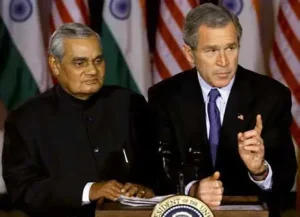
Then came September 11, 2001. Vajpayee’s swift declaration of solidarity with the United States signalled a new pragmatism. Counterterrorism cooperation deepened. Strategic dialogues began (Next Steps in Strategic Partnership (NSSP). The two countries spoke of partnership, even as old nuclear restrictions remained unchanged.
Vajpayee’s era did not resolve the nuclear question—but it softened the ground. India was no longer an outsider knocking at the door; it was a necessary participant in a changing global balance.
Manmohan Singh: Quiet Persistence and Strategic Maturity
Manmohan Singh approached the United States not with rhetoric, but with resolve. Where others saw risk, he saw an opportunity to permanently alter India’s international standing.
The civilian nuclear agreement he pursued was politically explosive. Critics accused him of surrendering sovereignty. Allies abandoned his government. Even within his own party, dissent simmered. Singh responded not with theatrics, but with persistence.
After years of negotiation, the 2008 nuclear deal did more than end India’s isolation—it tacitly recognised India as a legitimate nuclear power. The lifting of Nuclear Suppliers Group (NSG) restrictions unlocked energy security and marked India’s arrival as a trusted global actor in Nuclear energy.
That same year tested Singh’s instincts again. The Mumbai terror attacks by Pakistan, ignited public fury and demands for retaliation. Singh resisted. Instead, he built a meticulous international case against Pakistan, shifting global opinion without firing a shot.
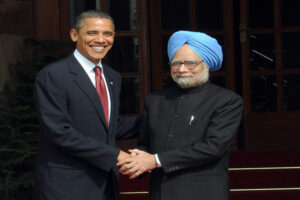
His restraint paid dividends. President Barack Obama’s open acknowledgment of Pakistan’s responsibility for terrorism—and his unambiguous statements on Indian soil—signalled a fundamental shift in American posture. For perhaps the first time, Washington was no longer pretending to stand equidistant between Delhi and Islamabad.
Singh’s legacy was not spectacle, but substance: a belief that power could be exercised through patience, credibility, and global consensus.
Narendra Modi: Visibility, Volatility, and the New Uncertainty
Narendra Modi brought a radically different style to foreign policy—personalised, performative, and unapologetically visible. His embrace of mass rallies, leader-centric diplomacy, and direct engagement with American politics marked a departure from past restraint.
His overt support for Donald Trump was emblematic of this shift. When Trump lost and Joe Biden took office, the relationship endured. But Trump’s return altered the equation dramatically.
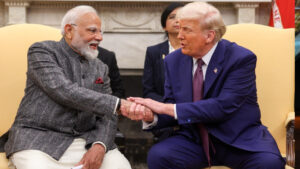
The 2025 terrorist attack in Pahalgam and India’s retaliatory strikes were a familiar script. What followed was not. Trump’s public claim that he had “stopped” the conflict—without condemning Pakistan—revived an old discomfort: the U.S. once again viewing India and Pakistan through the same lens.
Trade tensions soon followed. Punitive tariffs on Indian textile exports against the import of Russian crude oil, hit export hubs hard, making Indian goods uncompetitive in global market. Exporters found themselves paying the price for geopolitical theatrics far beyond their control.
For many in India, the moment felt like regression. The clarity achieved during the Manmohan Singh years appeared blurred. Strategic partnership seemed increasingly transactional—defined less by shared values than by leverage and pressure.
An Uneven Friendship
Over five decades, India–U.S. relations have evolved from suspicion to cooperation, from isolation to engagement. Yet the story is not one of linear progress. It is a reminder that power asymmetries persist, and that partnerships are only as stable as the interests that sustain them.
India has learnt to stand alone, to negotiate patiently, and to assert itself when required. The challenge now is to rediscover strategic balance—without mistaking visibility for influence, or proximity for parity.
History suggests that India’s strongest moments with the United States have come not from accommodation, but from clarity. Whether that lesson is being learnt remains an open question.