On Mahatma Gandhi’s death anniversary, All Indians Matter kicks off a two-part series that sheds light on what happened in the run-up to the assassination, the immediate aftermath of it and the days that followed.
A few years ago, an artist from Kerala, Tom Vattakuzhy, presented me with his painting titled ‘Death of Gandhi’. He has depicted the scene of Bapu’s (Mahatma Gandhi’s) murder as if he was an eyewitness on that fateful evening in Delhi.
January 30 and 31, 1948, Birla House
The last years of Bapu’s life and in particular his last stay in Delhi was well documented by photographers and journalists, but no one captured the moment he was shot.
French photographer Henri Cartier-Bresson stayed at Birla House and extensively photographed the last six months of Bapu’s life. In his pursuit of getting unusually framed photographs, he would choose unique spots and angles. This would distract Bapu, so, on January 30, since two very important meetings were scheduled before the evening prayers (one with Sardar Vallabhbhai Patel and another with Pandit Jawaharlal Nehru), Bapu requested Cartier-Bresson to stay away from Birla House.

Henry was photographing the opening of the fruit and vegetable market at Paharganj where, as agreed upon in the Peace Pledge signed by various parties to end Bapu’s last fast for communal harmony, Muslim traders were going to be handed back their looted shops from where they had been driven away. While Cartier-Bresson was taking photographs, he heard of another attempt on Bapu’s life and rushed to Birla House. That afternoon and the next day, Henry took some iconic photographs of the aftermath of Bapu’s murder and the funeral.
When Birla House was acquired by the government and turned into the ‘Gandhi Smriti’ memorial, Cartier-Bresson gifted a selection of his photographs taken on January 30 and 31 as large, sepia-toned enlargements. They were prominently displayed with very evocative captions in the gallery at Birla House.

Sometime after 2014, these enlargements were removed, replaced by large TV screens on which photographs flashed meaninglessly like screensavers without the captions. If you do not stand and look at the entire slideshow, you are likely to miss most of it.
One of the most iconic photographs was that of Nehru standing halfway up the gate of Birla House, illuminated by the lamps, delivering his iconic speech: “The light has gone out of our lives…” It met with the same fate. Now a large portrait of VD Savarkar, an accused in the Gandhi murder case, adorns the VIP waiting room at Gandhi Smriti!
The other internationally renowned photographer, Margaret Bourke White of ‘Life’ magazine, had also extensively photographed Bapu during his last stay at Birla House. But she too was away on January 30 in what is now Uttarakhand, photographing Meera Ben at her ashram.
On the evening of January 30, 1948, there were no photographs of the murder. And so Vattakuzhy’s painting, an imaginary rendition of Bapu’s death, is the only graphic image of the heinous act.
I am proud to have the original, which was presented to me by the artist, although I have heard that he has painted more versions of it. When my book ‘Let’s Kill Gandhi!’ was reprinted in the early 2020s, I used this painting as the cover illustration.

Bapu was murdered at 17 minutes past 5 pm on the rear lawns of Birla House, as he walked towards his seat at his daily evening prayers. The shooter was Nathuram Vinayak Godse a radicalised Savarkarite, Chitpavan Brahmin of Pune. While a very loud campaign of lies has been unleashed by the Rashtriya Swayamsevak Sangh (RSS) to justify Godse’s actions and to demonise Bapu, one must keep stating the facts. Especially when unsubstantiated stories about his murder are being floated.
Defying Death
At the time of Bapu’s fasts in prison, the British administration used to prepare for his demise. This was when he fasted in Yeravada Prison in Pune in the 1930s on the issue of equality for the Harijans and then again at the time of the Poona Pact with Babasaheb Ambedkar. The colonial administration had issued orders as to how his last rites were to be performed and stocked wood for his cremation in the prison premises. Bapu did not oblige them.
At Yeravada, when he had to be operated on for the removal of his appendix, the administration dithered till the situation became potentially fatal. The prison authorities were ordered to get Bapu to sign a statement absolving jail authorities and the administration from blame in case he did not survive the operation. Only after that was the operation conducted at Poona’s Sassoon Hospital.
Once again, Bapu recovered and the arrangements made for his hurried cremation came to naught.
In 1942, while being held at the Aga Khan Palace detention camp, on two occasions Bapu almost died. Once during a 21-day fast and again when he had multiple bouts of malaria and acute dysentery. At that time, apart from making arrangements for his funeral in the compound of the palace and even stocking double the required quantity of wood, the administration and the Foreign Office of the British Government sent out detailed instructions to all British diplomatic missions on how to publicly condole his death.
Dr. Sarvapalli Radhakrishnan was visiting Chunking in China at the time. While visiting the British Consul there, he saw the circular signed by Foreign Secretary Anthony Eden which stated: “In case of Gandhi’s demise, do not diminish his moral stature, acknowledge his uncompromising allegiance to unworldly ideals, express regret that his unrivalled influence was not at the service of the Allied Nations, especially China and India.” This was classic British diplomatic speak. On both these occasions, Bapu did not oblige the British by passing away.

On February 22, 1944, when Kasturba passed away at the Aga Khan Palace, part of the wood stocked for Bapu’s cremation was used to cremate her.
Later that year, upon his release, when the car carrying Bapu out of the palace passed the gate, he gazed upon the unused pile of wood with a wry smile. He would survive four more unsuccessful attempts on his life by fanatics, followers of Savarkar and cadres of the Hindu Mahasabha and the RSS.
Accounts from the Kapur Commission of Inquiry
There are mentions of intelligence reports about conspiracies hatched to murder Bapu in the findings of the Kapur Commission.
One of them is about the Alwar conspiracy.
Pannalal Chaube, an informer, had alerted the colonial police about a meeting in Alwar, a princely state in Rajasthan, attended by princes of five princely states – Alwar, Gwalior, Bharatpur, Kota and Baroda – and Savarkar and the RSS’ MS Golwalkar. Chaube claimed that a plan had been hatched to instigate a nationwide ‘uprising’ to topple the Congress government and establish a ruling council of these princes with Savarkar and Golwalkar becoming the margdarshaks. The Manusmriti, said Chaube, was to be adopted as the Constitution of this Hindu Rashtra. This was after the Interim Government had been sworn in.
The signal for the ‘uprising’ was to be Gandhi’s murder. Chaube said the task had been entrusted to Godse, who was present at the meeting. Initially, guns were provided from the armoury of the Alwar ruler. Godse and other accused Narayan Apte, Vishnu Karkare and Madanlal Pahwa were trained in the use of small arms and explosives in Alwar and then in Gwalior. Chaube said the king of Gwalior had funded the Godse-Apte gang and the gun with which Godse finally murdered Bapu was procured from Jagdish Prasad Goel, a trader of illicit weapons in Gwalior. The gun’s last known owner was the serving aide-de-camp of the king of Gwalior.
The Divan of Alwar, Dr NB Khare, a radical member of the Hindu Mahasabha, had on several occasions called for Gandhi’s killing. He proclaimed a “Brahmin’s curse” on Gandhi and implored Hindus to give Gandhi a death akin to the “killing of crows and dogs”, to chop him up and feed him to carrion eaters.
One of the strangest incidents reported to the Kapur Commission was that a handbill printed in Amritsar was distributed in Alwar at noon on January 30, 1948, announcing the slaying of Gandhi and imploring citizens to rejoice. Bapu was murdered only at 5.17 pm that day in Delhi!
Bakshiram’s Warning
Bakshiram, a petty thief lodged in the Central Jail in Agra, claimed to be an associate of Bhagat Singh and Batukeshwar Datt. Senior Superintendent of Police (Agra) GK Handoo had arrested him but had also won his trust.
On January 23, 1948, Bakshiram went on a hunger strike, insisting on meeting Handoo and claiming he had vital information. When Handoo met him, Bakshiram said Gandhi would soon be murdered. He asked Handoo whether it was true that Pahwa had been arrested for exploding a bomb at Gandhi’s prayer meeting on January 20. He claimed that Pahwa, who hailed from his home district of Montgomery in Punjab, had hired him to train seven “Maratthas” in the use of small arms and explosives. The training took place in Gwalior sometime in early December.
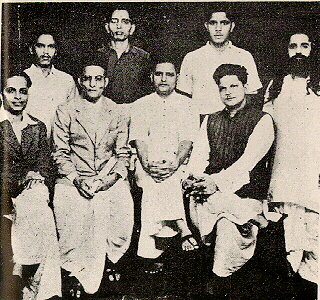
Bakshiram told Handoo that the men never used their real names to address each other and each one had a designated military rank, such as naik, subedar, jamadar, etc.
In one of the recorded failed attempts on Gandhi’s life, an attack at Sevagram as he left to confer with Jinnah, LG Thatte, the leader of the group, had pointed to Godse and told the arresting police official that “when the time comes to deal with Gandhi, our jamadar, would deal with him”.
On January 30, Godse finally dealt with Gandhi.
Bakshiram had pointed out the identity of the murderer to a senior police officer a few days before Gandhi was murdered. The officer had conveyed the information to his seniors immediately.
This article was also published on All India Matters.