

Annals Of Democracy- The Right to Know

In the early 2000, a thirty-one-storey apartment tower rose along the seafront in Colaba, the old colonial quarter of Mumbai that has always belonged to the well-heeled. The building had begun life with government approval as a modest six-storey residential block, built on army land, nominally intended to house the families of soldiers killed in war. Somewhere between the approved blueprints and the finished structure, that purpose had been quietly discarded. Politicians, military officers, and civil servants had instead allocated its flats to themselves. When the arrangement was eventually exposed, five former chief ministers, opposition leaders, senior army generals, and foreign service officials were implicated. The sitting Chief Minister of Maharashtra was forced to resign.
The scandal—which became known as the Adarsh Housing Society case—was one of several that erupted in India in the first decade of this century, the 2G spectrum allocation, the Commonwealth Games contracts, the Vedanta University land deal to name a few. What connected them, in nearly every instance, was a single piece of legislation: the Right to Information Act. Under its provisions, any Indian citizen could file a request at a government office, pay a fee of ten rupees and compel the state to open its files.
This law was not drafted by eminent jurists or powerful politicians. It was thought through, slowly and with great difficulty, out of the specific grievance of some of the poorest people in India and by three individuals who had chosen, against all reasonable advice, to go and live among them.
The amount at stake when the struggle began, in 1987, was eleven rupees.
THE HUT AT DEVDUNGRI
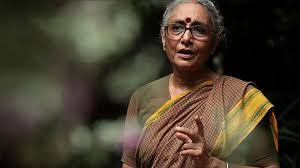
Aruna Roy
Aruna Roy was born in Madras in 1946, the daughter of a Union government employee in Delhi. She was educated across several institutions—schools in Delhi, Kalakshetra in Chennai, the Aurobindo ashram school in Pondicherry, Bharatiya Vidya Bhavan—before reading English literature at Indraprastha College, Delhi University. In 1967, she passed the Indian Administrative Service examination, joining that elite corps of civil servants who constitute the backbone of the Indian state, and was posted to Tamil Nadu.
She lasted in government for eight years. The constraints of serving a bureaucracy she found increasingly incompatible with genuine public service wore her down. In 1975, she resigned and joined her husband at the Social Work and Research Centre in Tilonia, known more evocatively as the Barefoot College which was a Gandhian institution in the Ajmer district of Rajasthan devoted to rural development. It was there that she met Shankar Singh, a gifted organizer who was fluent in the idioms and stories of Rajasthan. To this pair was added, in time, a twenty-one-year-old named Nikhil Dey, who had set aside a scholarship to an American university to work in rural India.
The three of them had similar dreams. The common men and women had no knowledge or understanding of their rights given by the constitution. Democratic institutions, they believed, were largely invisible to the rural poor, not because the poor were indifferent to democracy but because democracy had been made inaccessible to them. This ignorance had been exploited by the state administration to deprive them of a dignified livelihood. They decided to start working for those rights.
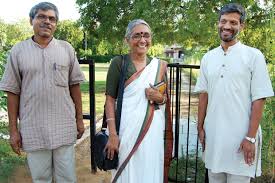
Shankar Singh, Aruna Roy, Nikhil Dey
In 1987, after searching for a suitable base, the three settled in Devdungri, a dry, remote village in the Rajsamand district of Rajasthan, in the foothills of the Aravalli range. The choice was partly sentimental—Shankar Singh’s wife, Anshi, wanted to live near her own village—and they rented a mud-and-thatch hut from a relative of Shankar’s named Hakku. Journalist Rajni Bakshi, one of their first visitors, later described the hut as reminiscent of Gandhi’s ashram at Wardha, though she knew better than to say so to Aruna and the others, who would have found the comparison embarrassing. They were simply living as the people around them lived.
Friends from the city came, looked around, and left with cheerful predictions that the whole experiment would soon collapse. “You’ll be back in the civilized world soon enough,” they said, by way of farewell.
ELEVEN RUPEES
As the trio started living in Devdungri, Rajasthan came into the grip of a severe drought. The Planning Commission sent a team to assess conditions on the ground, and Roy persuaded its deputy chairman, Hanumanth Rao, and its adviser, Bunker Roy, to visit the village and speak directly with the people. When one of the team members asked a woman what she was eating, the woman produced a flatbread made from the ground thorns of a roadside shrub. It was, as one observer later recalled, the kind of detail one encounters only in the most extreme historical accounts of famine—not in contemporary India. The district collector, standing among the Planning Commission officials, promised to arrange grain deliveries immediately. No grain arrived.
The drought relief works that followed was the state’s principal mechanism for providing income to the rural poor during famines, a system dating back to the Famine Relief Code of 1878. Under law, labourers engaged in public works were entitled to a minimum daily wage of eleven rupees for eight hours of work. In practice, they were receiving between two and four.
Roy, Singh, and Dey went to the worksite to investigate. The junior engineer in charge told them that workers were being paid according to their output—the amount of earth moved, the length of embankment completed. The workers said they had never been told what their target was, and therefore had no basis on which to contest their wages. A negotiation followed; the engineer agreed to specify the work targets. The labourers completed them and then some. When they went to collect their wages a fortnight later, the results were arbitrary and reversed: those who had worked more received less, and vice versa. The muster roll, they were told, governed everything. When they asked to see the muster roll, the engineer refused.
The reality of such muster rolls, Roy and her colleagues had come to understand, was well established in the political economy of rural Rajasthan. A roll recording a hundred workers might carry forty fictitious names, their wages pocketed by the Supervisor, a local contractor’s man who rarely set foot at the actual worksite. The wages of the real workers were then adjusted downward to whatever the Supervisor chose to enter. The engineer, meanwhile, stayed in his office.
Roy, Singh, and Dey organized the workers, measured the completed work themselves, and documented the discrepancy. In the end, they could not compel the government to pay. The system was closed to them. The files were closed to them. The engineer had no obligation to show them anything.
The minimum wage battle could not be won so long as the records were secret. And the records were secret because the law said they had to be.
THE UNION ON THE FIRST OF MAY
The fight at Sohangarh came next. A powerful landlord—the village sarpanch, or headman—had occupied public land and was levying illegal fees on anyone who wished to use it. Women, in particular, were affected, and they greeted Roy and her colleagues with enthusiasm. The trio organized awareness meetings. The sarpanch responded with death threats. They pressed on, working with a sympathetic sub-divisional officer in the nearby town of Bhim, and eventually identified and reclaimed nearly four hundred and fifty acres of encroached land. A women’s cooperative was formed; the land was folded into a government afforestation scheme, and for the first time in memory the labourers who worked for the project received the legal minimum wage.
The lesson of Sohangarh, and of the wage battles that preceded it, was something the three friends had begun to articulate only gradually: unity among labourers was necessary, but not sufficient. Without access to the documents—the muster rolls, the contractor’s bills, the engineer’s estimates, the workers could protest all they liked, and the state could simply deny everything and wait them out.
On the first of May, 1990, the Mazdoor Kisan Shakti Sangathan—the Workers’ and Farmers’ Power Union, known universally as the MKSS—was formally constituted at Devdungri. There were no officers, no hierarchy of president and treasurer and secretary. Everyone was equal. The symbol the members designed for themselves showed a man’s fist in black, for struggle, and a woman’s in red, for revolution. The slogan that would define it was already circulating: ‘Ham hamara adhikar jaante; nahi kisi se bheek maangte.’ We know our rights; we beg from no one.
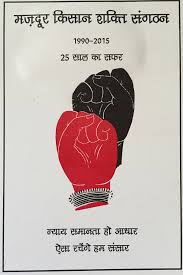
Majdoor Kisan Shakti Sangathan logo
That summer, when the state’s drought relief works were again under way, the MKSS announced that no worker would accept a wage below the minimum wages as per law. The Public Works Department and the Irrigation Department offered eight. Three hundred laborers refused.
What followed was a months-long confrontation of escalating intensity. A one-day sit-in outside the sub-divisional officer’s office in Bhim. Seventeen people beginning a hunger strike when the administration refused to negotiate. The local Member of the Legislative Assembly declaring, with magnificent indifference, that if the hunger strikers died, at least the population would decrease. The district collector coming up from Udaipur, promising to resolve the dispute, and then watching helplessly as the Public Works Department refused to comply. The Chief Minister of Rajasthan, Bhairon Singh Shekhawat, arrived at the protest tent in person, pledging a resolution—and then, at midnight on the same day, sent two vans of policemen to disperse the dharna by force.
By morning, the protestors had returned to the site of dharna. The merchants of Bhim—small businesspeople with no particular political affiliation announced that if the dispute was not resolved by the thirtieth of July, they would join the protest. The central government froze funding for the employment scheme. Under mounting pressure, the administration relented: wages at the rate of twenty-two rupees were paid out at the protest tent, to every worker from the Devdungri area, that afternoon.
WE KNOW, WE WILL PREVAIL
Out of these battles emerged a question that the MKSS increasingly placed at the center of its organizing: why was the state allowed to keep its records secret? Every abuse they had documented, the phantom workers on the muster roll, the contractor who pocketed the difference, the engineer who never came to the site, all depended on the opacity of government files. When the workers raised complaints, officials denied them. The official denial was, structurally speaking, always more credible than the worker’s accusation, because the official held the documents and the worker did not.
It was a village elder who gave this observation its sharpest formulation. At a MKSS meeting, he said simply: “As long as government documents are kept from the public, we will always be liars.” The remark had the quality of a proverb. It was quoted everywhere that followed.
The MKSS’s answer was the Jan Sunwai, which translates approximately as ‘people’s hearing.’ The format was simple and intentionally public. On a designated day, villagers gathered in the open air. Retired government servants, teachers, and community elders served as independent observers. Copies of official documents—panchayat accounts, muster rolls, contractors’ bills—were read aloud. Workers and residents spoke about what they had actually received, what work had actually been done, what materials had actually been purchased. When the accounts showed that a school compound wall had been built and paid for, and the wall was not there, the money was recovered from the official responsible. The hearings were filmed. The proceedings were calm and procedural: all findings had to be grounded in documentary evidence.
The first Jan Sunwai was held in Kot Kirana, in Pali district, in December 1994. A sympathetic I.A.S. officer, Nirmal Wadhwani, had reluctantly permitted the MKSS to make copies of the panchayat records, over vigorous objections from local politicians who had already taken the precaution of summoning village residents before a magistrate and extracting signed statements declaring that nothing irregular had occurred. The hearing went ahead regardless. Corruption was documented. Wadhwani filed a police complaint against the junior engineer, the village development officer, and others.
The bureaucracy convulsed. The village development workers’ union went on strike in protest. But the Jan Sunwai format spread, village by village, and the MKSS drew from its results four formal demands: that all panchayat documents be made available to the public; that officials found guilty of corruption be held personally accountable; that social audit—the people’s public verification of official accounts—be recognized in law; and that embezzled money be recovered from those who had taken it.
In April 1995, Chief Minister Shekhawat, watching the Jan Sunwais gathering political momentum, announced in the state assembly that panchayat documents would be made accessible. The MKSS took the newspaper carrying the announcement to the relevant offices and asked for records. They were told that no government order had been issued. A year passed.
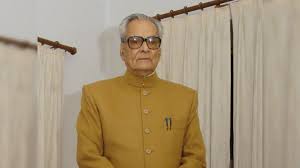
Bhairon Singh Shekhawat
In April 1996, exactly one year after Shekhawat’s announcement, the MKSS launched a dharna in the town of Beawar. This one would be different. There would be no hunger strik. The MKSS had concluded that hunger strikes were too easily neutralized by the government’s simple strategy of delay, and too damaging to people who were already undernourished. Instead, there would be a sustained public sit-in, organized with the thoroughness of a military campaign. Three hundred villages in the surrounding districts were canvassed; each household was asked to send one member for four days and to contribute a kilogram and a half of grain to the communal larder. The organizers estimated that the dharna would last at least a month, and they were not wrong.
Senior journalists arrived: Kuldip Nayar and Nikhil Chakravarthi, ensured that the story reached readers far beyond Rajasthan. Medha Patkar, the activist who had led the campaign against the Narmada Dam, came to express solidarity. The street outside the secretariat in Jaipur—where the dharna eventually arrived, on its thirtieth day, after marching through Ajmer—became something between a protest and a festival: folk singers rewrote Kabir bhajans and Sufi songs to carry the campaign’s arguments, theatre students from the National School of Drama trained locals to perform street plays, vegetable vendors donated produce, and grain came from small shopkeepers. The accounts of income and expenditure were written on a board outside the tent, open to any passerby.
The state administration attempted a different form of intimidation. The Chief Secretary let it be known, to MKSS representatives, that the foreign funding received by Bunker Roy’s Barefoot College— Aruna Roy’s husband’s institution, technically unrelated to the MKSS—might attract scrutiny. Within days, the Barefoot College opened all its financial records to public inspection, before a retired Supreme Court judge. People who had chosen to live on the minimum wage in the service of the poor do not have much to confiscate.
It was during this dharna that Prabash Joshi, a veteran journalist who had spent decades with the Indian Express group, travelled to Delhi and wrote an essay that became one of the defining texts of the campaign. Its title was ‘Hum Jaanenge, Hum Jeeyenge’— (‘The Right to Know, The Right to Live’). Its central argument was that the reason this movement had succeeded where so many others had failed was that Aruna Roy, Shankar Singh, and Nikhil Dey had actually lived among the people they organized—not as their representatives, not as their patrons, but as their neighbours.
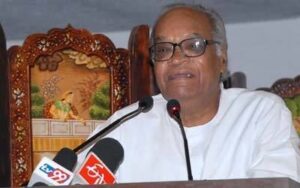
Prabash Joshi
THE LAW
The national campaign that grew out of the Beawar dharna—the National Campaign for People’s Right to Information, or NCPRI—had two objectives: to draft a model Right to Information bill, and to build the political pressure necessary to pass it. The drafting process was led by Harsh Mander, an I.A.S. officer and close colleague of Roy’s, in collaboration with N. C. Saxena, who directed the Lal Bahadur Shastri National Academy of Administration in Dehradun, the institution responsible for training the country’s civil servants. A national consultation was convened at the Academy itself. Among the most important proposals to emerge from it was Saxena’s own suggestion: that everything placed before Parliament or a state legislature ought to be, by definition, available to the public. A model draft was prepared, refined by the retired Supreme Court Justice P. B. Sawant, and delivered to Prime Minister Deve Gowda of the United Front government on the thirtieth of September, 1996.
Gowda referred the draft to a committee chaired by H. D. Shourie, a veteran consumer rights advocate. The committee produced a bill in 1997. That same year, Tamil Nadu and Goa became the first states to pass freedom of information legislation. A national act was finally passed in 2002, but the government declined to implement it. It sat on a shelf.
In 2004, the United Progressive Alliance, the Congress-led coalition that came to power on a platform that included a specific commitment to a stronger Right to Information law, established a National Advisory Council to assist the Prime Minister in implementing its Common Minimum Program (CMP). The council included the agricultural scientist M. S. Swaminathan, the ecologist Madhav Gadgil, the development economist Jean Drèze, Aruna Roy and few other eminent individuals who were really interested in the development of common man. At its first meeting, the council tabled a Right to Information bill. It was passed by Parliament on the twelfth of June, 2005, and came into force on the twelfth of October of the same year.
The distance from Devdungri to Parliament House is roughly a thousand kilometers. The distance in time—from the stolen wages of 1987 to the Right to Information Act of 2005—was eighteen years. Gandhi’s first satyagraha, in South Africa, took eight years to conclude. His campaigns in India each consumed between eight and ten years of sustained organizing. The RTI campaign took eighteen, which is not a failure of speed but a measure of the depth of institutional resistance—and of the patience required to outlast it.
The uses to which the Act was immediately put gave some sense of what had been at stake. The Adarsh apartment tower, the 2G spectrum, the Commonwealth Games: all brought to light through RTI applications filed by journalists, activists, and ordinary citizens who had been given, for the first time, a legal instrument with which to force the state to account for itself.
Apart from RTI Act, the National Advisory Council (NAC) of which Aruna Roy was a member, helped enact the Mahatma Gandhi National Rural Employment Guarantee Act (MGNREGA), which gave every rural household a legal entitlement to a hundred days of paid work per year—the most ambitious employment guarantee in Indian history was enacted by the UPA government. NAC played crucial role in drafting the Right to Education Act and the National Food Security Act. The common thread in all of them was the same principle that the village elder had stated in the hut at Devdungri: that citizens have a right not merely to receive benefits from the state but to know what the state is doing in their name.
THE HUT, STILL
This is a fact that is easy to state and surprisingly difficult to fully register. Roy had the IAS. She had the connections, the education, the fluency in English and in power, that open every comfortable door. She closed those doors in 1975 and has not reopened them. The village where she lives has no particular glamour. The work she does—attending meetings, reviewing documents, organizing people who have very little to organize with—is slow, repetitive, and frequently demoralizing. Governments that make promises break them. Officials who agree to reform retreat. Elections bring new faces committed to the same evasions.
And yet the Right to Information Act exists. The employment guarantee exists. The right to food, the right to education: these exist. They are imperfect laws, unevenly enforced, routinely circumvented. But they exist, and tens of millions of people have used them—to challenge a contractor, to verify a wage payment, to expose a ghost worker on a government roll—in ways that would not have been possible before 2005.
The Adarsh tower still stands on the Colaba seafront. The politicians who gave themselves its flats were mostly not prosecuted. In India, as elsewhere, accountability tends to be partial, and justice tends to arrive late and incompletely. But the files were opened. And once you have established—in law, in practice, in the shared expectation of citizens—that the files can be opened, something has permanently changed.
That is what was won, over eighteen years, from a mud hut in a dry corner of Rajasthan. It started with eleven rupees.





that story:
“An insightful piece that underlines the importance of transparency and the public’s right to know in a healthy democracy. Truly relevant in today’s times.”