

Remembering Madhav Gadgil With Some Contemplation on How to Listen to Him in the Days Ahead

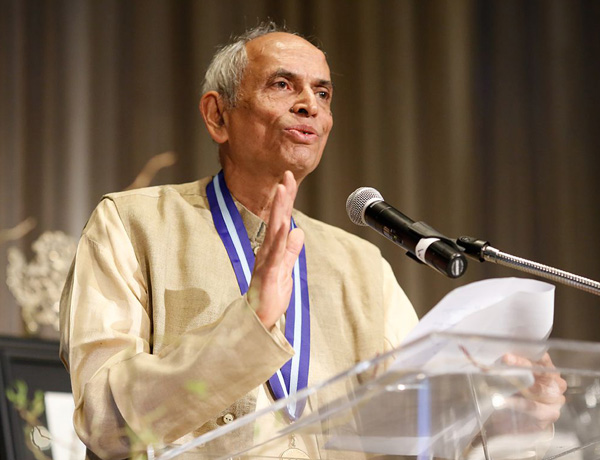
May 24 marked the birth anniversary of Madhav Gadgil, one of India’s most uncompromising ecological thinkers whose warnings against reckless development continue to acquire greater urgency in an age of recurring environmental disasters. At a time when “progress” is increasingly measured through highways, extractive economies, and unchecked urban expansion, Gadgil’s life and work remain a powerful reminder that ecology cannot survive through performative concern or policy rhetoric alone.
Rooted equally in scientific rigour and deep respect for local communities, his vision challenged the dominant development discourse and exposed what he called the “economy of violence” underpinning it. Remembering Gadgil today is therefore not merely an act of tribute, but also an invitation to revisit the ethical, political, and ecological questions he persistently placed before the nation.
“Human lives have long been shaped by development discourse through carefully manufactured lies.” Thinkers belonging to diverse streams of philosophy and political thought have explored variations of this idea in their seminal works. These thinkers range from Michel Foucault and Edward Said to Noam Chomsky and Edward S. Herman.
A central theme that recurs in these nuanced ideations is that many institutions claiming to improve human life actually deform autonomy and community while presenting themselves as benevolent progress.
But modern history, especially our contemporary times, also shows us that very few have had the courage to identify, speak out against, and refuse to perform those calculated lies. Madhav Gadgil was one such figure.
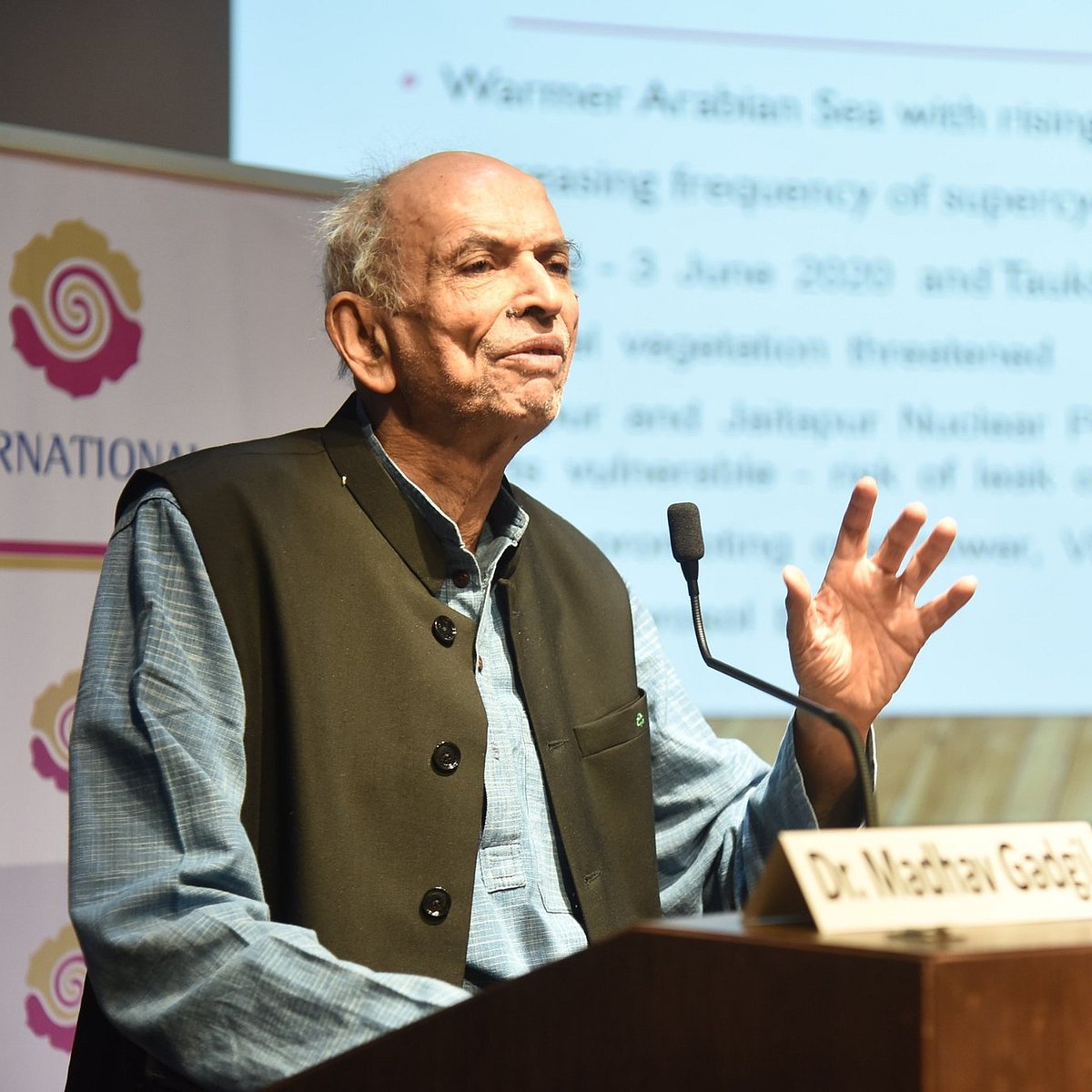
As a rule, people focus on their own human interests and, at times, the interests of fellow beings. Gadgil went beyond people and loved the spaces where people lived and the biodiversity they shared, thereby making the concept of love between people itself all the more profound. Undoubtedly, it is precisely this kind of understanding that the world requires today.
Remembering him on his birth anniversary on May 24, it would be fitting to reaffirm what Gadgil stood for. Primarily, what he stood for was the recognition that biodiversity, our surroundings, and love for nature and others are not just for showing off, but rather are essential to understanding and advancing legitimate environmental concerns. Even a small weed in the forest is essential to the protection of biodiversity, and it too needs to breathe for the very survival of this world and, indeed, humanity. Such a concern is what converts Gadgil’s persona into an ecological icon worthy of reverence.
More than skyscrapers or roads that dissect tribal and animal life and settlements, we require people who genuinely care for ecology. When the wrath of ecology pours down on its people, it is the people themselves who have to suffer. Gadgil realised that, along with a firm belief that what protects human beings is not always other human beings alone but also a lot of unexplored others.
Interestingly, one should also be aware of the fact that the point rests not just in identifying who these “unexplored others” are; rather, the point rests in understanding the fact that there are these unexplored others also in the ecology we live in, which we as human beings easily tend to displace. Such a realisation, which vouches for concern even for the minutest particles on earth, makes Gadgil definitely a unique figure, not just in the domain of academia but also a living example of what care and responsibility mean for all of us going forward.
Such uniqueness, however, also made Gadgil disliked by many. In fact, it is in this particular character trait that one also realises the fact that compromises can never be a part and parcel of ecological care. It is a fierce radical utterance of saying “No” against the discourse of development. This characteristic trait of not being liked by all is what I particularly revere Gadgil for. After all, a life lived without being disliked is perhaps a life insufficiently lived. He understood that the social capital of any economy resides in a life led through social harmony, cooperation, and trust, all of which today suffer in what Gadgil called the prevalent “economy of violence.”
Economy of Violence
Gadgil found that an economy of violence dominates the development discourse and that such an economy promotes the grabbing and despoiling of land, water, mineral, and forest resources to benefit a few at the cost of society at large. He argued that such a track of development is facilitated by lawlessness and social injustice too (Gadgil, 2014). A major reason for such an underpinning that Gadgil discusses is the notion of what he finds to be a deeply flawed model of the GDP-centric discourse that perpetuates the economy of violence.
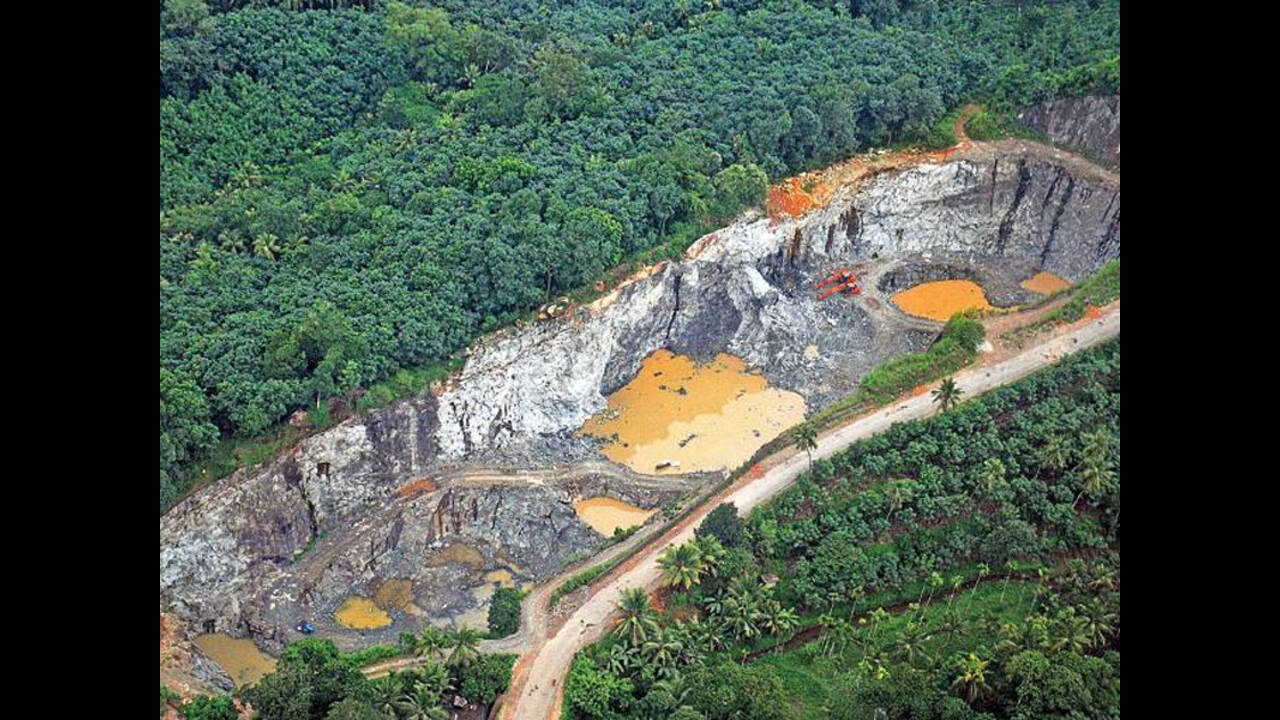
Of course, Gadgil was right in pointing out the fact that the GDP-centric viewpoint counts not only quarrying, crushing, and truck transport as positive development gains, but also the rise in sales of drugs as a result of ill health caused by quarrying (Gadgil, 2014).
He finds that in the absence of proper records, relevant elements of economic activities, such as the decline in agricultural productivity and loss of employment for agricultural labourers, which ought to be counted on the debit side, get overlooked. Over and above that, the GDP-centric view totally ignores the depletion of natural, human, and social capital (Gadgil, 2014), resulting in violence becoming a generalised aspect in order to feed the development discourse.
Multiple examples can already be listed in the case of India, which newspapers have already documented in today’s context. In such a regard, what are certain simple entry points that we must look upon from Gadgil’s work becomes crucial.
Tradition of Conservation
In his study on Uttara Kannada, which is known for its forests and wildlife, Gadgil interestingly lists the traditions of conservation, including:
Protection of individual plants and animals considered to be sacred, e.g., trees of the genus Ficus or monkeys such as the Hanuman langur and bonnet macaque.
Protection of specific life-history stages, such as birds breeding at heronries.
Protection of entire biological communities in sacred groves and sacred ponds.
Protection of animals from overhunting through devices such as a ban on hunting fruit bats at roosting sites, but not outside those sites (Gadgil, 1992).
These listed points, if one may take them up individually for further discussion, offer a general understanding that not even a single species and concerns regarding its survival amidst development discourse are left out. That kind of thinking, which seeks to remain with the local and indigenous rather than becoming modern through a kind of performative artificiality (Varma, 2023) in the name of love for ecology, is what Gadgil constantly lived and worked for.
Gadgil’s love for ecology is not reduced to planting trees or putting plants on the balcony; it’s altogether a different ballgame which, if adhered to irrespective of political party or governance, can prevent catastrophe from happening, thereby also making life on earth better.
Perhaps such a macro vision of Gadgil needs also to be seen in his strict correlation with micro-level analysis and understanding of the traditional-modern duality. This quality perhaps stems from his genuine and direct understanding of the “science behind the social” and the “social behind the science.” In other words, as Varma (2023) puts it, “Perfective Fakeness” was never an entry point or part and parcel of Gadgil’s ecological consciousness. This made him truthful and hence perhaps not liked by many.
Local is Local and not Global
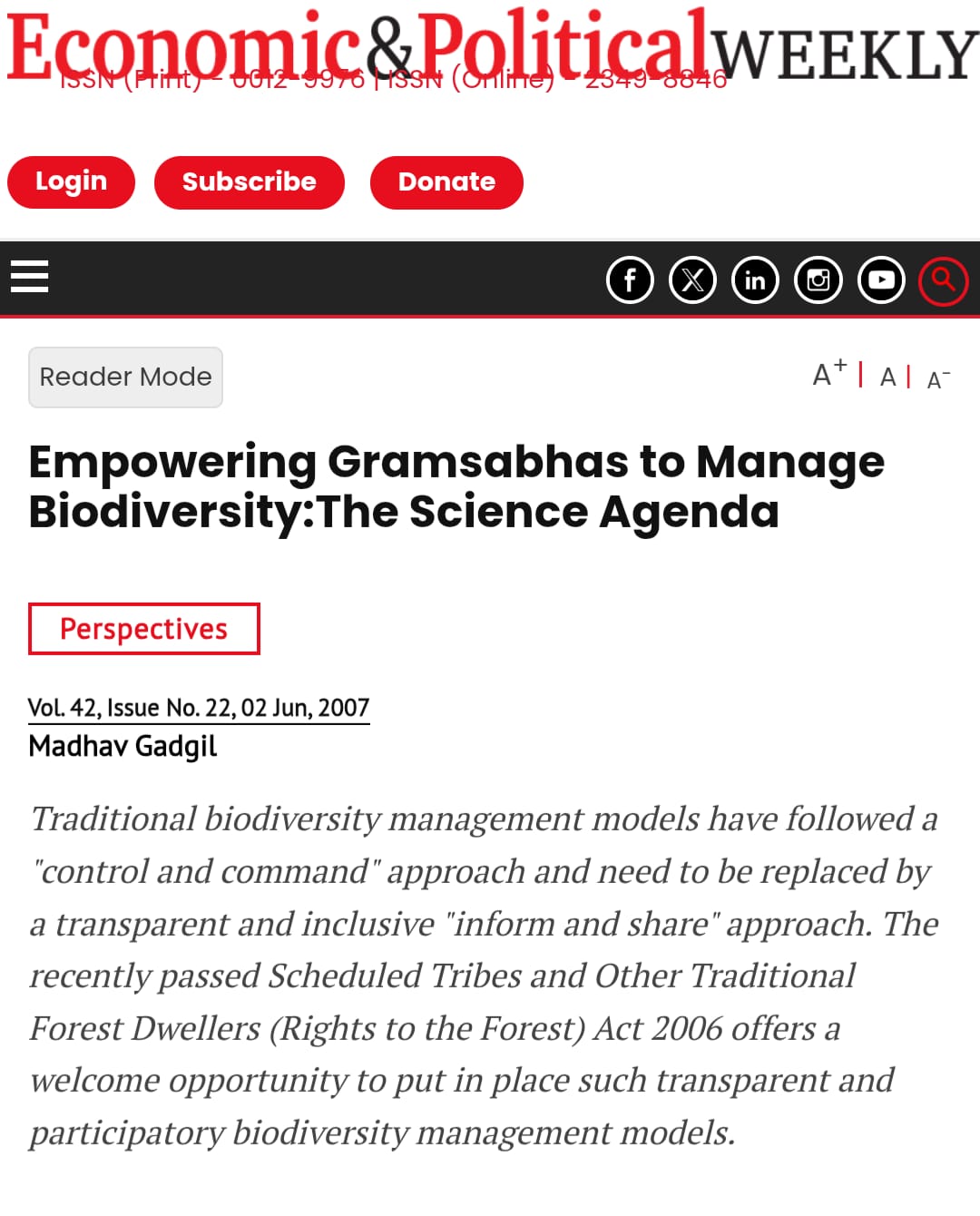
In his seminal paper in Economic and Political Weekly titled ‘Empowering Gramsabhas to Manage Biodiversity: The Science Agenda’, he explains how important science is for society. In a way, the ability of Gadgil to merge the traditional with the modern is best understood through this article.
He finds that traditional biodiversity management models followed a “control and command” approach, which was largely a colonial imprint. Gadgil vouched for the need to replace such an approach with a more transparent and inclusive “inform and share” approach (Gadgil, 2007).
He particularly notes that there have been no major scientific breakthroughs in applied ecology equivalent to the discovery of the role of microbes in causing diseases or technological advances such as antibiotics in medicine (Slobodkin, 1988).
He, along with Berkes, finds this to be a consequence of modern scientific biodiversity management practices, which are yet to be read in parallel terms with traditional ones (Gadgil, 2007; Gadgil and Berkes, 1991).
In a world that is vouching for progress through globalisation and other forces, perhaps the idea that one must sometimes refrain from blind notions of progress in order to truly progress is an interesting takeaway from Gadgil and his writings. Educated at Harvard University, Gadgil could have easily chosen a comfortable life in the Western academic establishment. Instead, he returned to India with a mission to understand and protect its unique biodiversity. As the founder of the Centre for Ecological Sciences at the Indian Institute of Science (IISc) in Bengaluru, he pioneered a brand of ecology that respected India’s traditional knowledge systems.
Long before it was fashionable, Gadgil argued that indigenous and local communities were not the enemies of conservation, but its most vital practitioners. He studied sacred groves in Maharashtra, demonstrating how ancient cultural taboos served as highly effective mechanisms for biodiversity preservation. This fundamental belief—that environmental protection must be a democratic process involving local custodians—culminated in his advocacy for the People’s Biodiversity Registers, an initiative to document local ecological knowledge and empower village-level governance.
Crossroads
Today, the rule of law as well as the state is deeply enmeshed in a kind of managerial corporatism that largely monetises ecology for populist gains. Progress has become the buzzword, and there is no scope to stand still or arrive at a moment of stationarity and look back at the piles of wreckage that we ourselves have caused to ecology. Gadgil did that, cautioned all of us through different means, yet multiple catastrophes happened despite his strict warnings, taking away many lives. We as a nation fail and deliberately make it a point not to pay heed to this luminous figure.
He was always for an “economy of non-violence” and vouched for Gandhi’s economist disciple J. C. Kumarappa’s Economy of Permanence (Gadgil, 2016), where “self-interest and self-preservation demand complete non-violence, cooperation, and submission to the ways of nature if we are to maintain permanence by non-interference with and by not short-circuiting the cycle of life.”
Such adherence to this ideology made Gadgil collectively independent as well as independently collective. It is perhaps because of the same quality he upheld that he never fell for any lured transactions by political parties. Today, when different political parties commemorate Madhav Gadgil’s passing in their own ways, Gadgil continues to remain that lone warrior with a firm voice, standing individually while creating a collective consciousness and fervour.

Everybody will be forced to listen to him at one point or another, but he never wrote merely to be listened to. Many know that we are disagreeing with and taking giant leaps despite Gadgil’s caution, and that we are prone to ecological disasters, yet these same forces continue to execute the logic of masked development. Madhav Gadgil’s enduring legacy, therefore, lies in showing that India’s forests, rivers, and hills cannot be protected by laws and fences alone. They endure when the knowledge, rights, and aspirations of local communities are respected, documented, and placed at the centre of policy.
On his birth anniversary, commemorating him therefore is not merely an exercise in praising a great scientist; it is also an opportunity to reflect on our own responsibilities. It means carrying forward a vision of ecology rooted in democracy, equity, and everyday lived experience.
Having said that, living at a time when skyscrapers and multilane roads are built after felling trees and displacing lives dependent on them, let us not forget to tell our children that there once lived a unique man who loved ecology not for performing “Perfective Fakeness” (Varma, 2023), but for ensuring that each and every life on earth—explored and unexplored—had a place, meaning, and a deep sense of purpose. Gadgil lives on!
References:
- Gadgil, M. (2006). Science and the Right to Information. Economic and Political Weekly, 1895-1902.
- Gadgil, M. (1992). Conserving Biodiversity as If People Matter: A Case Study from India. Ambio, 21(3), 266–270. http://www.jstor.org/stable/4313937
- Gadgil, M., Berkes, F., & Folke, C. (1993). Indigenous Knowledge for Biodiversity Conservation. Ambio, 22(2/3), 151–156. http://www.jstor.org/stable/4314060
- Gadgil, M. (2016). Today’s Environmentalism: Time for Constructive Cooperative Action. Economic and Political Weekly, 57-61.
- Gadgil, M. (2007). Empowering Gramsabhas to manage biodiversity: The science agenda. Economic and Political Weekly, 2067-2071.
- Gadgil, M. (2014). Western Ghats ecology expert panel: a play in five acts. Economic and Political Weekly, 38-50.
- Varma, S. (2023). A New-age Urban Imaginary. Available at – https://www.epw.in/journal/2023/1/letters/new-age-urban-imaginary.html








Remembering Madhav Gadgil and the powerful ideas he stood for throughout his life. The article beautifully highlights how his thoughts on ecology, sustainability, and people’s participation remain deeply relevant even today. An insightful and meaningful read that encourages us to think seriously about the future of our environment.