


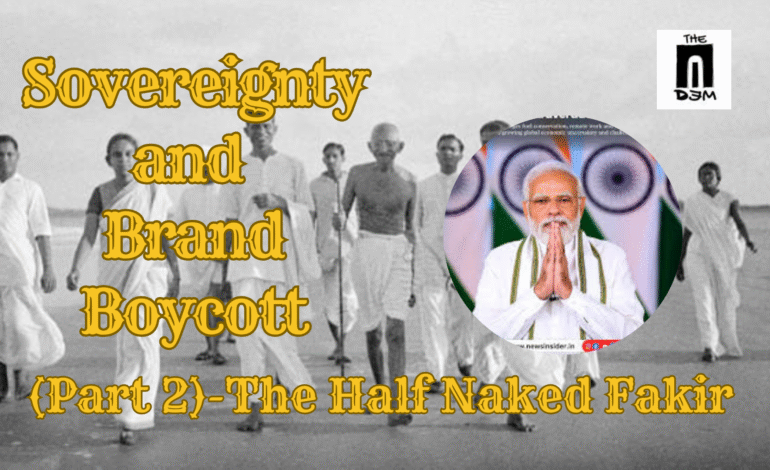
The politics and history hiding behind daily aesthetics are often the bearers of socio-economic and religious identity. Symbolic and social capital is etched onto human bodies through grooming, clothing, branded indulgences, the roll of the tongue while conversing, the crispness of the collar, the gait of walking etc, which are all ultimately discrete outfits signaling authority and power. The way in which we consume the world, the way markets micro-manage and serve the function of visibilising our socio-political identities is starkly evident. This series looks at how aesthetics have always been appropriated and transformed into symbols that are injected into everyday life through policy, rhetoric, propaganda, and deliberate ethical or moral statements and so on, and why one must always reflect on their daily habits to inspect the larger leviathan upholding and maintaining it.
(This article is divided into two parts. This is Part 1. The following is Part 2)
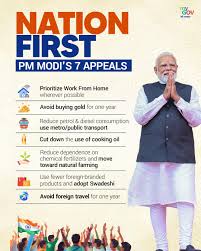
Prime Minister Modi’s 7 Austerity Appeals
Non-Possession Becomes the Moral Standard
At this stage, his dress was an act of personal discipline rather than political theater. In his Autobiography, Gandhi is clear: “I had no idea of posing as a reformer of dress.” He was simply a man who had found comfort in the functional. However, India, with its blistering sun and its vast, impoverished interior, would soon demand more from him than mere comfort. The journey of the next thirty years would be a process of “sacred subtraction”, the systematic removal of layers until only the bare, undeniable truth of the human condition remained.
The first major alteration occurred not in a political assembly, but under the relentless sky of Bengal. During a stay at Rabindranath Tagore’s Shantiniketan, Gandhi engaged in the daily manual labor of the school. He quickly discovered that even the reduced wardrobe he brought from South Africa was excessive for the physical demands of the Indian climate.
“The clothing I had worn in South Africa was found to be unnecessary here,” he noted with his characteristic pragmatism. “I reduced it even further.” This was a pivotal realization: dress was not just a social statement. It was a physical burden. In the heat of the Indian landscape, every extra yard of cloth was a barrier between a man and his work. This began his transition toward the “Kathi” style, a short dhoti and a shirt, signaling a shift from a “Western-educated laborer” to an “Indian worker.”
By the time Gandhi established Sabarmati Ashram in 1917, clothing had moved from the realm of convenience into the realm of high ethics. Under the foundational principle of aparigraha (non-possession), Gandhi began to view personal property through a radical moral lens. To Gandhi, wearing more than was “absolutely necessary” was not just a vanity, it was a form of theft.
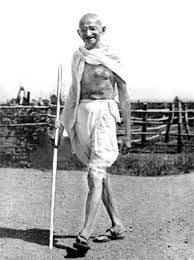
In a country where millions lived in rags, the act of wearing a fine shirt became, in Gandhi’s eyes, a moral failure. “I began to feel that I had no right to wear more clothes than were absolutely necessary,” he wrote. At the Ashram, simplicity hardened into a spiritual regulation. Dress was no longer a matter of personal taste. It was a communal vow. Every thread was scrutinized. If the goal was to serve the poor, one had to look like the poor.
Perhaps the most profound subtraction occurred during this period when Gandhi addressed the janeu, the sacred thread worn by upper-caste Hindus. Having inherited it by birth, Gandhi increasingly found it to be a symbol of “morally incoherent” privilege. To wear a mark of high-caste status while simultaneously campaigning against the “sin of untouchability” was a contradiction he could no longer tolerate.
The abandonment of the ‘janeu’ was a quiet but seismic act of social defiance. He was stripping away not just a piece of string, but centuries of inherited hierarchy. He argued that external symbols could never substitute for ethical conduct. By baring his chest of the sacred thread, he was signaling to the orthodox and the oppressed alike: his identity was not rooted in the accident of birth, but in the choice of service.
Around this same time, he replaced his leather footwear with wooden sandals (padukas). This choice aligned with his commitment to ahimsa (non-violence) and the rejection of animal harm, but it also imposed a deliberate physical discomfort. The padukas offered little protection against the rugged Indian terrain, but for Gandhi, bodily inconvenience was a form of training, a way to build the endurance and humility necessary for a leader of a non-violent revolution.
The definitive turning point in the history of Indian political identity occurred in September 1921. Gandhi was traveling through South India, preaching the virtues of Khadi (homespun cloth). In Madurai, he was confronted with a heartbreaking reality, the people he was urging to buy Khadi could not afford the fabric, even at its lowest cost.
He saw men and women who possessed only a single rag to cover themselves. The realization hit him with the force of a physical blow. How could he, the leader of a national movement, wear a tunic and a cap when his brothers and sisters were essentially naked? “I felt ashamed to wear more than a loin-cloth,” he recounted. “Henceforth I resolved to dress myself like the poorest.” In a single, public act of renunciation, Gandhi discarded his shirt and his cap. He adopted the short dhoti (loincloth) that would become his uniform for the rest of his life.
At that moment, the “Half-Naked Fakir” was born, as quoted by Winston Churchill later. This was not a stunt. It was a moral limit. By making his body visibly vulnerable, he made the poverty of India impossible for the British, or the Indian elite, to ignore. He was no longer a leader looking down at the masses. He was a man standing in the dust beside them. From this point onward, clothing became the “moral economy” of the Indian independence movement. Khadi was no longer just a fabric. It was, as Gandhi famously declared in Young India, a “sacrament.”
The spinning wheel (Charkha) became the center of his political universe. Gandhi insisted that every Indian, regardless of status, should spin for at least thirty minutes a day. By making his own clothes, he was demonstrating Swaraj (self-rule) in its most literal and accessible form. He understood that the British Empire was built on the back of the textile trade. By boycotting Lancashire cotton and wearing homespun cloth, Indians were unweaving the economic fabric of colonial rule.
Khadi became the “livery of freedom.” It dissolved the visual barriers between the Brahmin and the Dalit, the landlord and the peasant. In the Khadi cap and the white dhoti, the diverse and divided people of India found a common skin.
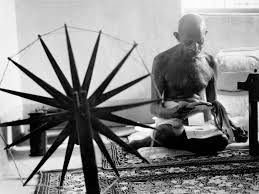
The climax of this sartorial journey came in 1931, during the Second Round Table Conference in London. It marked a profound contrast with an earlier phase of Mahatma Gandhi’s life. As a young student in London, he had once aspired to conform to British standards of respectability, even frequenting places like Bond Street in search of a proper evening suit. By 1931, however, he returned to the imperial capital having consciously renounced such markers of status, appearing instead in a simple loincloth and shawl. In this transformation lay the deeper symbolism of his politics—an outward rejection of imperial norms and an inward identification with India’s poorest.
When Gandhi arrived in London on 12 September 1931, he stayed not in elite quarters but at Kingsley Hall in the East End, reinforcing his identification with the poor. He engaged widely with political leaders, critics, and the public, even expressing a willingness to meet his staunchest opponents such as Winston Churchill.
During his stay in London, arrangements were made by Scotland Yard to ensure that no untoward incidents occurred. Official concerns extended even to the possibility of symbolic acts, such as students imitating Gandhi by wearing loincloths or leading a goat, which, though seemingly harmless in Britain, were feared to carry political sensitivities in India. Reports from supervising officers also reveal a degree of administrative uncertainty, noting the difficulty of anticipating Gandhi’s movements and the limited reliability of his informal schedules (Guha, 2018).
Mahatma Gandhi also reached out to the British public through the press. On 28 September 1931, he contributed an article to the Daily Herald, titled “Myself, My Spinning-Wheel, and Women.” In it, he described the spinning wheel as a “symbol of salvation” for India’s impoverished masses, emphasizing that the charkha could teach values such as patience, industry, and simplicity. Addressing widespread curiosity and criticism regarding his attire, Gandhi explained that his dress was both customary in India and suited to its climate. He clarified that while he would adopt Western clothing if he were in England for work or citizenship, his loincloth represented the dress of his people and was therefore integral to the political and moral purpose of his
The most significant formal engagement of his visit was with King George V, the British monarch and Emperor of India. On 5 November 1931, the King hosted a reception at Buckingham Palace for delegates to the Second Round Table Conference. The invitation specified that attendees should wear formal “morning dress.” However, after considerable deliberation between palace officials and Gandhi’s secretary, Mahadev Desai, an exception was made, allowing Mahatma Gandhi to attend in his customary attire (Guha, 2018, pp. 402–403).
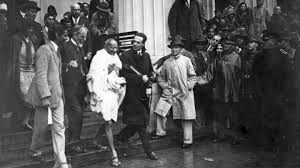
Gandhi’s visit to Great Britain in 1931
This episode can be seen as a significant moment in Gandhi’s “ethics of visibility,” as he chose not to compromise on his principles even in the presence of the British monarch. He attended the reception in his customary dhoti, with a shawl draped over his shoulders and wooden sandals, thereby maintaining the symbolic consistency of his political message.
Eyewitness accounts suggest that the King and Queen received Gandhi with formal composure, greeting him without visible reaction to his unconventional dress. An account recorded by the British businessman E. C. Benthall indicates that Gandhi conducted himself with restraint, avoiding political discussion within the setting of royal hospitality. Observers such as Samuel Hoare, the King’s secretary of state for India, noted his courtesy and presence of mind, remarking on the refined manners of a figure often perceived as austere (Guha, 2018, p. 403).
The encounter also became the subject of public fascination, giving rise to popular anecdotes such as the claim that Gandhi remarked the King “had enough for both of us.” However, as Ramachandra Guha clarifies, such stories are not supported by contemporary evidence. A more authentic remark attributed to Gandhi was made earlier to a journalist in Marseille, where he humorously observed: “In your country you put on plus-fours; I prefer minus-fours.”
In this context, Gandhi’s attire functioned as a form of political communication: khadi was no longer merely fabric, but a deliberate expression of identity, equality, and resistance. This symbolism was not universally received with admiration. Winston Churchill, a staunch critic of Gandhi and of Indian self-rule, famously referred to him as a “half-naked fakir,” expressing disdain for both his appearance and political stance. Such reactions from sections of the British establishment highlight the extent to which Gandhi’s sartorial choices disrupted imperial expectations and norms.
Gandhi’s clothing was a living manifesto that evolved alongside his soul. From the inherited conventions of Porbandar to the anxious imitation of London, from the disciplined endurance of South Africa to the deliberate vulnerability of Madurai, he used his body as a canvas to test the limits of freedom. He didn’t just reject foreign rule. He rejected the very idea that one human being is “dressed” to be superior to another. He proved that leadership did not require insulation from the world’s suffering, but a total immersion in it.
In the end, his greatest garment was his own weathered skin. He had transformed clothing from a marker of status into an instrument of truth. By stripping away the layers of the “gentleman,” he found the “Mahatma”, a man who had nothing left to hide, nothing left to lose, and therefore, a man whom an entire Empire could not break. He had unlearned the world’s hierarchies, one thread at a time, until all that was left was the indomitable spirit of a free man.






A thoughtful article that reconnects Gandhi’s philosophy of clothing, self-reliance, and sovereignty with present-day political calls for austerity and boycott. The piece raises important questions about whether symbolic appeals can truly reflect Gandhian ethics without addressing deeper economic and social realities. Insightful, balanced, and intellectually engaging.
Repeating my comment from part one of this… please ask NCERT to make this story part of students text
A good reading to counter ignorance in these times of fading logic and goodness