

Ritwik Ghatak’s Century: Beyond the Myth of the Misunderstood Master

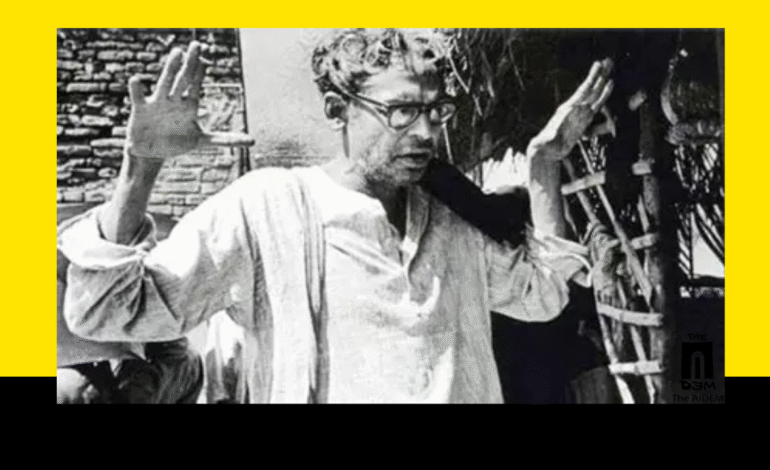
As India marks the centenary of legendary filmmaker Ritwik Ghatak, spanning November 2025 to November 2026, tributes, retrospectives, and scholarly discussions have renewed interest in his extraordinary cinematic legacy. Yet beyond the familiar image of Ghatak as a neglected genius lies a more complex story; of a fiercely political artist, a popular storyteller, and a filmmaker whose career was shaped as much by institutional hostility and political conflict as by artistic brilliance.
Ritwik Ghatak (1925–1976) would have been both irritated and amused to see his centenary being celebrated by the very people or many of their descendants, he was stuck with in the dark second half of his career starting from 1963 to the end; he died on 6th February 1976. These people, while praising his complex films, as much for the right reasons as not, projected him as a misunderstood master, whose worth could only be understood by them and not the hoi poloi!
Ghatak was celebrated by the students of the Film and Television of India, Pune (then Poona) where he was Vice Principal for less than two years from 1963 to 1965. He also served there as Professor of Direction. As in his professional career in Calcutta (now Kolkata) where he had made many enemies because of his outspokenness and alcoholism, he found detractors amongst the people who wielded power and ran the Institute. He was forced to resign and return to Calcutta penniless and unemployed. His life took a turn for the worse.
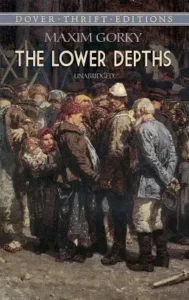
His alcoholism grew worse and his desire to make films remained constant. He had always seen cinema as an art that reached millions of people. He chose film making over theatre, where he was already being recognized as a rising young director–actor. He had already done plays like Neecher Mahal, a Bengali adaptation of Maxim Gorki’s Lower Depths. He had also made a reputation for himself as a short story writer, with a few that would have won the approval of a master of the genre like Saadat Hasan Manto, the Urdu writer with whom he shared certain traits, like, expressing emotions with directness and intensity, loyalty towards the down-trodden members of society and a subtle understanding of the workings of the human mind.
He came to cinema as a committed artiste via The Indian People’s Theatre Association (IPTA), the Culture wing of the Communist Party of India (CPI). His goal was to reach as large an audience possible and not be appreciated fifty years after his death by nobs, students from FTII and other places like the Satyajit Ray Film and Television Institute, Kolkata and the Mass Communication Research Centre, Jamia, Delhi. There are of course, Departments of Film Studies in India, and in various Universities the world over, whose alumni think that Ghatak belongs to them particularly because a paying audience for his films did not help sustain his career in his heyday, that is, from 1957 (Ajantrik) to Subarnarekha (1965).
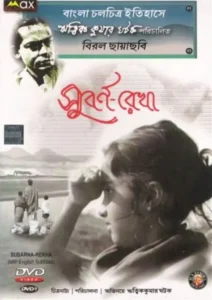
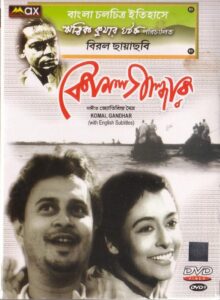
These worthies seem to forget that Ritwik Ghatak, was a victim of political conspiracy—The CPI had worked actively to sink his luminous serio-comedy, Komal Gandhar (1960–61) in which he subtly criticized the Communist Party for side-lining thinking artists in their midst. He could not take the engineered box-office failure of his film like a mature adult. He started drinking heavily and started abusing his detractors often with good reason. His other film Subarnarekha (1962–65) was also ‘sabotaged’ by people for wholly business reasons. In the first place, the film got made thanks to the intervention of Abhi Bhattacharya, a successful character actor in the Hindi cinema of Bombay, whom Ghatak knew from his days of apprenticeship in Calcutta in the early 1950s. Bhattacharya found Radhe Shyam Jhunjhunwala, a financier, to put up the money, and Ghatak got enough of an advance out of him to do the shooting of the story, — a putrid one, provided by Jhunjhunwala himself, for which Ghatak nearly socked him, restrained by a timely kick under the table by Bhattacharya. The finished film resembled nothing of what the financier expected, and who, then immediately took to his heels. Ghatak’s influential friend from Imperial Tobacco Co. (now India Tobacco Co.) Chidananda Dasgupta, gave him a film, ‘Scissors’ advertising a popular cigarette manufactured by his company. With the fee he got for his only Ad film, Ghatak completed Subarnarekha, now hailed as a masterpiece, drawing comparisons with the major plays of the great German playwright, Bertold Brecht, because of the narrative technique that Ghatak used to tell his picaresque story.
Subarnarekha, first held up for nearly three years by the Censor Board for its “unseemly” narrative that appeared to mock the freedom movement, was finally released in 1965 by Rajshree Pictures, which already had a superhit, Dosti on its hands and a huge income tax return in the offing. They bought and released Subarnarekha, hoping for a flop which could help write off a very large portion of Dosti’s profits. Like its predecessor, Komal Gandhar, Subarnarekha ran to a packed house week for two weeks. Rajshree Pictures took alarm and withdrew the film citing egregious reasons. Ghatak was ruined a second time, financially and psychologically. There was nobody to help. Drink became a ruinous habit. It was under these circumstances that he went to the Film and Television Institute, Pune.
A brilliant, drunken teacher was a hero for his young students. Two films that he supervised Rendezvous (Dir. Rajendra Nath Shukla) and Fear; supervised by Ghatak which, many said was also directed by him, showed he was in full command of his artistic faculties. But his drinking ensured his being asked to resign. His two attempts at feature film making in Calcutta, Bagala Bangadarshan (a hilarious comedy) and Ranger Golam (a dramatic tale) had to stop because producers, despite repeated requests, failed to stop Ghatak’s drinking at work; so, financial support was withdrawn. Both films, if completed and fairly released would have done well at the box-office, as would have Koto Ajana Re (1959) which the producer stopped after ninety percent of the film was shot because he was insulted by the literal minded Gorkha sentry at the gate of the studio, strictly instructed by Ghatak not to let anyone in when the filming was on. The people who have celebrated his centenary seemed to be ignorant of their hero’s picadilloes and only see him as a martyr to philistinism.
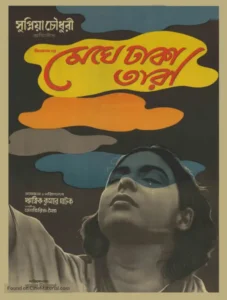
Martin Scorcese, doyen of current American filmmaking, in his sincere but recent misinformed tribute to Ghatak, said that none of his films had done well at the box office; this is not true. Meghe Dhaka Tara (1960) was indeed a popular success and a Hit. It is the two-and-a-half lakh rupees that he earned from the film – not exactly a small sum for a regional film – he had sunk into Komal Gandhar, which ran to packed houses in its first two weeks. Then, ‘lightning struck’. The Communist Party of India (CPI) hired goondas from their sworn enemy, the Congress Party in West Bengal, to buy a large number of tickets and to laugh during serious scenes and cry in funny ones to confuse the genuine audience.
Attendance fell drastically. The film had to be abruptly withdrawn. Ghatak was financially wiped out. The reason behind this act of utter villainy by the CPI was that Ghatak was declared a Trotskyite by the party ideologue Pramod Dasgupta, because he asked too many questions being a thinking man. He had to be destroyed because he had dared to question the absolute authority of the party over its members. Scorcese, of course, was unaware of this fact, as he, also was unaware about the Subarnarekha fiasco. (source: Ritwik Ghatak to Sanjib (‘Babu’) Chatterjee and Partha Chatterjee – Delhi,1975).
He had said even in his final conversation with this writer that he had intended to reach out to a very large audience. When asked about most of his colleagues in the medium he said, “The films they make aren’t that good and mine aren’t that bad.” His so-called admirers, both new and old, ought to know that he was first and foremost a people’s artist, and an exceptionally gifted one.
Scorcese’s Indian informants obviously fed him half-baked information. He said, had Nagarik (Citizen, 1952) Ghatak’s first film, been released at the time of its making, it would have been the first Indian art film, ahead of Satyajit Ray’s epoch-making Pather Panchali (1955).
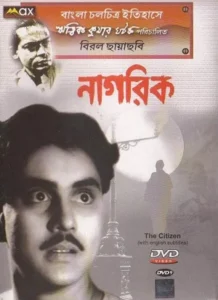
Having seen the film, even in its damaged condition (rescued from Bengal Lab, Calcutta in 1976 by Mohammad Zamir and Mohammad Siraj) at a special screening for six, at New Empire cinema, Calcutta, this writer can say that the debut-making director’s talent was obvious, but it was far from the master director who was to emerge five years later with Ajaantrik (1957). There were four really good sequences in this film set after the partition of India with stellar performances from Prabha Debi, Ketaki Dutta, her biological daughter, and Ganga Prasad Bose. Nagarik was a good film but not a masterpiece.
The film was accidentally discovered because of a clue thrown to yours truly by the late Mahendra Gupt, owner of The Motor and General Finance Limited, Asaf Ali Road, New Delhi. He had produced Meghe Dhaka Tara and co-produced Komal Gandhar. Ghatak’s tragic, and, yes, senseless death had left us all distraught. Mahendra Gupt was the soul of hospitality. The other gentleman present was Sunil Janah, the famous still photographer. After listening patiently to the ramblings of this student and adoring fan of Ghatak’s, he, Gupt, tried to explain Ghatak the man and artist to him for an hour, and then said goodbye. When, plaintively asked if Nagarik could ever be found, he said cryptically, “why don’t you try Mr. Khemka at the Bengal Lab? (in Tollygunj, Calcutta).
A prompt letter to Mriganka Shekhar Ray, a film aficionado and veteran film society member in Calcutta, resulted in Mohammad Zameer and Mohammad Siraj landing up at Bengal Film Laboratory, with cash in hand. A battered print was found and bought. The original Nitrate negative had turned to water in the cans not having been aired or carefully cleaned of dust for over twenty-five years.
The screening of a restored new digital print of Subarnarekha under the auspicious of the Satyajit Ray Film and Television Institute, Kolkata, presumably supervised by a Lady Film studies scholar had one unforgivable act of tampering indeed mutilation, that harms the core meaning of the film.
Sita and Abhiram, the two central characters in the film, are seen playing as children on an abandoned World War II airstrip built by the British. They discover a broken-down, smashed Dakota aircraft from the war. The two pretend to mimic the flight of an imagined aircraft. In the course of their play, a fast, travelling shot is seen, as if through the cockpit window of a plane taking off, and, is accompanied by the appropriate sound of a quick running engine, that suddenly gets cut off, like in actuality, when the plane is airborne.
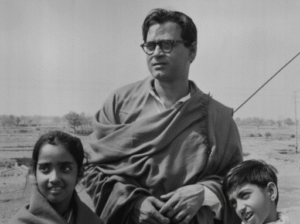
In the new digital print of Subarnarekha, this shot, and its accompanying sound is missing. The restoration supervisor probably found this shot unnecessary and thus edited it out. For many this was a pivotal shot in the film, perhaps, signifying the rise and fall of a desire, doomed to be thwarted. As adults their efforts to rise above the poverty of their circumstances will be crushed. They are victims of the blind cruelty of history thrust on millions of people like them, when India was partitioned in 1947. In the film they represent all those millions who, through no fault of their own were displaced in so many countries in the 20th century for entirely political reasons, and forced to live in other lands as unwelcome refugees.
Ritwik Ghatak’s cinema, on the balance, is an unending saga of injustice, inhumanity and depravation of the innocents whose fate is decided by politicians and their champions who treat human beings with utter contempt, to be used and thrown away once the intended objective is achieved.
However, there is an innate positivity that shines through the gloom and sadness. In the last sequence of his overwhelming, insightful, Titash Ekti Nadir Naam ( A River Called Titash) about the destruction of a once thriving fishing community in East Bengal, Ghatak achieves a simple, beautiful awareness about the movement of time in cinema as in life. Basanti, the dying protagonist, somehow crawls, slithers her way to the dried riverbed and claws with her trembling fingers to find some water and catch it in her ghoti ( small vessel) to perform her last rite. An innocent little boy, just then, comes dancing across the crop-laden field blowing on a reed whistle. In a trice, Ghatak makes the viewer aware of the transformation of the dying fishing village – the river has changed course- into agricultural land now owned by powerful outsiders, and the inevitable destruction of an older, more humane way of life. Basanti in her last moments, becomes a part of the cycle of life, death and change.









“A beautifully written tribute to Ritwik Ghatak that moves beyond the familiar image of the ‘misunderstood genius’ and explores the depth of his artistic vision, political consciousness, and cultural legacy. An engaging reflection on a filmmaker whose work continues to resonate across generations.” �