

Why Rahul Gandhi’s Endorsement of Vijay May Discredit the Congress

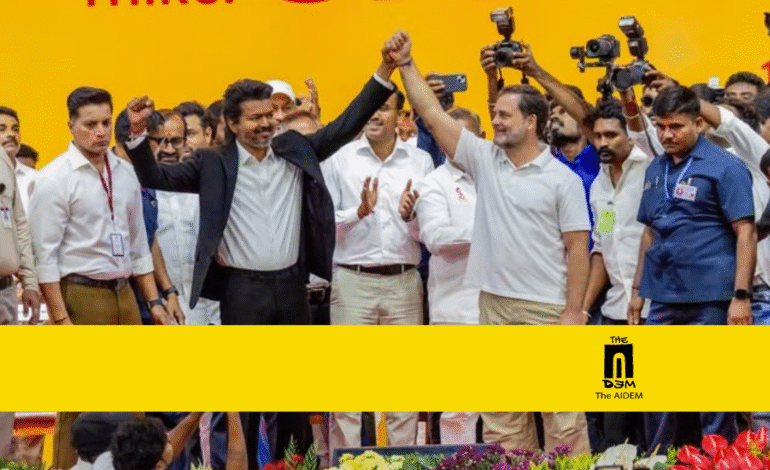
The Congress did not strike a happy alliance with the Dravida Munnetra Kazhakam ( DMK) before the 2026 Assembly elections in Tamil Nadu. This was in tandem with the inexplicable cold-shouldering of the RJD in Bihar, opposition to the TMC in West Bengal, which was fighting the BJP tooth and nail, and the opportunistic slandering of CPI(M) and Pinarayi Vijayan in Kerala during the Assembly elections in the respective States. They all — RJD, TMC, DMK and CPI(M) — lost the State elections and are now solicited by the Congress into the INDIA alliance to fight the BJP. The Congress appears to have a strange strategy of weakening the forces opposed to the BJP in the States and mobilising them nationally.
It is necessary to understand what happened in Tamil Nadu since it may have certain serious repercussions for the INDIA alliance. Actor Vijay, whom Rahul Gandhi had invited to Delhi long before, in 2009, perhaps to court him to join the Congress, announced the launch of his political party, Tamilaga Vetri Kazhagam (TVK), before the parliamentary elections in 2024. But Vijay neither contested in the parliamentary elections nor endorsed the INDIA alliance. He announced that TVK would only contest the Assembly elections in 2026; he also added that whichever party aligned with him would be part of a coalition ministry headed by the TVK in the State. Unsure of how successful his campaign would be, no political party took the gambit. The Congress, however, demanded that the DMK match up to the offer of TVK on power-sharing in the State.
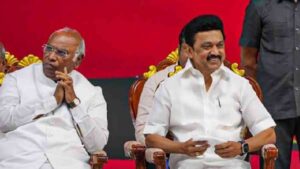
The DMK made it clear that it would not offer to form a coalition government in the State since the people of Tamil Nadu generally delivered a clear mandate. The Congress was not happy; it had several rounds of consultations in Chennai and Delhi as the party appeared to be split on whether to align with the DMK or the TVK. Finally, they decided to align with the DMK and strike a hard bargain in terms of the number of seats and also secured a Rajya Sabha seat in the process. But Rahul Gandhi made his displeasure known by not joining the DMK leader M.K. Stalin in any campaign rally, even though Mallikarjun Kharge and D.K. Shivakumar marked their presence.
The TVK campaign was unprecedented in Indian democracy since actor Vijay had a few public appearances and kept cancelling scheduled rallies. His occasional appearances were thin on political discourse, marked only by a high-decibel denunciation of the DMK as an evil force. His party machinery was absent in most places and the candidates were unknown faces in many constituencies. However, he managed to spring a surprise through the use of social media platforms, reaching out to voters through cell phones. His star persona, the whistle symbol of the party promoted as the epitome of change by Instagram influencers and WhatsApp group administrators, won him 107 seats in the Assembly, eleven short of the majority mark in the 234-seat Assembly.
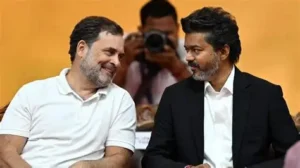
The Congress was swift in shifting sides to offer the support of the five MLAs it had, not only joining the Vijay ministry but also securing an alliance with him in all the upcoming polls, including the 2029 Parliament elections. The unseemly haste with which it parted company with the DMK to align with the TVK has surprised many observers. While the proponents of the drastic move couch it as political pragmatism, the critics wonder whether the Congress has traded a strong ideological orientation for the cult of star persona sans political discourse and grassroots organisation. The personality cult of the TVK has many resemblances to the 2014 campaign of the BJP promoting Modi as the face of the change the country needed. But in the case of the BJP, it was a personality cult backed by Hindutva ideology and a long-nurtured cadre base. In the case of Vijay, it is just his star persona all the way up until now.
The Background
The seventy-five-year-old democracy in the Indian republic presents two contrasting pictures. On the one hand, despite the various doubts, allegations and functional improprieties concerning the Election Commission, the vote remains a powerful weapon of the weak, to go by the slew of welfare and poverty-alleviation measures announced and executed by every political party in fierce competition with each other. On the other hand, a manipulative media that is blatantly partisan, coupled with the old hate-mongering rumour mill invigorated by digital, virtual social media platforms reaching out to millions of cell phones, has made any appeal to public reason and communicative ethics a far cry.
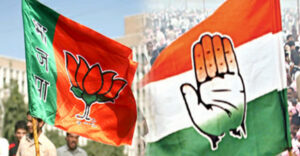
It is in this broad context that we have the Hindutva and the secular-pluralist versions of the republic fighting for hegemony and for reshaping the political ethos of the country. The proponents of Hindutva propose a nation-State model that comprises people always already unified as Hindus; they consider the constituent States of the Indian Union as administrative units created for the convenience of governance. Since the interests of the people of the Union and those of the States are unified as one, they campaign that only if the BJP rules at the Union and the State levels would there be a “double-engine sarkar” that would propel the engines of development.
This is strongly contested by the State-level political parties, billed as regional parties, of which the DMK is the historical exemplar, as it advocates the model of a federal republic in which the States will have far greater autonomy. The so-called regional parties have time and again proved their patriotic credentials; they have been part of coalition governments at the Union level; they are zealous about sending their flotillas in the Republic Day parade in Delhi and compete to encourage people to enlist in the Indian Army. This has to be complemented by the fact that the social fabric from which the regional political formations spring supports a plethora of non-Brahmin devotional cults, old and new, a bewildering range of piety and even theological compacts that are not easily assimilable into a Brahminic-Sanskritic monolithic Hinduism that Hindutva was fabricated upon. For example, opposition to Brahmin-Sanskrit priestly class hegemony is ingrained in the traditions of Tamil Saivism and Tamil Vaishnavism, apart from Tamil Jainism, Tamil Buddhism and Tamil Dalit neo-Buddhism, all happy to be Indian in a republican sense, but resolutely pluralising. This is why regional, that is, State-level, political formations are inherently antithetical to the unitary nation-State model of Hindutva proponents and aspire for a federal republic.
The Congress Split Identity
The Congress is Janus-faced. It popularised its endorsement of cultural pluralism with the famous adage “Unity in Diversity.” Politically, it had great difficulty in allowing autonomous political formations to emerge in the Indian States. It displayed a fear of self-conscious inscriptions of State identity, mistaking it to be “sub-nationalism” that could become antithetical to Indian nationalism. A healthy nurturing of federalism towards a just republic was the major casualty. In the sanguine coinage of one of our foremost political theorists, Partha Chatterjee, India is a federation of the peoples.
The constitution of the Indian peoples in each State does not happen as a majoritarian consolidation but as formations of the political through which distinct electoral arenas are formed, where various social groups mobilise to form political parties. In other words, the distinct formations of the political do not constitute “sub-nationalism” as a contestatory identity with Indian nationalism. They are the necessary outcomes of democratic practice in which each linguistic and provincial public sphere has its friend-enemy formations to constitute the imaginary whole of the people in the State. The so-called national parties, both the Congress and the BJP, have been ill at ease in allowing their own State units to function autonomously, thereby conceding the political ground to State-level parties. Once State parties take the ground, the Congress and the BJP are anxious to weaken them and take back the political space they unwittingly conceded through their own centralising tendencies.
The Congress attitude can be best illustrated in the case of its hesitation to rename Madras State as Tamil Nadu after the reorganisation of States on the basis of language in 1956. It was a Congressman, Sankaralingam, who undertook an indefinite fast demanding the renaming of the State; as the Congress government remained intransigent, he died. It was only after the DMK assumed office in 1967 that the name change was finally enacted and the martyrdom of Sankaralingam honoured.
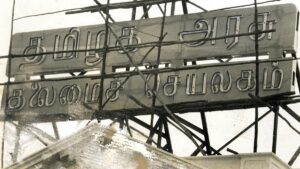
The apparent problem was the fear of the suffix “Nadu”, which has a gloss similar to the English term “country.” It refers to any cultivated land as opposed to “Kaadu”, which is forest. Nadu has a wide semantic range that can be a territorial marker for different spreads, from micro-regions to kingdoms. As the Congress was anxious about the construction of the Dravidian Tamil people as a self-conscious political collective by the DMK, it did not want the “Nadu” suffix to intone a certain degree of political independence which it thought was tantamount to separatism. The DMK was mistaken by everyone as a Tamil nationalist party, while it had only demanded a South Indian federal republic called Dravida Nadu before Independence. C.N. Annadurai, the founder of the DMK, was essentially a federalist who endorsed the idea of world federation proposed by Wendell Willkie, an American politician, in 1943.
Name as Inscriptions and Erasures
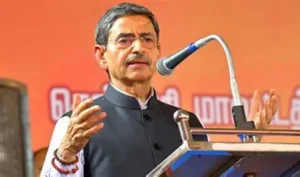
The political aspirations of the DMK rest on the Dravidian prefix that stands for non-Brahminism and the Nadu suffix that stands for State autonomy. The RSS, as recently and repeatedly articulated by the erstwhile Governor of the State, R.N. Ravi, loathes both. He suggested that the State be called “Thamizhagam”, which is widely used in adjectival form. The suffix “agam” implies interiority, which refers to cultural indigeneity as against the political autonomy marked by the “Nadu” suffix. R.N. Ravi, as would the RSS, stridently opposed the Dravidian identity as false and as an orientalist insinuation, even as they remain silent on the construction of the Aryan racial identity spurred by Orientalist philologists that had disastrous consequences in Europe. The Dravidian identity politically mobilised in Tamil Nadu is not racial but civilisational, based on the linguistic distinction and non-adherence to Brahminical varna classification.
When actor Vijay named his party Tamilaga Vetri Kazhagam, he performed an erasure of both these key terms — the Dravida prefix and the Nadu suffix — thereby making his party palatable to Indianist sentiments of both the BJP and the Congress. This suited his political mission, which was to fill the gap created by the attenuated star-persona stewardship of the AIADMK after Jayalalithaa’s demise. As the most popular hero of Tamil cinema after Rajinikanth, who withdrew from the threshold of politics, he thought he might succeed in occupying the star-persona alternation shadowing the DMK’s ideological mobilisation. The erasures, silences and the vacuity of the political discourse of the TVK are a deliberate architecture meant to scaffold his star image as the sole political message. In the event, he has also erased the twin boundaries constituted by the Dravidian Tamil consolidation by including two Congress members and two Brahmins in his Cabinet. Both the Congress and the BJP appear happy with this erasure.

It might have been unexceptional had Vijay joined the AIADMK under the leadership of Edappadi K. Palanisamy and gradually risen to become its leader. Instead, he opted to fight the election on the virtual domain, just investing his film-hero image. Undoubtedly, he has created history of sorts by winning an election purely through social media handles and reaching people through mobile phones. As a result, even if people did not know the local party functionaries or the candidates, they all ended up voting for Vijay’s star persona and the symbol whistle. The basic concept of representative democracy itself has largely been overturned in the process since Vijay and Whistle have won the election and not the political party TVK and its candidates.
What appears even more worrying is that Vijay just remains a face to the public. Vijay has never met the press and taken questions from them either before or after the elections. As a person, Joseph Vijay remains unknown behind the façade of his film-star image. This is in total contrast to the political culture that Rahul Gandhi has been building. Rahul Gandhi has set a high benchmark for public interaction wherever he goes, from an Indian village square to Oxford University. He fields all kinds of tough questions, thinks on his feet and offers sincere responses. While this may not have yielded him the electoral victory it deserves, he is surely shaping democracy in the right way. Vijay offers a total contrast by nurturing a regressive personality cult sans communication.
Rahul Gandhi and Praveen Chakravarthy, the Congress liaison with Vijay, cannot be unaware of this. The question then becomes whether they are endorsing this depoliticising star-persona cult. In antagonising the DMK, a strident anti-Hindutva party that has a long and tested history, how can their own priority to oppose the BJP stand not discredited? Where does the Congress priority lie? In securing a few ministerial berths in Tamil Nadu or dislodging the BJP at the Union level? Apart from the clichéd question of whether the end justifies the means, it is not even clear what the Congress has in its mind as its political goal. Is it just assuming power or contesting the hegemonic assertion of Hindutva? If it is the latter, the Congress could not have switched sides from the ideologically grounded DMK to the cult of star persona promoted by the TVK. This is how, at least from the point of view of the observers in Tamil Nadu, the Congress may stand discredited in its opposition to the BJP.






The article makes a compelling case that political endorsements are not just about immediate gains but also about the message they send to voters. If Congress is seen as compromising its principles for expediency, it risks weakening the very credibility it seeks to rebuild. An insightful and timely piece that deserves serious reflection. 👏📖