


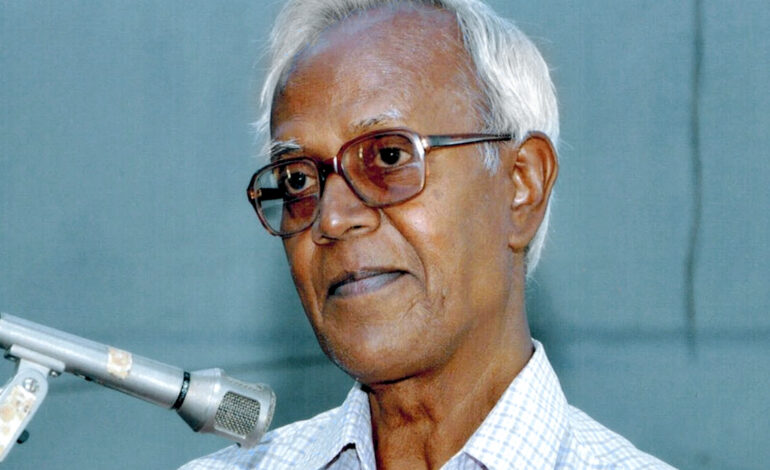
What made an 84-year-old Jesuit priest working quietly among Adivasis one of the most feared figures for the Establishment in contemporary India? In this powerful lecture, economist and political commentator Parakala Prabhakar argues that the answer lies not in who Father Stan Swamy was, but in the values he embodied—dissent, constitutional morality, solidarity with the marginalised, and an unwavering commitment to justice.
Adapted from his Father Stan Swamy Memorial Lecture, delivered at St Patrick’s High School, Secunderabad, on 11 July 2026, this two-part series moves beyond remembrance to examine the political anxieties that Stan Swamy’s life continues to provoke.
In Part 1, Prabhakar reflects on Stan Swamy’s enduring legacy before turning to what he sees as the deepening economic and democratic crisis confronting India. Part 2, to be published tomorrow, explores his critique of the ongoing Special Intensive Revision (SIR) of electoral rolls and its implications for the idea of India itself.
Dignitaries on the dais and my dear friends, I felt sad and was moved to tears when Father Stan Swamy died.
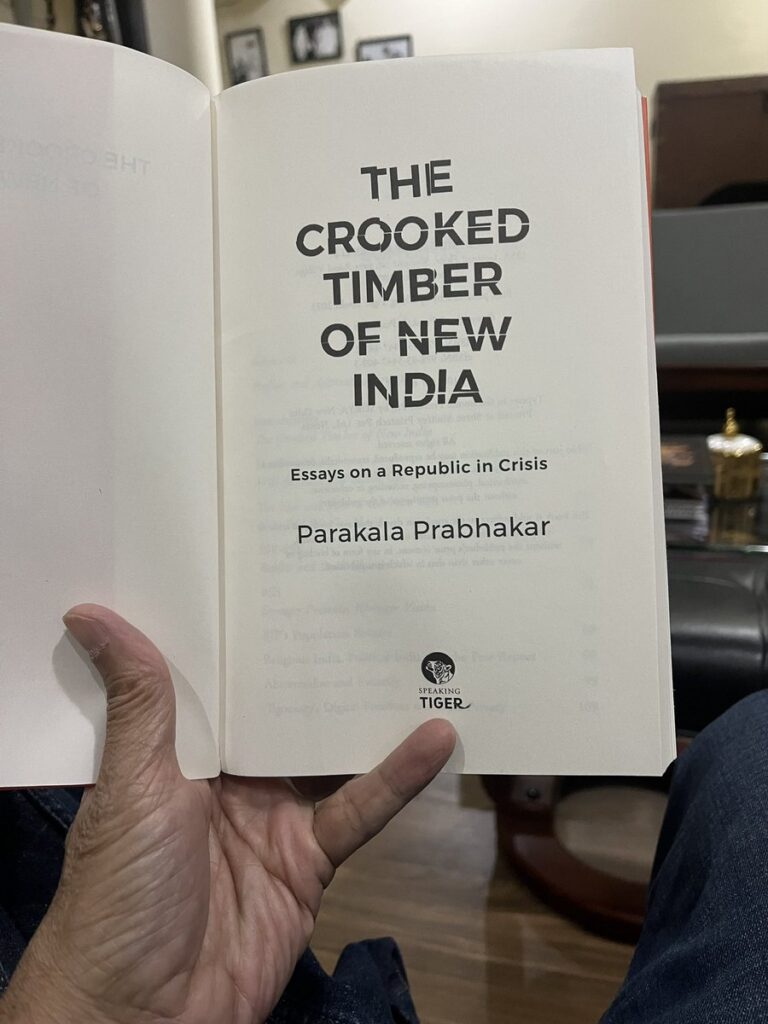
There was a chapter on him in my book, The Crooked Timber of New India. The title of the chapter is Who Killed Father Stan Swamy? You would have noticed that I asked, “Who killed Father Stan Swamy?” I meant that he did not simply die. I meant that he was, indeed, killed.
Today, I am not asking the same question. I am asking a different one: “Who is afraid of Stan Swamy?” I further ask, “Why are they afraid of him?”
I n April this year, I went to Bagaicha, Namkum, on the outskirts of Ranchi. I spent two days there. I delivered a lecture on the occasion of his Jayanti. It was called Stan Swamy Jayanti Vimarsa.
Today, I am here not to share my sorrow with you. I am here to celebrate the life of Father Stan Swamy and, together with you, draw inspiration from the values he stood for and his work to uphold them.
I am grateful to the organisers for giving me the opportunity to speak on this occasion.
A Few Concerns
Before I proceed further, I would like to caution you about a few things that worry me these days. Some of you might have come across these alarm bells. I share these cautionary words whenever I get an opportunity to address a gathering, big or small. Those who have heard these lines before should forgive me for repeating them. I repeat them because I strongly feel they are important and bear repetition.
First caution. If some people in this gathering think that we can continue to hold meetings of this kind in future, I appeal to them to shed that delusion. Even now, in many parts of the country, it is becoming increasingly difficult to air our views freely and without consequences. If things continue the way they are now, it will soon become impossible to hold such meetings.
Second. This year, it is almost certain that our beloved Tricolour will fly over the Red Fort on Independence Day. But come next year, I am not so sure. Anyone here can guess the colour of the flag that is likely to fly.
Third. Recently, the Union Home Ministry issued a circular making the singing of all six stanzas of Vande Mataram compulsory. It also specified that it should be sung before Jana Gana Mana. If the present drift continues unchecked, Jana Gana Mana could, sooner rather than later, be gradually phased out.
If the ten-hour marathon debate on Vande Mataram in the Lok Sabha tells us anything, it is this: our Parliament no longer discusses the issues that matter to ordinary people. It has no time for them. There has been no discussion on unemployment, rising prices, the situation in Manipur, rural distress, the falling exchange value of the rupee, Operation Sindoor, the Chinese occupation of large tracts of our territory, declining domestic investment, and many other urgent issues. Yet, the Lok Sabha found time for a ten-hour marathon discussion on Vande Mataram.
If we allow the present drift to continue unchecked, these three dangerous possibilities could soon become realities.
There is one more danger in the making—a fourth. Recently, the government constituted a High-Level Committee on Demographic Changes (HLCDC). One has only to read its terms of reference to understand its import and what it could do to our society. The repeated use of the term “illegal immigration” is a giveaway of the present dispensation’s intentions behind embarking on such an exercise.
Our Values
When I remember Father Stan Swamy and think of how we look at him, and how the regime looked at him, I am reminded of William Blake’s words:
A tree that moves some to tears is to
others a green thing that stands in the
way… As a man is, so he sees.
We all share a set of values and ideals. The finest expression of those values was given by Father Stan Swamy just before his arrest on 8 October 2020.
This is what he said:
“Over the last two decades, I have identified myself with the Adivasi people and their struggle for a life of dignity and self-respect… In this process, I have clearly expressed my dissent over several policies and laws enacted by the government in the light of the Indian Constitution. I have questioned the validity, legality, and justness of several steps taken by the government and the ruling class. If this makes me a ‘deshdrohi’, then so be it. We are part of the process. In a way, I am happy to be part of this process. I am not a silent spectator, but part of the game and ready to pay the price, whatever it may be… I/we must be ready to face the consequences. I would just add that what is happening to me is not unique. Many activists, lawyers, writers, journalists, student leaders, poets, intellectuals, and others who stand for the rights of Adivasis, Dalits, and the marginalised and express their dissent against the ruling powers are being targeted. I am grateful to all who have stood in solidarity with me all these years.”
Let me draw out the important words and expressions from what he said and make a list of them.
Economy
There are some stubbornly enduring features of the present dispensation in the economic domain. It has been unable to shed them even well into its third consecutive term: ad hoc-ism in policymaking; reluctance to learn from past mistakes; denial of the lived economic reality of ordinary people; massaging of data to present a rosy picture of the economy; believing its own propaganda, though initially intended merely to shape public relations narratives; and wrongly interpreting its electoral successes as an endorsement, if not an outcome, of its economic performance.
The government remains resolute in its mode of denial. It takes little note of the economic slowdown, the tapering off of capital inflows into the country, the flight of capital from India, the decline in domestic private investment despite reductions in corporate taxes, the underwhelming performance of the much-hyped Production Linked Incentive (PLI) scheme, and the so-called “crowding in” of public investment. The decline and stagnation of the unorganised sector are of little concern to it. Yet we all know that this is the sector that provides at least subsistence incomes to the vast majority of our people.
Instead, the present dispensation spends its time ideating on how to “add more momentum to the reforms journey” and ensure “ease of living” and “ease of doing business”. For whom? Evidently, for a select few among its cronies.
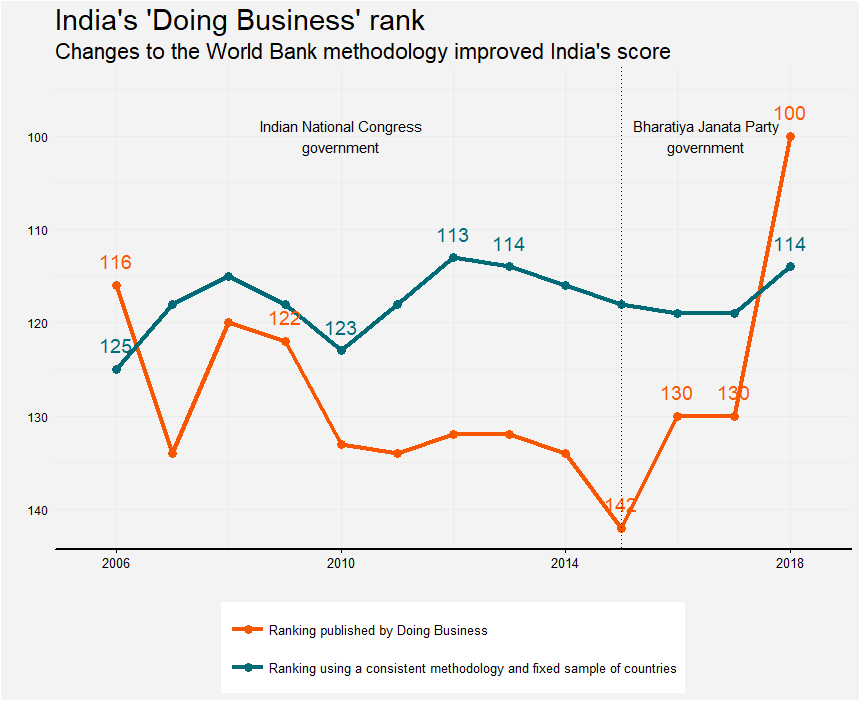
Much of the credit offtake in the country is now driven by consumption. Problems such as the rising cost of living, especially for the poor and the marginalised, unacceptably high youth unemployment, and unemployment among the educated do not seem to matter to the government. One of its high-profile economic policymakers is on record as saying that it was not the lack of opportunities but the lack of aspiration that kept our young people out of work. Little did he realise that neither the organised nor the unorganised sector has been able to absorb the country’s labour force. Rising economic inequality matters little to the dispensation. Its policy wonks even exhort us “not to lose sleep over inequality”.
The present dispensation lacks the appetite for an honest review of its past initiatives or for course correction. Demonetisation has done little to achieve any of its stated objectives, assuming it had even one. It decimated thousands of small businesses and establishments in the unorganised sector. Yet that ghastly experience appears to have offered it no lessons. Even the afterthought objective of reducing cash transactions in the economy remains largely unfulfilled nearly eight years after the measure. A glance at the disaggregated data on UPI transactions is enough to tell us that.
The dispensation remains tone-deaf to the plight of the poor and the marginalised.
That damage itself is difficult to undo. But what accompanied it is even more serious: the institutional compromise that occurred and continues to this day. Foremost among these is the compromise of our economic data infrastructure. Our national accounts estimates have become questionable. They are contestable not merely from methodological and base-year perspectives. Their integrity in data collection, proxy estimation, reporting, analysis and computation has come under a cloud.
Our statistical architecture has become unreliable. It is increasingly recognised as untrustworthy by global financial institutions. The Planning Commission may have been oversized and perhaps not the most efficient institution. But at least it did not furnish the government of the day with inaccurate data tailored to suit its political needs. Its replacement, the NITI Aayog, is yet to produce anything of comparable value over the last twelve years, other than serving that purpose.
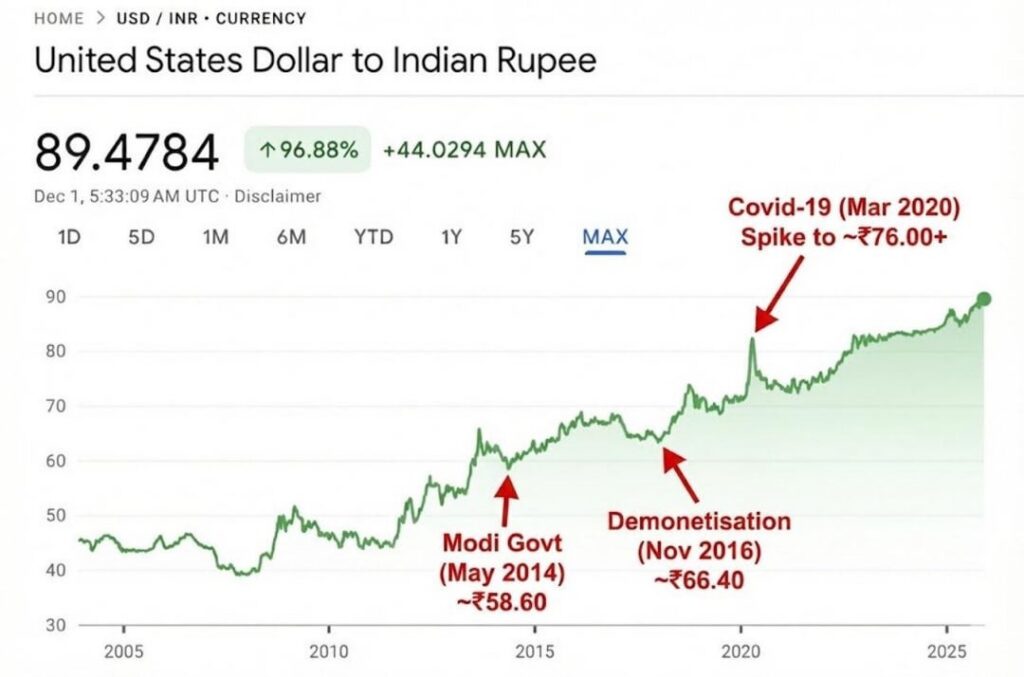
The Reserve Bank of India has been spending billions of dollars to defend the rupee against the US dollar. However, its intervention has only prevented a sudden collapse; it has not arrested the currency’s persistent decline. The rupee continues to touch new lows with alarming regularity. The government does not appear to have come to grips with the fundamental problems afflicting the currency or to understand why it has become the worst-performing currency in Asia. It remains in denial, preferring to attribute the crisis solely to global headwinds.
The present dispensation appears fundamentally incapable of setting the economy right. Its overriding preoccupation is to recast the polity in a majoritarian mould. It has no coherent economic project for the country. Its principal objective seems to be the enrichment of a small circle of cronies.
It would be a mistake to think that the last twelve years have been damaging only to the country’s economic performance.
The present dispensation is fundamentally altering India’s political society. That is an equally grave concern.
Part 2 follows tomorrow







A powerful and timely beginning to what promises to be an important series. By revisiting Stan Swamy’s life and legacy, this article raises profound questions about justice, dissent, and the treatment of those who stand with marginalized communities. Looking forward to Part Two