

Beyond Euphoria: Capital and Uneven Integration in the EU–India Trade Deal


Seen against the wider arc of global political economy, the EU–India trade agreement reflects the ambivalence of contemporary global capital, caught between a long-standing commitment to liberalisation and a more recent turn towards protectionism, strategic autonomy, and economic nationalism. After nearly a decade marked by trade wars, supply-chain securitisation, and industrial subsidies (especially following the 2008 crisis, the pandemic, and geopolitical shocks) the agreement signals that large blocs have not fully abandoned liberal trade, even as they hedge against its risks. Rather than a clean return to free trade, the deal embodies a cautious, selective liberalisation, suggesting that global capital itself is uncertain whether future accumulation lies in open markets or in managed, geopolitically aligned economic spaces.
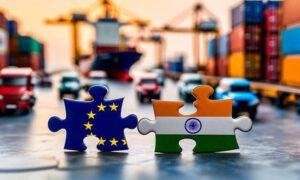
Cautious Beginnings of the EU-Deal under the UPA
Although widely projected as a Modi–NDA achievement, the agreement in fact has a long and complex history that predates the current government by nearly two decades, rooted in negotiations initiated well before the present phase of trade diplomacy. Conceived during the UPA years, the EU–India trade negotiations reflected a phase of cautious liberalisation, marked by sustained resistance to intrusive regulatory and intellectual property demands. Negotiations between European Union and India were formally launched in 2007, during the time of the UPA government, driven by mutual interest in expanding trade and investment ties as India’s economy liberalised and the EU sought deeper engagement with emerging markets. Negotiations had stalled by 2013, primarily over disagreements on tariff reductions, access to India’s services market, public procurement, data protection, and intellectual property, especially EU demands linked to pharmaceuticals, patents, and geographical indications. India, for its part, resisted deep tariff cuts in sensitive manufacturing sectors and objected to what it saw as intrusive regulatory and labour-environmental clauses.
Negotiations were revived in 2021, in a changed domestic context of crony capitalism and the global context marked by US–China rivalry, pandemic-induced supply disruptions, and Europe’s search for “trusted partners.” The renewed talks reframed the agreement not only as a trade pact but as a strategic partnership, yet many of the original contentions, market access asymmetries, regulatory standards, and policy sovereignty, continued to shape the bargaining process. The eventual agreement thus carries the imprint of this prolonged negotiation history: ambitious in scope, cautious in design, and marked by compromises that reveal the unresolved tensions within contemporary global liberalisation itself.
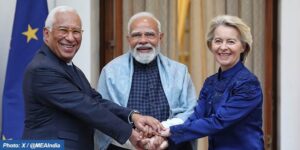
Divergent Payoffs: EU Market Penetration and India’s Conditional Upside
The EU–India trade deal is a wide-ranging free trade agreement that aims to liberalise around 96–99% of bilateral trade by value over a phased period, making it one of the EU’s most ambitious FTAs with a developing economy. It focuses heavily on tariff reductions in manufactured goods, with India cutting high duties on automobiles, auto components, machinery, wines and spirits, chemicals, and high-end consumer goods, while the EU opens its market further to Indian textiles, garments, pharmaceuticals, engineering goods, gems and jewellery, and marine products. Alongside goods, the agreement expands coverage in services, especially IT, business services, finance, and digital trade, and introduces provisions on regulatory cooperation, intellectual property, customs facilitation, and sustainable development. The deal is embedded in a broader strategic partnership and is expected to raise total bilateral trade from roughly USD 190 billion at present to around USD 200 billion by the end of the decade, subject to implementation and global conditions.
For India, the principal benefits lie in scale, diversification, and long-term positioning rather than immediate windfalls. Improved access to the EU, the world’s largest single market and India’s top trading partner, creates scope for export growth in sectors where India already has capacity, particularly textiles and apparel, pharmaceuticals, and engineering goods. Services exports stand to gain from enhanced market access and limited mobility provisions for skilled professionals, reinforcing India’s strength in IT and knowledge services. The agreement is also expected to encourage higher European foreign direct investment by offering regulatory predictability and deeper integration into European supply chains, especially in manufacturing and green technologies. Strategically, the deal helps India hedge against global protectionism and supply-chain disruptions while strengthening its economic ties with a major bloc outside the US–China axis, potentially anchoring India more firmly within global value chains if complementary domestic policies are effectively pursued.
Despite its scale and ambition, the EU–India trade deal carries several structural and political pitfalls that could blunt its promised gains for India. A central concern is the exposure of Indian manufacturing—especially automobiles, capital goods, chemicals, and high-end consumer products—to far more competitive European firms. India’s tariff protection historically compensated for infrastructural gaps, higher logistics costs, and uneven technological upgrading; tariff reductions without parallel domestic strengthening risk import surges that could squeeze MSMEs and deepen de-industrialisation in vulnerable sectors. Compliance with stringent EU technical, environmental, and labour standards is another major hurdle. While framed as “quality upgrading,” these standards function in practice as non-tariff barriers, raising costs for Indian exporters, particularly small producers, who may lack the capital, certification capacity, or institutional support to adapt quickly.
There are also longer-term distributional anxieties. Even though sensitive agricultural sectors like dairy have been formally excluded, the agreement increases indirect pressures on rural livelihoods through processed food imports, changing consumption patterns, and the possibility of future liberalisation through review clauses. Environmental provisions, especially when read alongside the EU’s Carbon Border Adjustment Mechanism, may penalise Indian exports in steel, aluminium, cement, and chemicals unless India rapidly decarbonises production, effectively shifting adjustment costs onto developing-country producers. From a policy-sovereignty perspective, deeper regulatory cooperation and intellectual property commitments could gradually narrow India’s room to manoeuvre on industrial policy, public procurement preferences, and access to affordable medicines, areas where the EU has historically pushed for stronger protections aligned with corporate interests.
Finally, there is a political-economy risk of asymmetry: the EU’s firms are far better positioned to exploit the agreement immediately, while India’s gains depend on medium- to long-term structural reforms whose outcomes are uncertain. Without active state intervention, targeted industrial support, MSME upgrading, standards-compliance assistance, and carbon-transition financing, the deal could widen sectoral and regional inequalities rather than correct them. In that sense, the FTA is less a guaranteed development lever than a high-stakes bet: its success for India hinges not on market access alone, but on whether trade liberalisation is matched by sustained domestic capacity-building and social protection.
Whether the EU–India trade deal is beneficial for India depends less on the headline tariff cuts and more on how the agreement is absorbed into India’s existing political economy. In a narrow trade sense, the deal clearly opens up opportunities. The EU is already one of India’s largest trading partners, and improved access to a high-income, relatively stable market can strengthen Indian exports in textiles, pharmaceuticals, engineering goods, marine products, and selected agri-processing sectors. For services, particularly IT, digital services, consultancy, and professional services, the agreement potentially consolidates India’s comparative advantage, especially if mobility provisions for skilled professionals are implemented in a meaningful rather than symbolic way. From this perspective, the deal can help India diversify export destinations at a time of geopolitical uncertainty and slowing global demand.
At the same time, these benefits are neither automatic nor evenly distributed. The agreement is likely to reward sectors that are already export-ready, capital-intensive, and integrated into global markets, while offering limited immediate gains to labour-intensive or informal sectors unless accompanied by targeted state support. The real payoff for India lies in its ability to convert market access into domestic capability, through upgrading infrastructure, supporting MSMEs, investing in standards compliance, and managing the social costs of adjustment. In that sense, the deal is beneficial not as a standalone instrument but as part of a broader developmental strategy. If treated merely as a liberalisation exercise, its gains may remain uncertain and fragile, an outcome that cannot be completely ruled out.
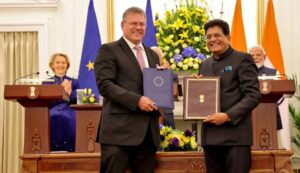
Trade Agreement or Geopolitical Realignment? Selective Liberalisation in a Fragmented Global Order
The EU–India trade deal needs to be read less as a bilateral commercial arrangement and more as a moment in the reconfiguration of global capital under conditions of intensified inter-imperialist competition. As supply chains fragment, protectionism rises, and geopolitical blocs harden, trade agreements increasingly function as instruments through which major centres of capital seek secure markets, reliable production bases, and strategic alignment. From this angle, the agreement signals Europe’s attempt to consolidate an economic foothold in South Asia at a time when both the US and China are recalibrating their global economic strategies. For the United States, the deal may be viewed ambivalently: welcomed insofar as it draws India closer to the Western economic orbit and counterbalances China, but also watched carefully as a potential challenge to US commercial dominance in high-value services, technology standards, and investment flows. China, by contrast, is likely to see the agreement as part of a broader effort to limit its manufacturing and supply-chain centrality by positioning India as an alternative production hub integrated with European capital. Japan, whose capital has long been embedded in Asian production networks and increasingly in India, may interpret the deal pragmatically, as an opportunity to leverage India–EU integration for its own investments, while remaining cautious about regulatory and standards regimes shaped primarily by Europe. Seen this way, the EU–India trade deal is not merely about tariffs and market access, but about how global capital reorganises itself amid shifting power balances, competing imperialisms, and the search for relatively stable anchors in an unstable world economy.
Ultimately, the EU–India trade agreement should not be overstated as a transformative intervention in the global balance of economic power, nor is it designed to be one. It does little to alter the structural hierarchies of global capitalism or the asymmetries between advanced capitalist blocs and emerging economies. India will continue to operate within a trade regime shaped by persistent pressures from global capital, adapting selectively and extracting partial gains where possible rather than redefining the terms of exchange. While the agreement may expand India’s options at the margins, it is likely to create even greater strategic and commercial flexibility for European—and indirectly American—capital seeking access to markets, production bases, and supply-chain alternatives. The deal thus represents continuity more than rupture: an incremental recalibration within an already uneven global system. In this context, there is little basis for euphoria. The agreement’s significance lies in its tactical adjustments and limited opportunities, not in any fundamental reordering of global economic power or a decisive shift in India’s position within it.








Written with nuance and deep clarity!