Bihar at the Crossroads: Youthful Aspirations vs Tired Alliances

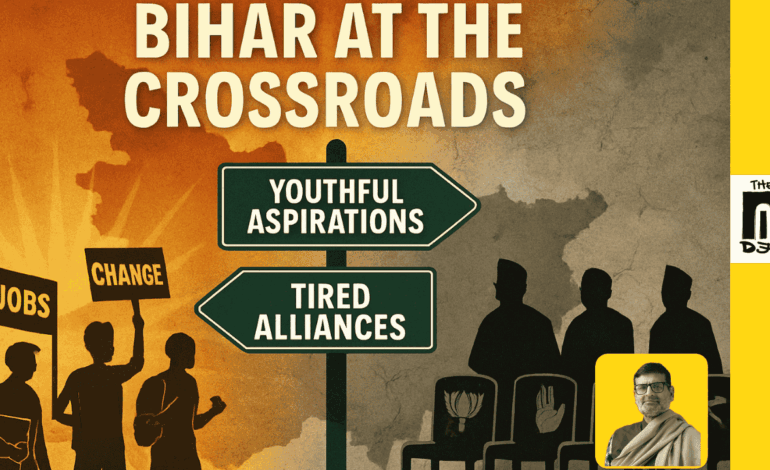
Bihar stands at a political inflection point. Its youthful population restless, its old guard floundering. As the 2025 Assembly elections near, the state is caught between a crisis-ridden status quo and emerging voices demanding transformation. The BJP-JDU alliance, drained of ideas and dynamism, clings to fading charisma and communal tropes. The opposition, despite being afflicted by ideological divides, shows signs of a new energy , primarily on the strength of RJD leader Tejashwi Yadav’s growing personal appeal . Others in the opposition side , including Prashant Kishor, the leader of the fledgling Jan Suraj Party are also drawing strength from campus-bred intellectuals to grassroots strategists. This is not just a contest for power, it’s a reckoning with Bihar’s past, a tug-of-war over its future, and a test of who can truly speak for its people.
This is the 17th article in Senior Journalist and author Nalin Verma’s fortnightly column in The AIDEM titled ‘Everything Under The Sun.’
“Educate, agitate, organize,” B. R. Ambedkar once said.
Ambedkar’s clarion call came at a time when India was shackled by dual forms of slavery—one under British colonial rule and the other under the Hindu varnashram system, which dehumanized marginalized communities by condemning them to perpetual servitude for their birth in the ‘Shudra’ caste.
As Bihar heads toward Assembly elections in October/November 2025, the state finds itself entangled in a web of crises: unprecedented unemployment, large-scale migration of farm workers, crumbling educational infrastructure, deteriorating law and order, and an eroding governance machinery. Chief Minister Nitish Kumar appears a shadow of his former self, and the controversial Election Commission-sponsored Special Intensive Revision of voter rolls has only deepened the prevailing confusion and chaos.
Bihar teeters on the brink. The Bharatiya Janata Party (BJP), which has shared power with Nitish Kumar for most of his 20-year tenure, appears jaded—recycling the worn-out ‘Hindu versus Muslim’ narrative. Meanwhile, the Janata Dal (United) looks adrift, weakened by Nitish’s declining health and its failure to cultivate a new generation of leaders.

In the post–Sushil Kumar Modi era—Sushil being a shrewd campaigner with a firm grasp of Bihar’s society, politics, and economy—the BJP lacks credible state-level faces. It leans entirely on Prime Minister Narendra Modi’s charisma, but even that has dulled after 11 years in office. Once able to draw spontaneous crowds, Modi’s rallies now reportedly rely heavily on government machinery to ferry ASHA workers, teachers, and employees to fill seats.
It would be naïve, however, to assume that the opposition parties—the Rashtriya Janata Dal (RJD), Congress, Left, and the fledgling Jan Suraj Party—hold a magic wand to rescue Bihar from its quagmire. Yet, there is a glimmer of hope. The opposition camp is brimming with fresh faces and youthful energy—like blossoms rising from muddy waters.
Opposition Reboots:
Tejashwi Yadav, who leads the RJD, has worked hard to refurbish the party’s image. Though critics deride him as “less educated,” he has outpaced many in inducting scholar-activists into his ranks. Professor Manoj Jha, a well-regarded academic from Delhi University, leads the party’s intellectual discourse in Parliament. The RJD boasts a roster of articulate and highly educated spokespersons such as Jayant Jigyasu, Priyanka Bharati, and Kanchana Yadav. Jigyasu holds a PhD from Jawaharlal Nehru University (JNU), while Priyanka and Kanchana are PhD scholars there—frequently matching wits with opponents on national television and digital platforms. Additionally, the party has Nawal Kishore, a Delhi University faculty member known for his knack for building campus-level organization.

And one cannot overlook Prashant Kishor and his Jan Suraj Party. Once a celebrated political strategist who played a crucial role in the electoral successes of prominent leaders—including Narendra Modi and Nitish Kumar—Prashant has now reinvented himself as a grassroots political activist. Over the past three years, he has traversed the length and breadth of Bihar, carving out a niche among the state’s electorate. Backed by data, clarity, and an engaging communication style, Prashant Kishor has become a household name in Bihar.
The Congress, the grand old party, has also significantly refurbished its image in Bihar. Under the stewardship of Rahul Gandhi—arguably the most persistent and trenchant critic of the Prime Minister and the Sangh Parivar—the party has appointed Krishna Allavaru as its Bihar in-charge ahead of the polls. Allavaru is a highly educated and competent professional, with an MBA from INSEAD, Fontainebleau (France), and an LLM from Georgetown University Law Center. Young and energetic, he hails from Karnataka and is known for his pragmatic approach in dealing with alliance partners and crafting electoral strategies. Importantly, he is believed to enjoy Rahul Gandhi’s trust. Additionally, the party boasts the presence of Kanhaiya Kumar, a JNU doctorate and fiery orator known for dismantling the Hindutva narrative with clarity and confidence.

The Left, meanwhile, is steered in Bihar by the CPI-ML Liberation under the leadership of Dipankar Bhattacharya, a graduate of the prestigious Indian Statistical Institute, Calcutta. Though not young anymore, Dipankar became a full-time revolutionary at an early age, joining the CPI-ML when it operated underground. He succeeded Vinod Mishra as the party’s general secretary in the 1990s while still in his early 30s. Those familiar with Dipankar know his vast and nuanced understanding of Bihar’s marginalized communities, gender discrimination, inequality, and poverty—and his progressive vision for governance. His commitment to the cause of the poor, the marginalized, and minorities is unwavering, and he enjoys solid support among the party’s cadre, both in the broader society and on educational campuses across India.
NDA Falters:
If one compares the BJP–JDU-led National Democratic Alliance (NDA)—which also includes Chirag Paswan’s faction of the Lok Janshakti Party, Jitan Ram Manjhi’s Hindustani Awam Morcha, and Upendra Kushwaha’s Rashtriya Loktantrik Samata Party (a Koiri outfit)—with the INDIA bloc and the Jan Suraj Party, the NDA visibly lags in youthful energy, fresh ideas, and a hopeful vision for the future. Chirag Paswan is, of course, young, but his long-standing friction with Nitish Kumar undermines the NDA’s cohesion.
However, the opposition too suffers from internal strife and mutual antagonism. Both Prashant Kishor and Tejashwi Yadav raise the same critical issues—unemployment, migration, price rise, crumbling educational infrastructure, the Prime Minister’s failed promises on jobs, industries and agriculture, and Nitish Kumar’s relentless grip on power despite visible infirmities—yet they remain embroiled in rivalry.
Prashant Kishor frequently derides Tejashwi as a “ninth-class pass” who owes his political career solely to his father, Lalu Prasad Yadav. In return, RJD workers dismiss Prashant as an upper-caste Brahmin elitist and brand him a “B-Team of the BJP.” Prashant advocates for vyavastha parivartan(systemic change) and categorically lumps together the past 35 years of Bihar politics—spanning both Lalu and Nitish eras—as symptomatic of backwardness and stagnation.
What both camps fail to grasp is that Tejashwi and Prashant represent the future of Bihar, while Nitish Kumar and Narendra Modi are nearing the twilight of their political careers. Even as they chart different paths, Tejashwi and Prashant will ultimately have to forge a working relationship to lift Bihar out of the quagmire left behind by the NDA’s misgovernance.

In contrast to Nitish and Modi—who still hold executive office—Lalu Prasad Yadav, the tallest mass leader in the Hindi heartland, has consciously receded into a de jure role, making space for Tejashwi and the younger generation. However, it would be unwise to disregard Lalu’s vast experience, his unmatched ability to counter saffron politics, and his deep understanding of Bihar’s social fabric and the broader Hindi belt. Far from being in the race for the Prime Minister’s or Chief Minister’s post, Lalu today should be seen as a mentor, a strategist, and a moral compass for the opposition—not as a rival to Modi or Nitish.
There is little doubt that if the opposition can put its house in order, the NDA’s presence in Bihar could be drastically diminished. But expecting a Prashant–Tejashwi alliance at this juncture is wishful thinking. What seems more likely is that the 2025 election will elevate these younger leaders as key players in Bihar’s political landscape, while significantly eroding the dominance of the Hindutva-anchored NDA regime in the state.