
Day 2: A chain-smoking deer, angry orcas and Rihanna’s bald impersonator make for quirky encounters


What happens when what started on the “fringe” takes centrestage?
It becomes a global celebration of everything art. For 78 years, the cobblestones of the Edinburgh Festival Fringe have witnessed the move of the margin to the mainstream. …And this year, it will also give volume to the 50 curated climate narratives that refuse to stay silent.
Storyteller and Arts Enthusiast Himali Kothari reports from Edinburgh.
CCTA started in 2015 with the view that theatre would impel the audience to act to address the climate crisis. It recognised the power of stories. And, it made the plays available to any audience of any size, anywhere in the world to perform them as they like. The same concept has been applied at the Fringe. The open call from Venue 13 invited theatre groups who would be in Edinburgh to present their performances to read the fifty plays and choose the ones they wanted to perform. The actors-readers had complete freedom to give the script the shape and flavour they wanted.
The team from Art Sake Theatre Company starts off the production by invoking a quote from author and professor Vanessa Machado de Oliveira, “What if collective healing will be made possible precisely by facing–together–the end of the world as we know it?”. Oliveira’s works have focused on global justice and citizenship and our collective social and ecological responsibility.
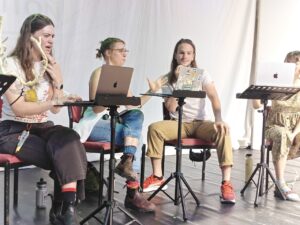
The performance starts off with Isla Cowan’s ‘Here in the Long Now’. Inspired by the concept of chronowashing the play highlights how corporations claim to support sustainability but their business practices push for needless consumption. In Cowan’s play a clockmaker talks to the company’s consumer about an innovative clock that the company is building which it claims is an icon of innovative thinking. On the other hand the company’s sellers prey on Susan’s mind to purchase its products. It is evident that both the products and the clock are useless.
In Alister Emerson’s play, ‘Six polar bears fell Out of the Sky this morning’. Unwilling to let the ‘greenies’ connect this to climate change, Madame Press Secretary and her coterie try to come up with a spin that could convince the public that nothing is wrong with the climate. From polar bear shaped space debris to drunk farmers to travelling circus, everything makes for a more plausible explanation than climate change. Emerson’s play emerges from her belief that, “Comedy makes universal truths more palatable.”
This is followed by Tira Palmquist’s ‘Eat the Rich’ in which a group of orcas plot to avenge the bad rep they are getting in the news. While Steve believes eating the rich could be the answer, Kai and Delmar try to reason with him. They manage to convince him to put his idea on hold and come up with a more peaceful measure to protest. Steve gives in but for how long?
The last play ‘The Presentation’ by Juan Sanchez ends today’s performance on a hopeful and empathetic note. It reminds us to stay connected to the present and not give up on a new beginning. The conversation between the two characters tells us that the solution lies in accepting that we may not all be at the same place in our journeys, but we can still be present without judgement and treat each other with compassion.
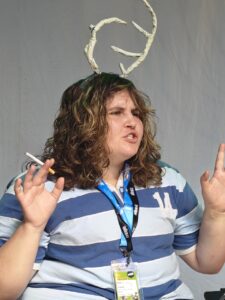
The play readings are interspersed with short monologues by a philosophical, chain-smoking reindeer, reprised from the theatre group’s production ‘Roadkill Bambi’ which features in another venue at the Fringe. A cigarette nonchalantly hooked on her fingers, Bambi’s words force us to think about the decisions we make when caught in the headlights of disaster. Hopefully, the headlights are not upon us yet?
Comic Timing
Comedy is the most popular genre at the Fringe. At any given point, one is likely to find dozens of comedians standing-up for comedy at the multiple bars, speakeasies, cafes, studios, etc. that make up the extensive list of hosting venues. I scroll through the description of multiple shows which only leaves me feeling that my brain has turned into soup (not sure what that should feel like though!). So, I summon timing, venue location and ticket prices to align and choose for me.
What I end up with, unwittingly, are two distinct-hued performances. The first one is titled Dance Like Everyone’s Dancing by Caitriona Dowden, who alternates between her study of the medieval past and her dread for her future. Dowden’s soft and single-toned voice seems more appropriate for an uncaring phone operator than the stage. But, it’s an illusion. And, one that shatters quickly as she successively lands punches for the entire hour.
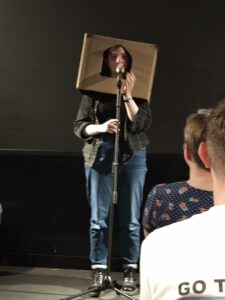
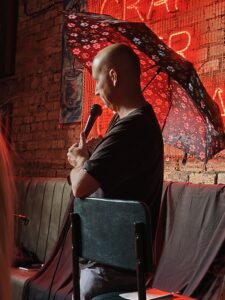
The second one at the end of the day ‘O Hair – Bald Man Sings Rihanna’ is presented in one of those contemporary after-office-hours bars. The description states that the show is back for the eighth time at the Fringe and has featured in comedy clubs across the globe. I fail to see the draw. There is little singing, barely any Rihanna and too much crowd-work.
From the CCTA plays to the stand-up comedy, hasya has turned out to be the rasa of the day. Storytellers and performers often speak of how challenging it is to elicit laughter from audiences. Perhaps that is also why it continues to be the emotion that holds maximum impact, be it in the form of a hesitant grin or a throaty laugh.




What a brilliant headline!