


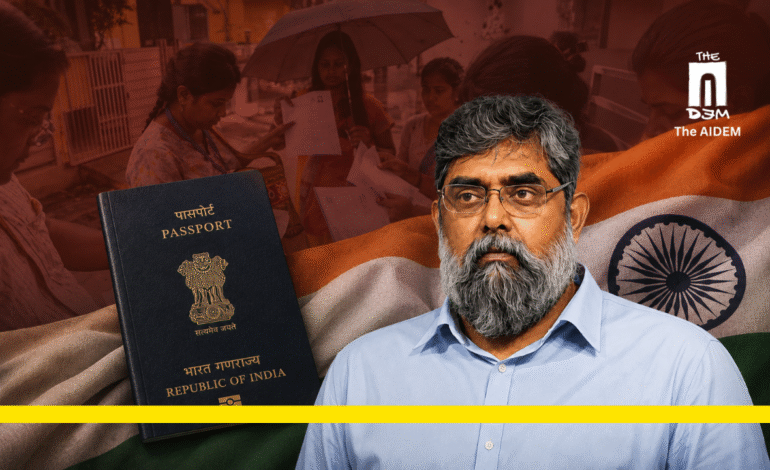
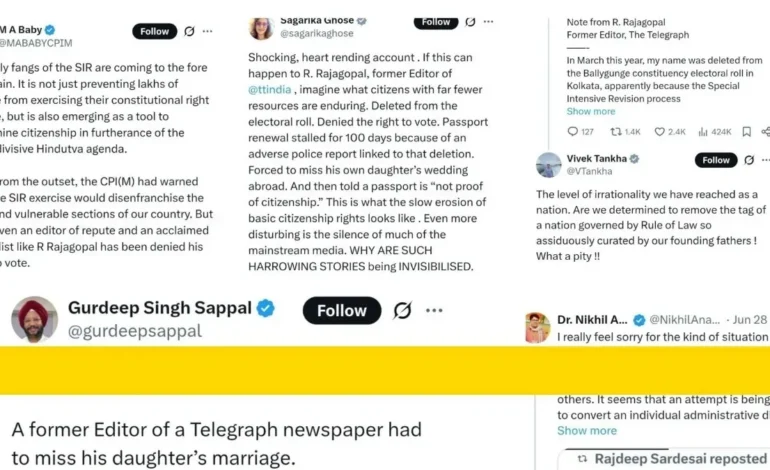
In a democracy, citizenship is meant to be a constitutional promise, not a privilege granted through endless paperwork. The ordeal of R. Rajagopal, the former Editor of The Telegraph, whose name disappeared from electoral rolls and who was denied passport renewal despite possessing valid identity documents, exposes a deeper anxiety about the changing nature of citizenship in India.
His personal struggle, as he himself has noted, may only be a glimpse of what millions could face in an era where belonging is increasingly mediated by documents, databases and digital verification. Academician and socio-political observer T. T. Sreekumar examines this dynamic shift — from citizenship as a fundamental right to citizenship as a condition constantly subjected to administrative and sectarian scrutiny.
The deeply unsettling experience narrated by R. Rajagopal, former Editor of The Telegraph, as he himself rightly points out, deserves to be read not merely as the misfortune of one individual but as a window into an emerging regime of citizenship in contemporary India. A veteran journalist and long-time voter, Rajagopal found his name deleted from the electoral rolls during the Special Intensive Revision (SIR) in West Bengal, ostensibly because officials could not trace his or his late father’s name in the 2002 electoral rolls. The deletion subsequently stalled the renewal of his passport after an adverse police verification report, leaving him unable to travel even for his daughter’s wedding abroad despite possessing multiple identity documents and a valid U.S. visa. Rajagopal himself has emphasized that his ordeal is insignificant compared with what millions of ordinary citizens may be forced to endure. His experience compels us to reflect on the changing architecture of citizenship in India, where constitutional membership increasingly appears to be mediated through documentary verification, administrative discretion, and interconnected digital databases. It is within this broader context that the evolving relationship between citizenship and digital governmentality needs to be understood.

A series of legislative, administrative, and technological measures have significantly reshaped the discourse and practice of citizenship in India. While these initiatives can be seen as necessary for improving governance, national security, administrative efficiency, and welfare delivery, that they collectively represent a shift from citizenship as a constitutionally guaranteed status towards citizenship as a condition that is increasingly documented, verified, and digitally authenticated. Nevertheless, as Shashi Tharoor argued in The Hindu (29 June 2026), democracies should move beyond piecemeal legislation and adopt a constitutional framework for the digital age that guarantees digital autonomy, privacy, informed consent, algorithmic transparency, corporate accountability, and meaningful public oversight, thereby safeguarding citizens’ rights in an increasingly digital society. In this context, it is pertinent to consider whether the recent trajectory of citizenship-related legislation and policy in India reflects the very concerns raised in this argument.
The most significant legislative intervention was the Citizenship (Amendment) Act (CAA), 2019, which introduced religion as a criterion for granting fast-track Indian citizenship to persecuted minorities from Pakistan, Bangladesh, and Afghanistan while excluding Muslims from its ambit. This marked an important departure from India’s historically religion-neutral conception of citizenship and generated widespread protests across the country. Closely associated with the CAA was the proposal for a nationwide National Register of Citizens (NRC). Although implemented only in Assam, the proposal raised concerns regarding the requirement for citizens to produce documentary proof of citizenship, particularly among poor, migrant, tribal, and marginalized communities. The controversy intensified because many observers viewed the NRC and the CAA together, arguing that they could produce unequal consequences for different religious communities.
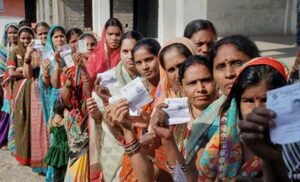
The National Population Register (NPR), though officially presented as a population database for administrative purposes, also became controversial. Critics argued that it could serve as the first stage of a future nationwide NRC by expanding the state’s capacity to collect demographic and identity-related information. In recent years, the Special Intensive Revision (SIR) of electoral rolls has similarly revived debates over citizenship and democratic participation. While SIR concerns voter registration rather than citizenship directly, it requires documentary verification of voters, increases administrative scrutiny, and potentially places the burden of proving eligibility on citizens. Consequently, the practical exercise of citizenship through voting becomes increasingly dependent upon documentary authentication.
Changes in passport administration also reflect this broader transformation. Greater digitization of passport services, expanded police verification, stricter documentation requirements, and closer integration with Aadhaar and other digital databases have made the passport system more document-intensive. Although these are primarily administrative reforms, they indicate a larger movement towards governance through documentary verification.

Perhaps the most far-reaching development has been the expansion of Aadhaar. Although Aadhaar originated before the BJP came to power, its integration into welfare delivery, banking, taxation, PAN, mobile phone services, and numerous public services accelerated considerably after 2014. While Aadhaar is officially not proof of citizenship, it increasingly functions as the foundational identity infrastructure through which citizens access essential state services. This trend has been reinforced by the growth of India’s digital public infrastructure, including platforms such as DigiLocker, digital health IDs (ABHA), and various online service delivery systems, all of which make digital authentication central to everyday citizenship.
Similarly, continuous electoral roll verification exercises and the integration of multiple government databases have strengthened the state’s capacity for identity verification. The Foreigners Tribunal system in Assam, though geographically limited, illustrates another important dimension of this transformation. Citizenship itself becomes subject to prolonged administrative adjudication, with individuals often carrying the burden of producing documentary evidence to establish their legal status. Alongside these developments, immigration and refugee policies have increasingly linked citizenship with questions of national security, border management, and illegal migration, thereby securitizing debates around belonging and political membership.
Taken together, these developments indicate a broader transformation in the nature of citizenship in India. The earlier constitutional model emphasized citizenship as a legal and universal status guaranteeing equal rights. Increasingly, however, citizenship is experienced through continuous documentary verification and administrative authentication. Rights become mediated by documents, databases, and digital identities. The universal language of constitutional membership is supplemented, and, according to some critics, increasingly overshadowed, by differentiated regimes of verification, documentation, and eligibility. Welfare entitlements, electoral participation, mobility, and access to public services are progressively organized through digital identity infrastructures, creating what many scholars describe as a shift from rights-centred citizenship to documentation-centred citizenship.
From the perspective of governmentality, citizenship increasingly becomes an object of governance through administrative procedures, surveillance, documentation, and bureaucratic regulation rather than merely a constitutional category. The concept of biopolitics helps explain how populations are managed through databases, identity systems, demographic classification, and continuous verification. Building upon these ideas, the notion of digital governmentality captures the emergence of governance through Aadhaar, digital identity platforms, artificial intelligence, facial recognition technologies, integrated databases, and algorithmic decision-making. Closely related is the concept of documentary citizenship, in which the enjoyment of rights increasingly depends upon the possession, production, and continuous validation of appropriate documents. Finally, scholars have argued that these developments contribute to the emergence of conditional citizenship, where citizenship may remain constitutionally secure for most Indians, but its practical exercise increasingly depends upon successful administrative verification and digital authentication.
Viewed collectively, therefore, the CAA, debates surrounding the NRC and NPR, the expansion of Aadhaar and digital public infrastructure, Special Intensive Revision of electoral rolls, passport reforms, electoral verification mechanisms, Foreigners Tribunals, and the securitization of immigration policy represent one of the most significant transformations in the understanding of citizenship in post-independence India. Whether interpreted as administrative modernization or as a restructuring of the citizen-state relationship, these developments have fundamentally altered the way citizenship is imagined, governed, and experienced in contemporary India.
Ultimately, Rajagopal’s experience is significant not because it is exceptional but because it may increasingly become ordinary. It serves as an important reminder that the future of citizenship in India will be determined not merely by constitutional guarantees but by how legislative reforms, administrative procedures, and digital governance are balanced against the fundamental principles of democracy, equality, and individual rights. The real challenge before Indian democracy is to ensure that technology and documentation remain instruments for facilitating citizenship rather than mechanisms that render citizenship contingent, precarious, and perpetually subject to verification.









“This article raises an important question about how citizenship is evolving in the digital age. While technology can improve governance, constitutional rights and due process must remain the foundation of citizenship. A democracy is strongest when digital systems enhance inclusion, transparency, and accountability—not when they create uncertainty or exclusion