

SEWA – The Gandhian Trade Union

Ela Bhatt spent decades building a union for women who sold vegetables on the pavement, rolled beedis at home, and carried cloth bales on their heads through the markets of Ahmedabad—workers who, by every conventional definition, could not be unionised. She did it anyway, and in doing so rewrote the terms on which the world’s poorest workers could claim a place in the economy.
The first thing to understand about the Self-Employed Women’s Association known in India, as SEWA is the scale of the problem it was created to address. Around 90% of India’s working population earns its living from what economists call the informal sector. These are people who do not have an employer in any conventional sense, who receive no benefits, who are covered by no contract, and who wake each morning to an income that is, at best, a reasonable guess. Street vendors, home-based piece-rate workers, construction labourers hired by the day, women who carry cloth on their heads through wholesale markets—these are the people who keep the Indian economy moving. And they are invariably invisible to the conventional economic planners and politicians.

The second thing to understand is the specific problem this invisibility creates for women. A traditional trade union functions by organising workers and by placing them on equal terms with an employer. It demands recognition, puts in place checks and balances through collective action, and extracts rights and concessions through bargaining. This model presupposes an employer to bargain with or against. For the woman who sells fish from a basket on a street corner, or rolls beedis in her kitchen for a contractor who may or may not reappear the next week, or carries other people’s goods through a market for a daily rate set by someone she will never meet twice, there is no employer to confront. There is only the market, with all of its indifference.
SEWA, which was formally constituted in Ahmedabad in 1972, now has more than 3.7 million members across India. It is the largest organisation of informal-sector workers in the world. Every one of its members is a woman and it is governed entirely by women. Its founding premise is that workers without employers still deserve the protections of organised labour, and that an organisation serving them is, legally and morally, a trade union—was considered somewhere between eccentric and incoherent when Ela Bhatt first proposed it. She has spent the fifty years since proving that it is neither.
THE EDUCATION OF ELA BHATT
Ela Bhatt was born in Ahmedabad in 1933, into a family shaped by two distinct inheritances. Her father, Sumant Rao Bhatt, was a successful lawyer. Her mother, Vanalila Vyas, was a prominent feminist and the secretary of the All India Women’s Conference, the organisation founded by the activist Kamaladevi Chattopadhyaya. The domestic atmosphere of Bhatt’s childhood was, by her own account, saturated with argument about rights, justice, and the condition of Indian women. It is perhaps not surprising that she became a lawyer, or that she spent her legal career doing something other than what lawyers in her circumstances typically do.
She completed her legal studies in Ahmedabad, taught briefly at the S.N.D.T. Women’s University in Bombay, and then joined the legal department of the Textile Labour Association—the TLA—in Ahmedabad. The TLA is one of the oldest and most storied trade unions in India, with roots in the great mill strike of 1918.
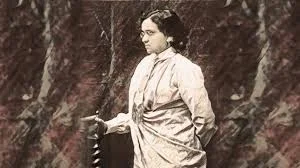
That strike is worth pausing on, because it explains the moral universe into which Bhatt was absorbed when she joined the TLA. The strike had been led by Anasuya Sarabhai, known to everyone as Mota Ben— Elder Sister—the daughter of a prominent Gujarat industrialist family and the sister of the mill owner Ambalal Sarabhai. Her biography contains enough paradoxes to sustain a novel. Married young and widowed, she had gone to London to study medicine, abandoned it when the requirement to dissect animals conflicted with her Jain convictions, taken up economics at the London School of Economics, become a Fabian, marched with the suffragettes, and returned to India in 1913 to work for the poor. When the mill workers of Ahmedabad struck for a fifty-per-cent wage increase in 1918, it was Mota Ben who led them. Gandhi, a family friend of the Sarabhais, supported the strike, went on hunger strike himself, and ultimately mediated a settlement at thirty-five per cent. Out of that settlement grew the Textile Labour Association (TLA).
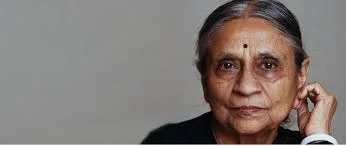
Bhatt joined the TLA in 1955. In 1968, she was asked to lead its women’s wing, and was sent to Tel Aviv for a three-month training program at the Afro-Asian Institute for Labor and Cooperative Studies. When she returned, she began, with the intensity that characterises everything she has done, to look more carefully at the situation of working women in Ahmedabad—not the women who worked in organised factories, but the women who worked everywhere else.
What she found disturbed her. Women who sold vegetables from pushcarts. Women who carried bolts of cloth on their heads through the wholesale textile market. Women who rolled beedis at home and were paid by the bundle. Women who sewed garments on piece rates for contractors who appeared and disappeared without warning. These women were, by any economic measure, workers. They were not, by any legal measure, recognised as such. They had no contracts, no minimum wage, no recourse when they were cheated, no savings, no credit, and no insurance. They were, in the full technical sense, on their own.
HEAD-LOADERS AND THE BIRTH OF SEWA
The immediate occasion for SEWA’s creation was a dispute in the textile market. In 1971, a group of women who worked as cart-pullers—hauling bolts of cloth through the lanes of Ahmedabad’s wholesale fabric district—approached Bhatt through their contractors. They were migrant workers, and they were being denied the shelter they needed. Bhatt went to the market to investigate, and there encountered a second group whose situation was even more precarious: the head-loaders, women who carried cloth bales on their heads and were paid by the merchants at whatever rate the merchants chose.
She wrote about what she found—the arbitrary rates, the extortion, the complete absence of any protection—in a local newspaper. The merchants responded with letters of their own, disputing her account. The controversy grew large enough to require a public meeting, at which both sides were represented. At that meeting, one of the women workers stood up and proposed that they form an organisation to represent their interests. SEWA was born.
The question of what SEWA was legally and institutionally, proved immediately contentious. The women wanted to register it as a trade union. The state labour department was baffled. A trade union, in the department’s understanding, was an organization that bargained with an employer on behalf of employees. SEWA’s proposed members were, for the most part, self-employed or engaged in informal piece-rate work. They had no employer in any recognisable sense. Who, the department asked, would they bargain with? Registration was refused.
Bhatt argued, patiently and repeatedly, that the purpose of a trade union was to organise workers and advance their interests, and that SEWA’s members were unambiguously workers, and that the organisation therefore qualified. She prevailed. SEWA was registered as a trade union in 1972, establishing a legal precedent that would eventually reshape how governments and international labour organisations thought about informal work.
THE ARCHITECTURE OF SEWA
SEWA’s membership is open to any self-employed woman or informal-sector worker. The annual subscription is five rupees. Members are organised by trade into constituent groups, each of which elects representatives at a ratio of roughly one per hundred members; these representatives form a governing council. Within each trade, a smaller working group of fifteen to twenty members handles the day-to-day problems specific to that occupation.
The range of trades covered is, in itself, a kind of portrait of how poor women in India actually earn their livings. There are street vendors: women who sell vegetables, eggs, fish, meat, and household goods from fixed pitches or from baskets carried through residential neighbourhoods. There are home-based workers: weavers, potters, beedi-rollers, papad-makers, garment-stitchers, and craftswomen of many kinds. There are manual labourers – agricultural workers, construction workers, casual labourers, handcart-pullers, head-loaders, domestic workers. And there are producers and service providers: small farmers, livestock herders, salt workers, and women who prepare and sell food from their homes.
What unites these categories is not the nature of the work but the condition of the worker: the absence of a fixed income, the absence of legal protections, the absence of any institutional voice. SEWA functions as that voice. It has lobbied for minimum rates in specific trades—beedi workers secured better contract prices, head-loaders won higher daily rates. It has used the collective weight of its membership to help individual women navigate government schemes that would otherwise be inaccessible to them. Kennedy School of Government researchers who studied SEWA’s outcomes found that members were significantly more likely than non-members to receive government subsidies for housing and education, not because the subsidies were designed with SEWA members in mind but because SEWA had taught its members how to seek.
THE BANK
A union, however well run, can only do so much for workers whose fundamental problem is the absence of any financial cushion. A woman who sells vegetables has no savings to fall back on when she falls ill. A woman who rolls beedis at home has no credit history that a bank would recognise. The moneylenders of urban India, the local loan sharks who have served the informal economy for generations charge interest rates that are, in the technical sense, usurious: borrowers frequently find themselves unable to repay the principal at all, let alone the accumulating interest, and remain in debt indefinitely. The formal banking system, for its part, had no interest in lending to women with no collateral, no credit history, and no employer.
SEWA’s answer was to build its own bank. In 1974, fifteen members of the organisation pooled their resources and established the SEWA Cooperative Bank, an urban cooperative registered under Gujarat’s cooperative societies law. Four thousand women contributed ten rupees each as their share capital. The bank began making small loans—enough to buy a pushcart, to purchase raw materials for a month’s worth of beedi-rolling, to repair a loom—at interest rates that were high by the standards of the formal banking sector but negligible compared to what the moneylenders charged.
The bank’s most distinctive feature was its field staff. Each ‘bank saathi’—bank friend—was a woman from the community she served, selected for her local standing and her natural authority among her neighbours. A saathi typically covered three hundred to four hundred members. Before recommending a loan, she conducted what amounted to a social audit of the applicant: investigating her family situation, the stability of her income, the reliability of her husband (specifically, whether he drank), the likely use of the borrowed money. The saathi’s recommendation then went to a senior officer, who made the final decision—but only after meeting the applicant in person and explaining the terms of the loan in language simple enough to be understood by someone without any prior financial literacy. The bank paid three per cent of each loan as the saathi’s fee; saathis also earned one per cent of the savings deposited by members in their territory. The incentive structure rewarded both lending and saving, and tied the saathi’s income to the financial health of her clients.
By the end of the 2024-25 financial year, the SEWA Bank had held deposits of 344 crores, had outstanding loans of 218 crores, and had generated a net profit of 1.21 crores. The Economic Times recognised Ela Bhatt for this achievement with its award for Outstanding Entrepreneur—an accolade that, applied to the founder of a cooperative bank for vegetable vendors and beedi-rollers, says something interesting about how the definition of entrepreneurship has evolved. The bank also administers a national pension scheme for low-income workers; its forty thousand participants use it to accumulate small savings that, combined with government subsidies, provide a minimal financial floor for old age.
THE LIMITS OF THE POSSIBLE
SEWA’s geographic expansion has followed the logic of demand. Beginning in Ahmedabad, it extended into Uttar Pradesh, Bihar, Madhya Pradesh, Rajasthan, Delhi, Kerala, Jammu and Kashmir, and the northeastern states. Forty-five per cent of its members now live outside Gujarat. The organisation adapts its programs to local conditions: in Bihar, it runs food-processing training for women; in Rajasthan, it offers computer literacy. What does not change across geographies is the fundamental observation that motivated Bhatt half a century ago—that economic insecurity is not a feature of informal work but its defining characteristic, and that this insecurity falls hardest on women.
The SEWA model has influenced policy at levels that Bhatt, setting up her first women’s unit within the TLA in the late nineteen-sixties, could not have anticipated. In 2015, the International Labour Organisation committed itself to advancing the rights of informal-sector workers—a commitment in which SEWA played a significant consultative role. The organisation has lobbied against labour law reforms it considers harmful to its members, advocated for construction workers to receive pensions funded from road taxes collected by the central government, and pushed for waste-pickers—women who collect recyclable paper and plastic from city streets—to be formally integrated into municipal waste-management systems, giving them both security of employment and access to protective equipment.
The response to sudden economic shocks has become one of SEWA’s most visible functions. When the ship-breaking industry at Alang, in Gujarat—where a hundred thousand workers, forty per cent of them women, break down old vessels for scrap—contracted sharply in 2015, it was SEWA that moved in quickly to provide retraining in self-employment for the women who had lost their livelihoods overnight.
And yet, by Bhatt’s own accounting, SEWA has touched only a fraction of the people it was built to serve. There are roughly two hundred and fifty to three hundred million women in India’s informal economy. SEWA has reached one and a half million of them. The gap between those numbers, between what has been accomplished and what remains to be done—is not a measure of failure. It is a measure of the size of the problem.
THE ELDER
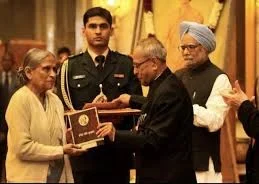
The honours she has received—the Padma Vibhushan, India’s second-highest civilian award; the Ramon Magsaysay Award; honorary doctorates from Harvard; the Indira Gandhi Prize—constitute a fairly complete list of the distinctions available to someone who has spent a lifetime doing what she has done. In 2007, Nelson Mandela and Archbishop Desmond Tutu established a group they called The Elders: a small collection of senior statespeople and public figures—among them Jimmy Carter and Kofi Annan—who had agreed to serve as an independent moral voice on the world’s most intractable problems, traveling to places of crisis and speaking without the constraints of office. Bhatt was a member. It is, in its quiet way, an appropriate role for someone who has spent her career building institutions designed to give voice to people who had none.
The Gandhian lineage she inhabits is not merely biographical. SEWA’s stated values are the ones Gandhi articulated: truth, nonviolence, the equal dignity of all religions, and the belief that social transformation is best achieved through the patient building of small institutions rather than the seizure of large ones. The TLA, which gave SEWA its institutional origins, was itself a product of Gandhi’s mediation in the 1918 mill strike. Mota Ben, who led that strike and mentored Bhatt, was Gandhi’s colleague and friend. The thread from Gandhi to Sarabhai to the TLA to Bhatt to SEWA is not a metaphor. It is a lineage, transmitted through institutions and through individual example.
What Bhatt added to that inheritance was a specific insight that Gandhi’s movement, for all its achievements, had not fully articulated: that the informal economy was not a temporary condition to be remedied by industrialisation but a permanent feature of the Indian—and global—economy, and that the workers within it deserved not charity but rights. The distinction matters. Charity can be withdrawn. Rights, once established in law and in practice, are considerably harder to revoke.
The head-loaders who carry cloth through the lanes of the Ahmedabad textile market are still there. Their daughters may be doing the same work, or something not very different from it. What has changed—what SEWA changed—is that those women now have an organiaation that knows their names, understands their trade, will advocate for their wages, will lend them money at reasonable rates when they need it, and will fight in legislatures and before labour tribunals for the principle that their work has value and that they are entitled to some of its fruit.
That is a modest description of a considerable achievement.








This story thoughtfully highlights the essence of Gandhian values in the trade union movement. In today’s changing labour landscape, such perspectives serve as a reminder of balance, ethics, and the importance of humane approaches to workers’ rights.