

The ‘Chakravyuha of Karma’: Where Myth, History and Life Converge

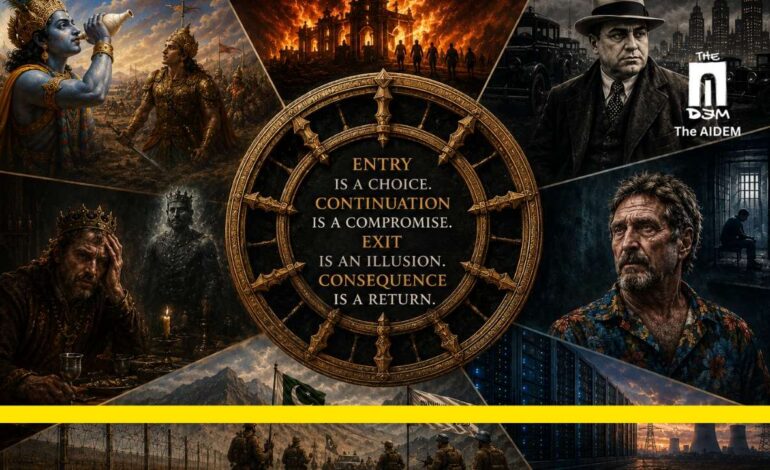
Ramesh Krishnan returns to drawing insights from the Mahabharata, this time addressing one of the epic’s most enduring ideas: karma, not as mystical reward or punishment, but as the inexorable return of consequence. Moving between mythology, history, literature and contemporary life, he explores how actions, once set in motion, acquire a momentum of their own.
Beginning with the unsettling story of a man confronted by the human cost of the very world he helped sustain, the essay travels through Duryodhana’s fatal conspiracy in the wax palace, the downfall of gangster Al Capone, the self-destruction of software pioneer John McAfee, and Shakespeare’s haunted Macbeth. Across centuries and cultures, the stories reveal a common pattern: wrongdoing rarely remains contained. What is inflicted on others often circles back in unexpected and intimate ways.
In The Chakravyuha of Karma, Krishnan argues that consequence is not merely a moral abstraction but a recurring geometry woven into human affairs. Like the legendary battle formation from the Mahabharata, it is far easier to enter than to escape. The wheel may turn slowly, but it turns with remarkable precision.
Lord Krishna is adored as the blue-hued. Raghuvanshi amoured blue, not the Lord’s colour, nor the expanse of sky or ocean, but the screen. By outward measure, he was a self-made man. He did not begin in darkness; like many, he wandered into it. Out of curiosity first, then convenience, then quiet complicity. The industry he entered was not spoken of in polite company, but it was profitable and discreet. What began as passive consumption became facilitation. He told himself he was merely a cog. History is unkind to such self-deception.
In the Mahabharata, Karna was not the architect of injustice, yet his allegiance to it proved fatal. Standing with the wrong side, even in silence, is rarely neutral. Raghav’s world ran on the same logic as the illicit economies that dot our headlines.
The sand-mining syndicates hollowing out riverbeds, coal mafias operating beyond law, the Sinola cartel of drug in Mexico, gold supply chains that begin in poisoned soils and end in polished vaults. Entry is easy. Exit is theoretical. Like the Clan del Golfo of Columbian gold mining, where permission is the first law and permanence the second, his ecosystem recorded everything, forgot nothing, and forgave even less.

Then, one evening, the wheel turned. Raghuvanshi was called into a private screening. No ceremony, no warning, just a room, a screen, and men who spoke softly. The film began like any other he had helped produce. Until it did not. A face appeared: his daughter’s. In that moment, the abstraction of wrongdoing collapsed into a single, unbearable point. What he had enabled had not remained “out there.” It had circled back, precisely and mercilessly, into his own life. There would be no clean break, no moral reset. Only a lifetime of knowing that the line he had crossed had, in time, crossed back over him.
The Wax Palace And The Returning Flame
Duryodhana committed his first act of murderous conspiracy not on a battlefield, but in a house of lac and wax. Plotting to burn the Pandavas alive, he had the palace secretly built as a death trap, intending to emerge blameless while his cousins perished. They escaped through a tunnel, but the fire consumed six innocent souls, a Nishada woman and her five sons.
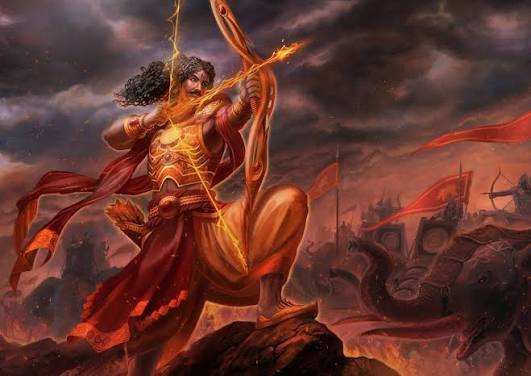
Here karma set its wheels turning. The very element Duryodhana deployed as a murder weapon became the instrument that pursued his lineage to extinction. When Ashvatthama launched the Narayanastra, and the funeral pyres of Kurukshetra burned for eighteen days, it was Duryodhana’s own bloodline, ninety-nine brothers, allies, generals, all consumed by flame. The fire he had lit in secret returned as a continent-wide conflagration he could not escape.
The Ledger That Outlived The Gun
Alphonse Capone ran the most feared criminal empire in 1920s America through bootlegging, gambling, prostitution, and murder, most infamously the St. Valentine’s Day Massacre of 1929. He had insulated himself brilliantly: witnesses vanished, judges were bought, policemen were on his payroll. Yet his fatal vanity was his love of the good life, lived loudly and in plain sight with lavish banquets, diamond-studded belts, rivers of undeclared cash. He regarded tax forms with the contempt of a man who had outgunned rivals.
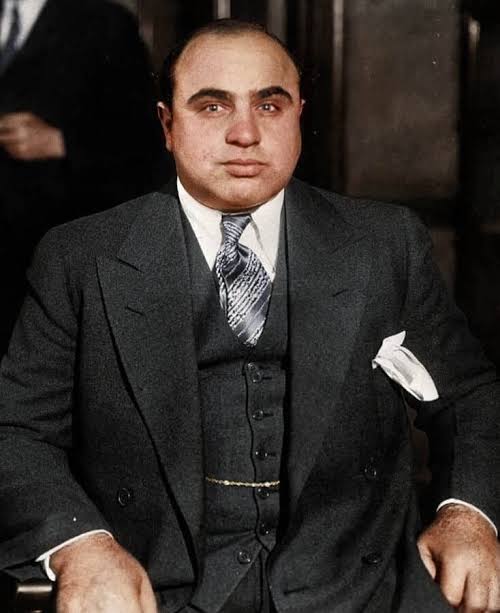
IRS agent Frank Wilson did what no bullet could. He followed the money. Capone had been meticulous about violence but careless about ledgers. Hotel receipts, gambling-house ledgers, and furniture invoices traced back to Capone.
In 1931, the most feared gangster in America was brought to his knees not by a rival’s gun but by income tax evasion. Sentenced to eleven years, his empire dissolved overnight. The true karmic sting came in prison: the syphilis he had carried for years ravaged his untreated brain.
By his release, Al Capone had the mental capacity of a twelve-year-old. The violence he had unleashed on others returned not as a bullet, but as a slow, internal demolition of the very mind that had built the empire.
The Virus In The Antivirus
In 1987, John McAfee created the world’s first commercial antivirus software. He understood better than almost anyone that malignancies left unchecked will corrupt and crash the entire system. He grew fabulously wealthy preaching this gospel to corporations and governments worldwide.
Yet in his personal life he ran no such protection. He plunged into a world of drugs, weapons, and cult-like communes on his Belize property, where he was accused of running a private militia and manufacturing illegal substances. His neighbour who had complained about McAfee’s dogs and behaviour was found shot dead; McAfee fled disguised in costumes, blogging his escape in real time with breathless self-dramatisation. He returned to the United States almost as a celebrity, leveraging infamy into a platform, seemingly convinced that his genius placed him beyond ordinary consequence, much like a virus that has disabled the very antivirus meant to catch it.
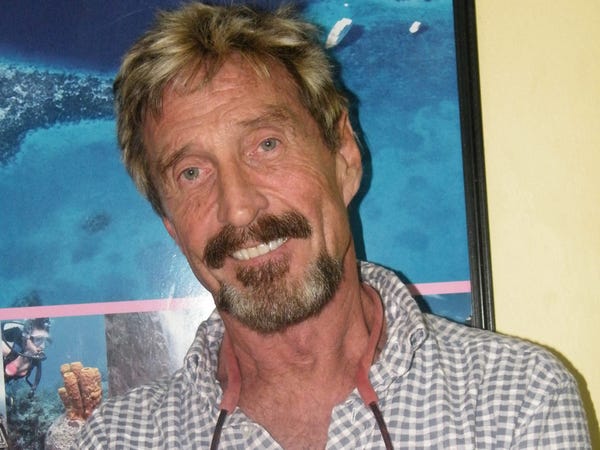
The reckoning came, as it had for Capone, through tax authorities. He had earned tens of millions promoting cryptocurrencies and paid not a penny in taxes, publicly boasting he never intended to. Arrested in Spain in 2020 on charges of tax evasion and crypto fraud, he was found dead in his Barcelona prison cell on the very day a court approved his extradition to the United States. He was 75.
The man who spent his career telling the world to build walls against destruction had, systematically, demolished every wall around himself, moral, legal, psychological, and finally physical. The architect of digital protection died utterly unprotected, alone in a foreign cell.
Karma, in McAfee’s case, did not arrive as an external force. It wore his own face.
“Full Of Scorpions Is My Mind”
Shakespeare gives us no better study of karma as psychological inescapability than Macbeth. The precise act that triggers his destruction is not ambition in the abstract, it is the specific, premeditated murder of the sleeping King Duncan, a guest under his roof, in violation of the sacred duty a host owes his guest. The consequences are not merely political; they are neurological.
Immediately after the murder, Macbeth cannot say “Amen” — the word is stopped in his throat. He tells Lady Macbeth, “Macbeth shall sleep no more” — and this proves literally, clinically true. The man who murdered a sleeping king is himself condemned never to sleep again. Every night becomes a torment of visions. He confesses to her, in words Shakespeare gives him with quiet devastation: “O, full of scorpions is my mind, dear wife.” This is not metaphor deployed for dramatic effect. It is a precise description of what unresolved guilt does to a conscious mind. It does not sit still, it does not fade, it stings repeatedly from within, and it multiplies.
His guilt then performs its own public confession. Banquo’s ghost appears at the royal banquet, seated in the very throne Macbeth has just usurped. Visible only to him, the king screams at an empty chair before his assembled court. No torturer arranged this. No court summoned it. The architecture of his crime simply reassembled itself inside his own perception.
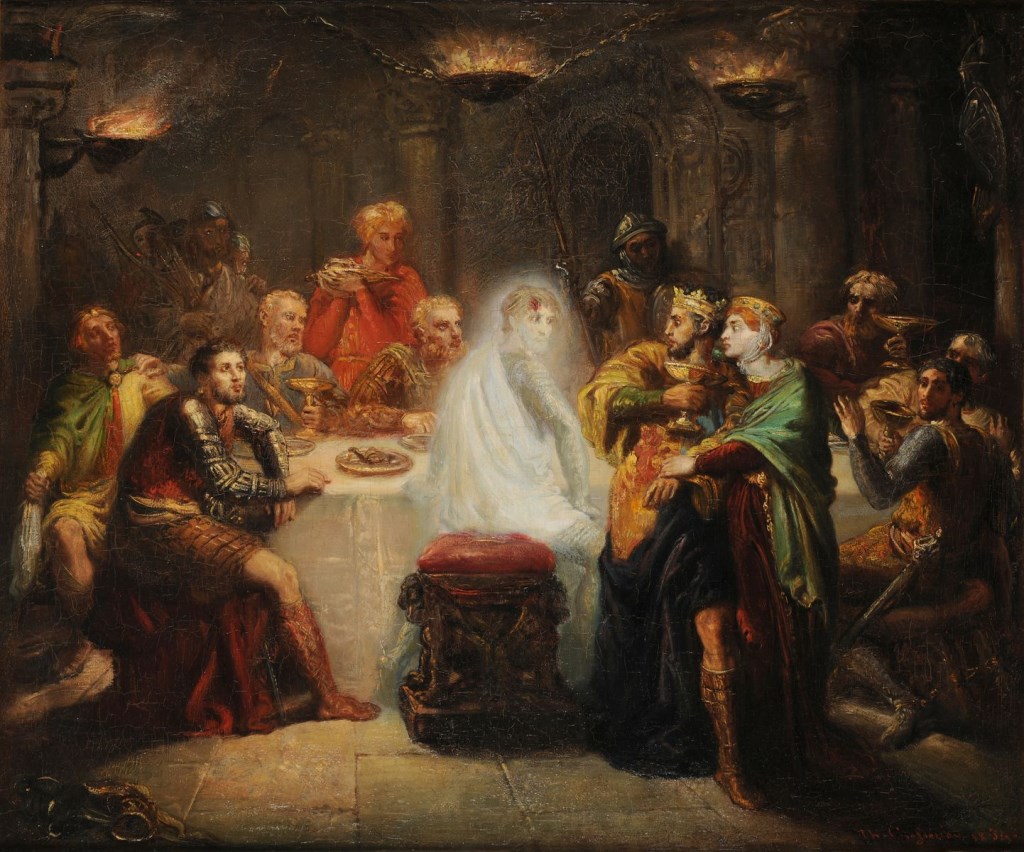
Macbeth’s final, fatal irony is that the supernatural insurance he sought. The witches’ prophecy that no man born of woman could harm him — bred the overconfidence that caused his death at the hands of Macduff, born by Caesarean section.
The very intelligence he marshalled to cheat destiny became the instrument of it. Karma, in Shakespeare’s rendering, is not a thunderbolt from outside. It is the scorpions. Already inside. Already multiplying. Waiting for silence.
The Proxy That Crossed The Border Back
History rarely offers ironies as sharp as Pakistan’s present predicament. For decades, elements within its establishment were accused by critics of nurturing militant networks as instruments of strategic depth in the region. Today, Pakistan finds itself in escalating confrontation with the very Taliban regime that emerged across its western frontier after the American withdrawal from Afghanistan. Cross-border attacks, airstrikes, and open hostilities have pushed the relationship into dangerous territory.
Whether one accepts every allegation or not, the symbolism is striking. The instrument once seen as leverage has become a source of vulnerability. What was cultivated as an asset now returns as a threat. It is an old pattern in statecraft: powers often imagine they can control the forces they unleash. Yet the arrow released eventually chooses its own direction. The proxy becomes the predator.
AI’s Energy Appetite
The current AI revolution promises extraordinary productivity gains. Yet the very success of AI is creating an unexpected challenge: enormous demand for electricity, water, and computing infrastructure. Data centres are consuming power at unprecedented rates, forcing utilities and governments to rethink energy planning. The solution is generating a new problem. Every technological breakthrough carries within it a shadow cost that eventually demands payment.
The Wheel Does Not Hurry
These are not unrelated stories. They are facets of a single geometry. Whether it is Duryodhana’s wax palace, Capone’s unmarked ledger, McAfee’s dismantled walls, or Macbeth’s unsleeping mind, the pattern repeats across centuries and continents:
Entry is a choice. Continuation is a compromise. Exit is an illusion. Consequence is a return.
The return is rarely abstract. It is intimate, personal, and precise. In Chapter 3, Verse 9 of the Bhagavad Gita, Lord Krishna counsels Arjuna:
Yajñārthāt karmaṇo ‘nyatra loko ‘yaṁ karma-bandhanaḥ
Tad-arthaṁ karma kaunteya mukta-saṅgaḥ samācara
Action performed for selfish ends binds the individual in consequences. Therefore, act without attachment and in alignment with the larger good.
We like to think of justice as something administered by courts and institutions. But there is an older, less visible justice that operates without proclamation. It does not forget. It does not hurry. But it recoils. And when it does, it returns not as abstraction but as consequence, often in the very form we thought we had kept safely at a distance.
The wheel is not cruel. It is exact.








A thought-provoking exploration of karma that beautifully connects mythology, history, and everyday life. The Chakravyuha metaphor offers a powerful way to reflect on our choices, responsibilities, and the deeper patterns that shape human experience. Well written and insightful.
I read your insightful article, “The Chakravyuha of Karma,” and found it deeply thought-provoking.Thanks for sharing the same.
One of the greatest challenges parents face today is guiding their children toward righteousness and ethical living. When we encourage them to follow the path of integrity, they often point to examples of people who have attained wealth, fame, and success through dishonesty, manipulation, or other negative traits. In earlier times, it seemed that those who inflicted harm on others eventually faced visible setbacks within their lifetime. Today, however, we often witness individuals who consciously harm others becoming even more prosperous, influential, and celebrated.
As a result, many young people are tempted to view such individuals as role models and feel little hesitation in venturing into morally questionable territory. They begin to believe that this is the way success is achieved and life is meant to be lived. For parents, this creates a profound sense of helplessness.
Your article beautifully addresses this dilemma by illustrating that the law of karma may operate beyond our immediate perception. The return of consequences may be slow and subtle, but it remains inevitable. This perspective offers both wisdom and reassurance in a time when appearances often seem to contradict moral truths.
Thank you for writing such a wonderful and enlightening article.