
The Ethanol Fuel ‘Revolution’ and the Rise of Minister Gadkari’s Son’s Company

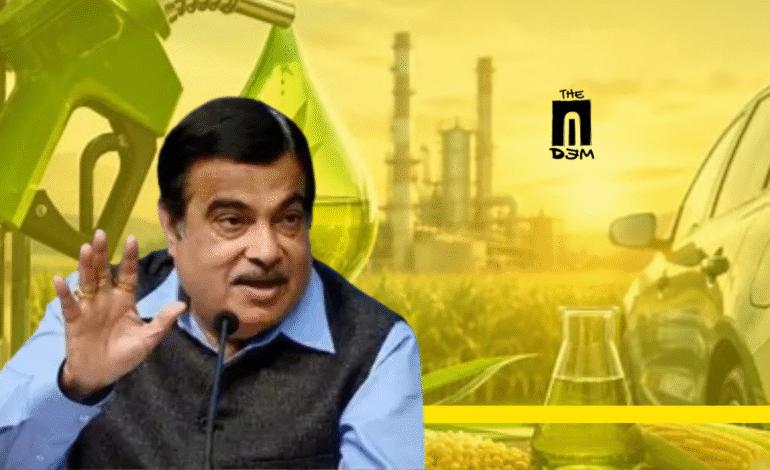
Among the cardinal virtues of leadership is the ability to transform crisis into opportunity. Union Transport Minister Nitin Gadkari, one might argue, possesses this quality in considerable abundance as evidenced by yet another decision he has taken with characteristic timeliness. There is, however, one small distinction: this particular decision was not made to resolve the nation’s crisis, but to resolve the crisis of a company owned by his own son. And should anyone dare raise questions about it, Gadkari knows well enough that the RSS faithful; from khaki-uniformed Sarsanghchalak leaders down to the last pracharak in the ranks will close ranks and sing their chorus of defense.
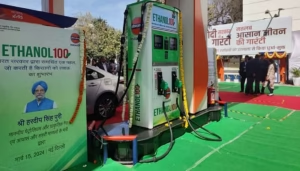
Among the conversations that have gathered momentum in India alongside the Trump tariffs and the Russian oil import debate, one has centred on the distribution of ethanol-blended petrol. Now, permission has been granted for E100 flex fuel, a formulation based on one hundred percent ethanol. Yet neither the government nor the Transport Ministry has seen fit to seriously engage with the substantial concerns being raised about the disruptions this shift to ethanol fuel may bring to the automobile manufacturing sector, the agricultural sector, and the availability of water.
Behind the Transport Minister’s hurried decision lie certain reasons that the mainstream media has chosen not to examine. One of them is this: among the leading companies in ethanol production in India is CIAN Agro Industries and Infrastructure Ltd. More than sixty percent of this company’s shares belong to Nikhil Gadkari, son of Nitin Gadkari. This detail must be read alongside everything else.
It is also worth knowing that CIAN Industries, which recorded a modest revenue of a mere ₹17 crore in June 2024, had by 2026 seen its revenue swell to ₹1,200 crore, a growth that strains the imagination.
This extraordinary financial ascent was achieved by the BJP minister’s son’s company within a matter of months, precisely at a time when associations of vehicle owners, especially truckers, were raising pointed objections to India’s ethanol policy.
One can see, too, an inextricable link between the Indian Prime Minister’s repeated assurances of protecting farmers’ interests, even as he left those same farmers with no choice but to agitate for over a year with their fundamental demands unmet, and the financial flourishing of the Gadkari son’s enterprise.
It is a matter of serious concern that no meaningful study has been undertaken on the social costs that would inevitably accompany a drastic expansion of ethanol production in India. In a country already beset by severe water scarcity, the social cost of promoting water-intensive crops such as paddy and sugarcane has not been assessed. Nor has anyone reckoned with the fact that diverting food grains toward ethanol production will imperil food security, drive up the prices of essential commodities, and bear down most heavily on those who are already most vulnerable.
India’s population is expected to reach approximately 1.7 billion by 2050. To meet the food requirements of the world’s largest population, India will need to dramatically scale up food production, from 354 million tonnes in 2024–25 to an estimated 480 million tonnes by mid-century. The question, then, is whether India will have sufficient surplus grain in the years ahead to sustain ethanol production at all.
To none of these questions have Nitin Gadkari or his government offered any answer.
Read the Malayalam version of this Article here







This is a thought-provoking and well-researched article. It highlights how public policies must be examined not only for their stated benefits but also for who ultimately gains from them. The discussion on ethanol, water resources, and potential conflicts of interest raises important questions about transparency and accountability in a democracy. Regardless of political views, such scrutiny is essential for informed public debate. Well written and insightful.