

Two Thirsty Policies: How India’s Fuel and Digital Dreams Could Drain Its Water

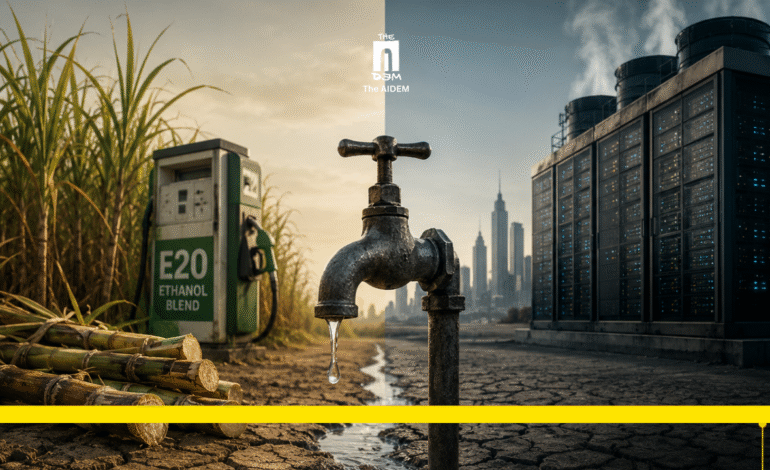
The government has just celebrated two big wins. First, India hit its 20% ethanol blending target (E20) in petrol almost five years early and is now talking about going even higher to E27, E30, and someday E100. Second, India is in the middle of a massive data centre boom. Google is putting $15 billion into an AI campus in Andhra Pradesh. Adani has promised $100 billion for hyperscale data centres. Reliance is building giant campuses too. Add Amazon, Microsoft, and Meta, and the total commitments since 2023 cross $32 billion.
Both are sold as “green” and “future-ready” moves. One cuts oil imports and tailpipe pollution. The other puts India at the centre of the AI race. But both quietly assume something that just isn’t true: that India has unlimited water. It doesn’t. India has about 18% of the world’s people but only 4% of its fresh water. That gap makes both policies risky.
The Ethanol Math Nobody Talks About
On paper, ethanol blending looks like a clear win; less imported oil, lower emissions, and more income for farmers. But here’s the part that gets skipped: the water cost. NITI Aayog’s own roadmap says it takes about 2,500 to 3,000 litres of water to make just one litre of ethanol from sugarcane. To hit the E20 target, India needed around 1,000 crore litres (10 billion litres) of ethanol a year, and the government now wants even more, with excise duty already waived on higher blends.

Analysts warn that meeting these biofuel targets could mean using farmland roughly seven times the size of New York City about 8 million extra hectares for maize by 2030, which is nearly a quarter of India’s farmland. Now add water to that picture. Maharashtra, Karnataka, and Uttar Pradesh, India’s main sugarcane belts, are already dealing with falling groundwater, unpredictable monsoons, and irrigation stress. So, a national fuel policy ends up pulling water out of the same rural aquifers that local people depend on for drinking water and food crops.
This isn’t only an India problem. Brazil’s ethanol programme and the US corn-ethanol mandate have faced the same “food vs fuel vs water” criticism for 20 years. But India is adding this pressure to a country where even a “good” monsoon is barely enough and where pushing one thirsty crop too hard can squeeze out staple grains in already stressed regions.
What if We’d Spent That Effort on Buses Instead?
Here’s a comparison that’s hard to ignore. Ethanol has had the full backing of the state; guaranteed prices for cane farmers, interest subsidies for distilleries, guaranteed buyers in oil companies, and now excise waivers all the way up to E30. That’s a serious, long-term commitment.
Now compare that to electric buses; a technology that’s already cheaper to run than diesel. Electric buses in India already cost about 6% less over their lifetime than diesel buses, and that gap could grow to 12–18% by 2028. With the PM E-Drive subsidy of roughly ₹35–40 lakh per bus, operators can recover their costs in just 2–3 years. India already runs more electric buses than any other lower-income country over 10,000 on the road, with a scheme to add 14,000 more.
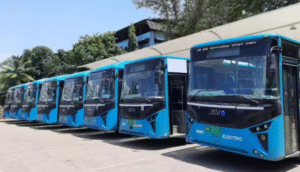
But outside a few states like Telangana, Karnataka, Delhi, and Kerala, bus electrification doesn’t get anywhere near the same urgency, guarantees, or tax breaks that ethanol does. Diesel still powers 60–65% of buses and heavy vehicles, and that’s unlikely to change before 2035.
Think about what each policy actually achieves. Ethanol blending slightly cleans up the petrol burned by India’s growing fleet of private vehicles, but it doesn’t reduce the number of cars, the fuel burned in traffic jams, or the congestion itself. It can even damage the engines of vehicles made before 2021, a cost that falls on regular car owners. A single bus, on the other hand, can replace 40–50 private vehicles. Scale that across cities, and you cut fuel use, traffic, and pollution all at once without using a drop of farmland water. If even some of the energy spent on ethanol tax breaks had gone into guaranteeing e-bus orders for state transport, India might be further ahead on climate goals without opening a new water front.
Data Centres: AI’s Hidden Thirst
If ethanol’s water cost is hidden in farm fields, the data centre’s water cost is hidden in server rooms and it’s growing even faster. Every big data centre needs huge amounts of water to keep its servers cool. India’s data centre water use is set to more than double, from around 150 billion litres in 2025 to about 358 billion litres by 2030, according to Global Water Intelligence. Some estimates put India’s AI and cloud sector at nearly 37.5 billion litres of water use a year once it’s fully built out.
And where are these centres being built? Often in places that can least afford it. Bengaluru’s data centres already use over 26 million litres of water a year in a city that just went through what’s been called its worst water crisis in nearly 500 years. Hyderabad, where Amazon keeps expanding, could face a water shortfall of 870 million litres a day by 2027. And Chennai, the city that hit “Day Zero” in 2019, when its reservoirs ran completely dry remains one of the top choices for new server farms. This isn’t bad luck. These cities are chosen for power, land cost, and connectivity; water is simply an afterthought.
It’s the same story worldwide. Google’s US data centres alone used 12.7 billion litres of fresh water for cooling in 2021, and training one large AI model can use hundreds of thousands of litres. Ireland, Chile, and parts of the US have already seen falling water tables, rising bills, and public protests over these facilities. In September 2025, local opposition actually killed a $1-billion Google data centre project in Indianapolis. Yet India is doing the opposite welcoming the same kind of facilities into cities that are already rationing water through tankers.
Groundwater And Drinking Water: The Warning Signs
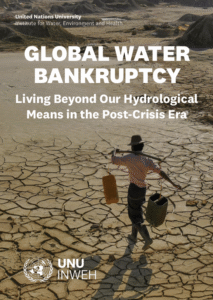
This is where the data centre story turns from numbers into a real plumbing problem. A UN report from January 2026, called Global Water Bankruptcy: Living Beyond Our Hydrological Means in the Post-Crisis Era, names India directly. It points to India’s 18%-population vs 4%-water gap, its falling groundwater, and warns that fast-growing data centres could put even more pressure on cities that are already stretched thin.
The Central Ground Water Board’s 2025 report makes for tough reading. Nineteen out of 23 districts in Punjab are now “dark zones”, meaning more water is being taken out than nature can put back. Worse, 62.5% of groundwater samples in Punjab after the monsoon had uranium levels above the safe limit, the highest in the country. Haryana, Delhi, Karnataka, and Uttar Pradesh also showed heavy-metal contamination.
Haryana’s water table has dropped by an average of 5.41 metres in just 10 years (2014–2024), mostly because of subsidised tubewell irrigation, and the same districts with the heaviest farm power subsidies are also the most water-stressed.
NASA’s GRACE satellite data backs this up at a national scale: groundwater supports over 60% of India’s irrigated land and 50–80% of household water use, and it’s falling fast across both north and south India. A study near Bengaluru’s Upper Arkavathy watershed the same area where the city’s data centres sit found that falling water tables are already forcing villages to abandon dead borewells and dig new ones, just to keep up. Now add huge, round-the-clock industrial water users like data centres to that same stressed ground, and the problem only gets worse. So far, there’s little sign that data centre approvals are even checked against the CGWB’s own “dark zone” maps before construction begins.
The Global Pushback India Isn’t Watching
Here’s what makes India’s enthusiasm look out of step: almost everywhere else, the data centre party is winding down, not starting up. Worldwide, data centre project cancellations jumped from just six in 2024 to 25 in 2025 about 4.7GW worth of projects. And 2026 looks even tougher: in the US alone, more than 70 projects were rejected or restricted in just the first four months more than all of 2025. A Gallup poll in March 2026 found that 70% of people don’t want a new AI data centre in their neighbourhood, and US public support for data centres has dropped to net minus 24%, down from positive numbers just months earlier.
The complaints sound a lot like India’s own risk list. In Chile, a court stopped a Google data centre after locals found out it would use over 7 billion litres of water a year. In the Netherlands, Meta dropped plans for what would have been the country’s biggest data centre after local opposition. Ireland where data centres already use a fifth of the country’s electricity and could hit 27% by 2029 has restricted new builds near Dublin to avoid blackouts. In the UK, campaigners held nationwide protests in February 2026 against these massive facilities, pointing to water and power strain, delayed housing, and threats to clean-energy goals. Even Malaysia saw its first protest at a data centre site that same month. Researchers also link the pollution from powering these centres to around 1,300 extra deaths a year by 2030, costing about $20 billion annually.
India is rolling out the same kind of hyperscale data centres that Ireland is restricting, Chile’s courts are blocking, and Dutch and British communities are fighting off and doing it with weaker water rules than any of those places, and almost no organised local pushback yet. That gap between what the rest of the world is doing and what India is doing should worry us.
Where the Two Policies Collide
Each policy sounds fine on its own. Together, they squeeze India’s water table from two sides. Ethanol pulls water out of rural farmland to grow thirsty crops. Data centres pull water out of cities to cool servers that mostly serve global, not local, needs. Both get called “future-ready” energy security on one side, digital growth on the other while nobody connects the dots on water.
That’s the real problem: India has no national system that checks these two booming sectors against each other, or against the water needed for drinking and farming. The EU now forces data centres to report their energy efficiency (PUE); India has nothing close to that. And while reports recommend mapping water stress before approving ethanol plants, it’s still just a suggestion, not a rule.
The Bottom Line
None of this means ethanol blending or data centres are bad ideas. Energy security and AI growth matter. But you can’t call something “green” or “future-ready” if nobody’s checked its water bill. A country with 4% of the world’s water and 18% of its people can’t treat water as a footnote to its two biggest growth stories.
If India wants to avoid a water crisis instead of just discovering one later, both policies need the same basic discipline: water-impact checks against real stress maps, efficiency rules for new plants and data centres, and most importantly, the courage to say “not here” when the local water math doesn’t add up. Right now, that courage is in shorter supply than the water itself.
This piece draws on reporting and analysis from NITI Aayog’s Roadmap for Ethanol Blending, the BBC, Business Standard, Context/Thomson Reuters Foundation, Global Water Intelligence, CSTEP, Deccan Herald, IEEFA, KPMG, the Central Ground Water Board’s Annual Ground Water Quality Report 2025, the UN’s Global Water Bankruptcy report, PLOS Water, Prospect Magazine, Trellis, The Ecologist and The Soufan Center, among others.









Excellent article. It highlights a critical but often overlooked reality: India’s ambitions in fuel production and digital infrastructure must be balanced with sustainable water management. True progress is not just about growth, but about ensuring that essential resources like water are protected for future generations.