

Unravelling Bulldozer Raj in West Bengal and the Crisis of Legitimacy Around Suvendu Adhikari

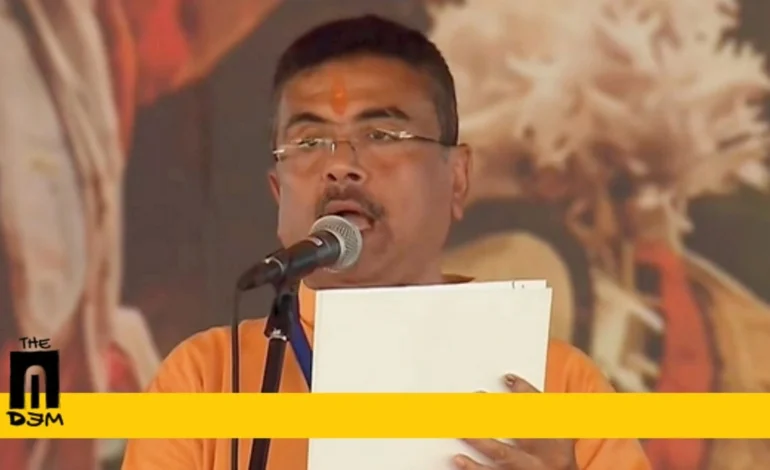
The bulldozer has already arrived in West Bengal — not yet as a machine tearing down homes, but as a palpable political threat, parading in the victory processions of the Bharatiya Janata Party (BJP) and the so-called “celebratory assaults” its workers are unleashing across the State. Significantly, the targets of these assaults are primarily workers of opposition parties as well as Muslim minority clusters.
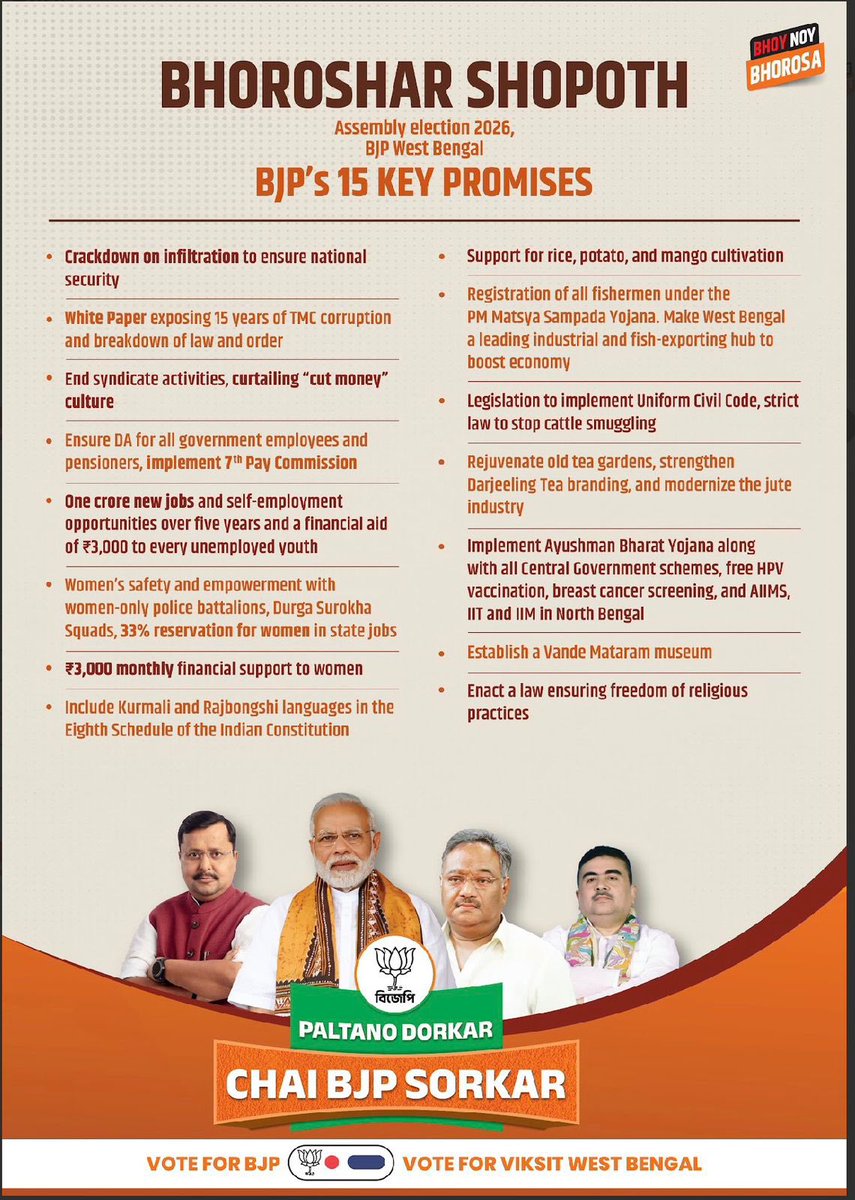
It has been only a couple of days since BJP Chief Minister Suvendu Adhikari and his initial team took the oath of office, but the very first steps of the government have already indicated how “Bulldozer Raj” would play out in governance. Among these steps was the declaration that those whose votes have been deleted from the voters’ list as part of the Special Intensive Revision (SIR), or those whose appeals against exclusion are pending, would be denied welfare benefits.
It was a declaration of intent: that governance would increasingly operate through fear, exclusion, and the public performance of punishment. What is now unfolding through the proclamation on suspending welfare entitlements is part of that same architecture of intimidation. The bulldozer here becomes both symbol and method — flattening not only structures, but welfare measures and citizenship itself.
Reports from different parts of the State have highlighted the early impact of these measures. In Kolkata, poor men and women suddenly fear that their bank accounts may be frozen because their names have disappeared from the electoral rolls. Many of them are reportedly worried that their citizenship, too, may be summarily dismissed.
These are not isolated anxieties. They are the lived consequences of a political project that transforms ordinary citizens into permanently suspect populations. Welfare is no longer treated as a social right but as conditional mercy, granted or withdrawn through opaque bureaucratic power. The shadow of Assam’s NRC and foreigners’ tribunals now hangs visibly over West Bengal’s political landscape.
And yet, the deepest contradiction lies in the moral authority claimed by those presiding over this discourse of legitimacy. Suvendu Adhikari, the BJP’s first-ever Chief Minister in the State, himself embodies one of the most glaring crises of political credibility in contemporary India. A politician who spent decades within the Trinamool Congress power structure, who rose through precisely the networks he now condemns, today presents himself as the custodian of political purity and nationalist authenticity. There was no ideological transformation in this journey — only a relocation of political convenience.
More importantly, the same political establishment that demands endless proof of citizenship from poor women, workers, and minorities has demanded no comparable scrutiny of politically useful defectors entering the BJP fold. Allegations, scandals, and accusations that once dominated public discourse dissolved almost overnight after realignments of power. The vulnerable citizen must constantly prove belonging; the powerful politician receives instant absolution.
That is the moral inversion at the heart of this moment. The bulldozer is not simply aimed at illegal structures or administrative irregularities. It is increasingly directed at democratic certainty itself — at the citizen’s confidence that rights cannot be erased by political whim. West Bengal is being asked to accept a politics where suspicion flows downward toward the powerless, while legitimacy flows upward toward power brokers whose own political and ethical foundations remain profoundly unstable.
What is unfolding in Bengal is not merely an administrative exercise around electoral rolls. It is the construction of a political category: the doubtful citizen. The moment welfare entitlements become contingent upon bureaucratic suspicion rather than constitutional guarantees, democracy itself begins to mutate.
The same establishment that now casts poor women, workers,and minorities into zones of civic uncertainty had no difficulty instantaneously legitimising defectors burdened by years of unresolved allegations and political contradictions. This is the real asymmetry of power in the BJP’s political posturing. The vulnerable citizen must endlessly prove innocence, citizenship, and belonging. The politically useful leader, however, receives automatic purification upon entering the ruling fold. Welfare can be suspended for the poor pending “verification”, but legitimacy is permanently guaranteed for power brokers who align themselves with the dominant regime. That contradiction exposes the dangerous moral inversion at the heart of the present moment.
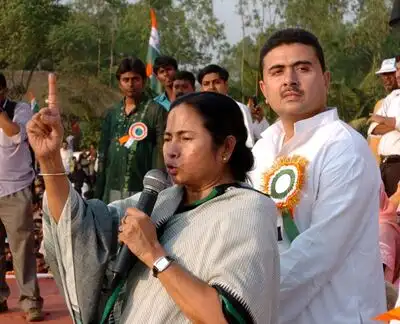
Adhikari’s political trajectory embodies this degeneration with remarkable clarity. For nearly two decades, he was not merely a functionary of the Trinamool Congress but one of its principal power brokers. He rose within Mamata Banerjee’s inner circle, built local patronage networks, consolidated organisational muscle, and became one of the key operational faces of the anti-Left mobilisation in Nandigram. The same Suvendu Adhikari who now speaks the language of “corruption-free governance” was, until very recently, an inseparable part of the political machinery he presently describes as decadent and criminal.
His migration to the BJP was not the outcome of conviction but of political calculation within a rapidly changing balance of power. What changed was not Adhikari’s politics but the regime under which his politics could flourish more profitably.
That is precisely where the question of legitimacy emerges. Adhikari’s public life has long been shadowed by serious allegations. His name repeatedly surfaced in connection with the Narada sting controversy, in which prominent political figures were allegedly seen accepting cash in exchange for favours. One of the central figures in those footages was Adhikari himself. Central agencies themselves had reportedly moved toward prosecutorial action at one stage. Likewise, the Saradha chit fund scandal generated persistent allegations and political accusations regarding his proximity to networks associated with the financial scam.
What requires scrutiny is the now-familiar pattern in Indian politics: the remarkable purification that occurs once a politically useful leader enters the BJP fold. Allegations that once dominated television studios, investigative rhetoric,and political attacks suddenly recede into silence. Agencies that function with spectacular urgency against opponents develop inexplicable restraint toward defectors absorbed into the ruling establishment. In contemporary India, accountability increasingly appears contingent not on conduct but on political location.
Suvendu Adhikari is among the clearest illustrations of this phenomenon. This degeneration becomes especially significant when viewed against the historical memory of Nandigram. Nandigram once stood as a symbol of popular resistance against authoritarian governance and corporate-state aggression. It represented the assertion of ordinary people against coercive power. Yet one of the principal beneficiaries of that movement now stands aligned with a political order marked by unprecedented centralisation of authority, institutional intimidation, hyper-nationalist propaganda,and the systematic weakening of democratic dissent. The question, therefore, is whether such power carries democratic legitimacy beyond arithmetic.
Can a politician whose career has traversed mutually contradictory political positions without ideological accountability claim moral authority? Can institutional silence erase years of unresolved charges ? Can aggressive communal polarisation become the foundation for governing a State whose historical consciousness was shaped substantially through anti-communal struggles?

These democratic questions will continue to haunt the spectacle of power in West Bengal even as the Bulldozer Raj threatens to steamroll across the State.







Venkitesh Ramakrishnan’s powerful article “Unravelling Bulldozer Raj In West Bengal And The Crisis Of Legitimacy Around Suvendu Adhikari” is a fearless and deeply important political critique. With sharp analysis and democratic concern, Venkitesh Ramakrishnan exposes how bulldozer politics threatens constitutional values, civil rights, and the very spirit of democracy. The piece brilliantly questions the growing normalization of intimidation-driven governance and the dangerous political messaging behind it. Bold, timely, and intellectually compelling journali
Opening sentence itself carries the punch..extremely powerfully articulated.