Vishwaguru’s Kitchen Crisis : How Ideology Strangled India’s Energy Supply

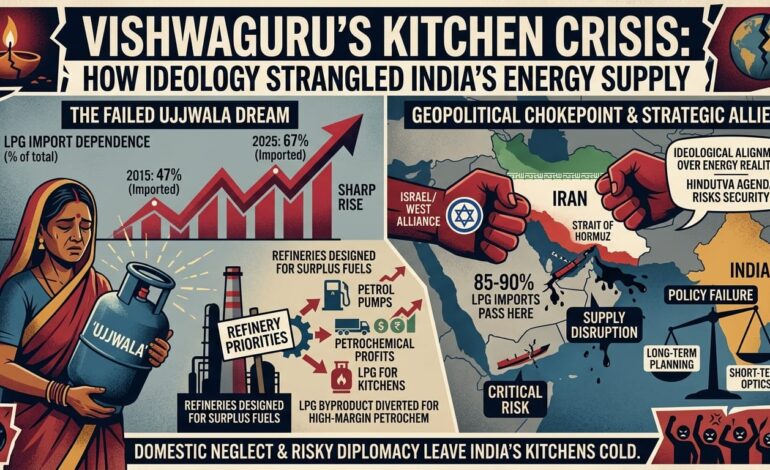
The crisis hitting Indian kitchens right now isn’t some unpredictable act of God; it’s the direct result of a government that prioritized ideological posturing and grand PR stunts over the actual security of its people. For years, the Modi administration preened over the Ujjwala scheme, claiming they’d revolutionized the lives of 100 million households by giving them gas cylinders. But they handed out the hardware without securing the software. They built a dependency on a fuel they knew India couldn’t produce enough of, and then they spent a decade playing a dangerous diplomatic game that has now blown up in our faces.
The reality is that while India is a net exporter of petrol and diesel, our refineries are essentially being run as corporate profit machines rather than national assets. They are tuned to churn out high-margin fuels for export and petrochemicals for industry, leaving the common citizen to rely on imports for the most basic necessity: cooking gas. Instead of forcing these refineries to prioritize the domestic kitchen, the government looked the other way while butane and propane—the building blocks of LPG—were diverted to feed the lucrative plastics industry. It’s a classic case of the Modi model: crony capitalism masked by a thin veil of welfare. In fact, just this week, the government was forced to invoke emergency powers under the Essential Commodities Act to beg refiners to stop making plastics and start making cooking gas.
Worst of all is the sheer recklessness of our foreign policy. By pivoting so aggressively toward an ideological alliance with Israel—driven largely by a domestic Hindutva agenda that thrives on a specific brand of geopolitical muscle-flexing—the government has effectively alienated the very neighbors who control our energy lifeline. We get nearly 90% of our LPG through the Strait of Hormuz. You don’t need to be a master strategist to know that if you’re going to spend years diplomatically isolating Iran to satisfy a “tough on Muslims” narrative at home, you shouldn’t leave your entire country’s food supply in their hands.
Now that the Iran war has actually choked off the Strait, the “Masterstroke” has turned into a disaster. Petrol and diesel are fine because they make money for the big players, but the average person is left staring at an empty, overpriced cylinder. This isn’t just a supply chain issue; it’s a failure of leadership. Modi’s government was so obsessed with the optics of being a global “Vishwaguru” and catering to a base that feeds on communal polarization that they forgot the most basic duty of a state: ensuring the fire stays lit in the poorest kitchens. We are now seeing the true cost of a government that values hate-driven agendas over the cold, hard math of national survival.