

The Biopolitical Anatomy of Hindutva Fascism: Citizenship, Sovereignty and Bare Life |Part 1|

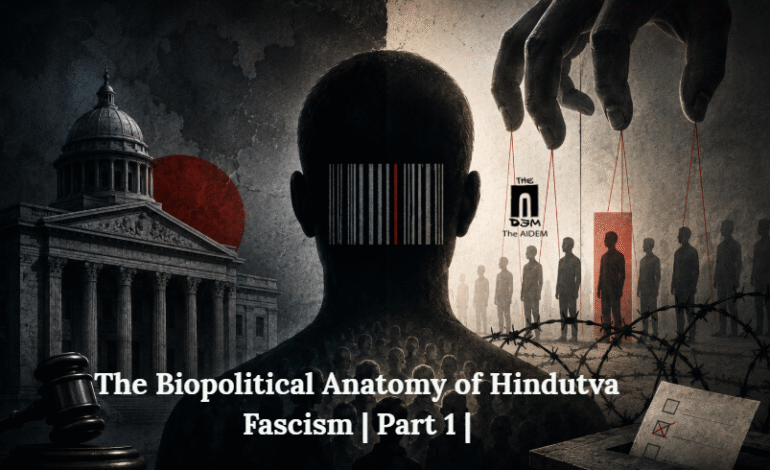
In a recent statement that has drawn sharp criticism from constitutional lawyers, Prashant Bhushan characterised a Supreme Court judgment on the Special Intensive Revision (SIR) process as a “dark day for the Judiciary.” He noted that the Court justified an opaque SIR process, conducted months after elections in many states, carried out by a “totally partisan” Election Commission of India (ECI), in which more than 10% of voters were deleted without transparency.

To understand why this matters beyond electoral law, we must place the SIR process within a deeper theoretical framework: the biopolitical understanding of Hindutva fascism. The question of who qualifies as a citizen, and whose body bears the imprint of the nation, lies at the heart of this analysis. When the state deletes a voter, it is not merely updating a roll; it is making a sovereign declaration about whose life is politically legible, and whose life can be reduced to bare existence.
The question of who qualifies as a human being, who attains citizenship, and the intricate relationship between humanity and citizenship is profoundly significant. Fascism, as a historical phenomenon, emerges as a radical redefinition of this relationship, transforming what once were purely anthropological inquiries into politically charged, nationalist, racial, and ultimately fascist projects.

In the ancient context, the distinction between City and Citizen was central to the organisation of society. The city-state, or polis, represented the epitome of political life. A resident of the polis was inherently political, echoing Aristotle’s famous assertion that humans are political animals. However, not all individuals born within the city-state were automatically granted citizenship. Thus, while humanity may be defined as inherently political, not every individual born within the city was considered a political being.
This subtle understanding emphasises the complexity of citizenship and political participation in ancient societies. It highlights the selective nature of citizenship and the hierarchical structures that governed access to political rights and privileges. In fascist contexts, this distinction becomes even more pronounced, as regimes seek to manipulate and redefine citizenship according to arbitrary criteria, including race, ethnicity, and religious ideology.
Ultimately, the question of who qualifies as a human being and who attains the status of a citizen is not merely an abstract philosophical inquiry but a deeply political and historical one. It speaks to the fundamental principles of equality, justice, and democracy and underlines the enduring struggle to uphold these ideals in the face of tyranny and oppression.
The Superimposed Body: From Birth to the Body Politic
In the ancient Greek democratic system, the concept of citizenship was strictly exclusive. Neither women nor slaves were afforded a share in the polis. They were relegated to a subhuman status or entirely excluded from the realm of political humanity. In this framework, reproduction and labour were perceived merely as animalistic qualities, devoid of the political agency (bios) granted to citizens.
The human body, far from being solely a product of nature (zoe), is inseparably entangled with politics and law. It embodies a complex amalgamation of natural and political forces; a synthesis forged in the crucible of societal norms and governance. At birth, an individual’s body becomes imbued with a biopolitical essence, a term denoting the state’s regulation and control over biological life, and a body politic is superimposed on their natural form.
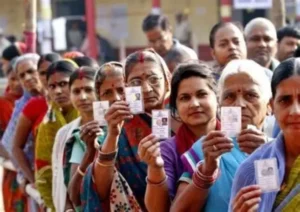
This fusion of the natural and the political renders the body a site of power and control, subject to the whims of the state, fascism, and sovereignty. It is through this superimposed body politic that individuals are governed and regulated, with their rights and freedoms dictated by the structures of power that govern society. Thus, the human body becomes not merely a vessel for biological existence but a battleground for competing political ideologies and systems of governance.
While Rousseau famously proclaimed that “man is born free, but everywhere he is in chains,” the truth of this statement is open to interpretation. Indeed, no individual is born into absolute freedom. Every human being is born into a web of preconceived roles and identities, predetermined by factors such as gender, language, nationality, and ethnicity.
The assertion that man is a political animal emphasises that human birth is not only a biological event but also inherently political. Each individual’s entry into the world is inseparable from the socio-political context of their birth. Their very existence is framed within a politico-juridical landscape, in which legal and political frameworks shape their rights, responsibilities, and opportunities.
Sovereignty, Agamben, and the Tragedy of the Declaration
The evolution of citizenship from ancient city-states to modern nation-states marks a profound transformation in the status of individuals, shifting them from subjects to active participants in political life. This shift also extended citizenship to previously excluded groups, broadening political engagement and rights. The transition from the sovereignty of kings to national sovereignty reflects the emergence of public sovereignty, in which the authority of governance is vested in the collective body of citizens.
However, the philosopher Giorgio Agamben highlights the latent risks inherent in this apparently progressive transition. By interrogating foundational documents such as the French Declaration of the Rights of Man and of the Citizen (1789) and the development of habeas corpus in England, Agamben reveals the complexities and ambiguities underlying the construction of citizenship in modern liberal democracy. These documents, while intended to safeguard individual rights and freedoms, also reinforce structures of power and exclusion, perpetuating inequalities and hierarchies within society.

The French Declaration of Rights asserts that “Men are born and remain free and equal in rights,” emphasising the fundamental equality and freedom inherent in all individuals. However, the term “man” in this context refers to a specific subset of humanity, namely, the citizen. While seemingly universal, the rights enshrined in the declaration are exercisable only by citizens, narrowing the scope of entitlements to a specific legal and political category.
This transition from the broader concept of “man” to the more limited category of “citizen” marks a shift from a natural or biological understanding of humanity to a legal and political construct. In essence, the declaration replaces the inherent rights of all human beings with the societal framework of citizenship, thereby transforming the abstract notion of “man” into the tangible status of “citizen.”
The transition from God-given royal sovereignty to national sovereignty marks a significant shift from subjects to citizens. However, this transition also brings a profound tragedy: the commodification of birth itself as a point of sovereignty. While all beings are born, not all possess the inherent rights to equality and life. These rights are reserved only for individuals whose bodies are explicitly imbued with citizenship. The metaphor of commodification describes how the modern nation-state transforms the natural, biological act of human birth into a state-controlled asset, a legal registry, and a tool of political currency. When modern democracy overthrew kings, sovereignty shifted to “The People” (National Sovereignty). But this created a massive bureaucratic problem for the new state: Who exactly are “The People”? Where does the state get its legitimacy?
The modern state’s answer was Birth. The nation-state linked political legitimacy directly to human reproduction. It declared that, by virtue of being born within a certain territory (jus soli) or to certain parents (jus sanguinis), a biological body is automatically claimed by the state. This is where commodification occurs. The state steps into the maternity ward, establishes a “territory” in the mother’s womb, and places an invisible, sovereign “tag” on the newborn body. The state turns the most innocent, natural act, a child entering the world, into the ultimate site of sovereign control, policing, and structural exclusion.
If your birth occurs outside the arbitrary criteria of the state, or if a majoritarian state retroactively changes the rules of belonging (like the ECI’s voter deletions or citizenship screenings), your birth is stripped of its political currency. You become an administrative Homo Sacer, a bare life. Your birth is suddenly worth nothing under the law.
According to Agamben, this transformation from biopolitics to “thanatopolitics”, a politics centred on the power to decide who matters and who is marked for death, occurs precisely at the intersection of citizenship, where the distinction between life and death becomes increasingly blurred. The Citizenship Amendment Act (CAA), together with the proposed Uniform Civil Code (UCC), exemplifies this biopolitical shift in contemporary India, raising deep concerns about the potential legal vulnerability and targeted disenfranchisement of Indian Muslims.
The Political Production of the Homo Sacer
When attempting to define citizenship, the concept of identity becomes paramount. Defining citizenship is inherently problematic, as it often involves delineating oneself from the “other.” This process is particularly significant in Indian social psychology, where self-awareness as a Hindu often arises primarily in contrast to the identity of a Muslim. In the political absence of this “other,” the monolithic Hindu identity risks regressing into its internal, fractured realities of caste. To define oneself, one must establish something outside oneself. Thus, majoritarian citizenship can only be comprehended by creating an external boundary through the definition of the “other” and subsequent exclusion.
The answer to the question of citizenship varies with the ideology governing a nation. In some contexts, citizenship is defined by birthright (jus soli): anyone born within the country’s borders is considered a citizen. However, in regimes such as Nazi Germany, Ethnic Israel, and Hindutva India, citizenship is increasingly untethered from the place of birth and is instead tied to racial, ethnic, or religious identity. Hitler’s concept of German citizenship was strictly limited to those born within the Aryan race, excluding others regardless of birthplace.
This racialised or communalised notion of citizenship transforms the human body into a biopolitical entity, in which citizenship becomes a political stamp imposed on nature. Fascism divides society along identity lines, relegating certain groups to the margins through arbitrary definitions of belonging. Yet such exclusionary definitions erode individuals’ inherent humanity, reducing them to mere subjects of political ideology rather than autonomous beings.
In an ethnically defined concept of citizenship, individuals who do not belong to the designated group are considered to be born without rights. They are viewed as “Homo Sacer”, an ancient legal figure resurrected by Agamben to describe individuals whose lives are deemed “bare life,” stripped of legal protection, expendable, and subject to targeting with impunity. In essence, their mere biological existence is seen as a threat to the ideological purity of the state, rendering them legally disposable.
The Democratic Channel to Fascism
With the rise of modern democracy, marginalised lives, women, workers, and the vulnerable were formally integrated into the political sphere, leading to the complete politicisation of human birth and natural life. The modern nation-state rests on a political framework in which existence itself is explicitly managed by law. Consequently, those deemed irrelevant or dangerous by authority can be stripped of their political rights and expelled from the system.
This process renders anyone susceptible to political disenfranchisement, transforming them into Homo Sacer. Agamben’s observation remains highly relevant today: whereas biopolitics in Nazi Germany targeted specific, legally catalogued religious and ethnic groups as scapegoats, today any citizen can be reduced to bare life. The concept of bare life is no longer confined to an exceptional category; it resides within the biological body of every living being, leaving everyone vulnerable to being stripped of their rights and reduced to mere existence at the state’s discretion.
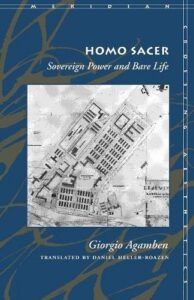
Agamben argues that modern democracy does not eliminate the sacred, banishable life but rather fragments and disperses it across every individual body, investing it in all civic bodies. When definitions change, citizens are transformed into refugees. This is historically exemplified by the plight of German Jews who lost their citizenship following the implementation of the Nuremberg Laws, as well as by Rohingya Muslims and Palestinians who were forced into refugee status due to shifting political boundaries and legal classifications.
Modern nation-states and democracies are founded on the biopolitical framework of citizenship, which determines who is considered a citizen. In this context, fascism is not an antithetical force opposing democracy; rather, it embodies the core political logic inherent in modern democracy itself. This explains how democratically elected leaders can transition seamlessly from democratic governance to fascist tendencies. The trajectory from democracy to fascism is facilitated by the underlying structures of democracy, such as majority rule, executive centralisation, and legal codification, which can morph into fascist ideologies when the constitutional coating of democracy is stripped away.
(To be continued)









A deeply engaging analysis that connects political theory with contemporary realities. The discussion on citizenship, sovereignty, and “bare life” challenges readers to think critically about democracy, rights, and the exercise of state power. Well worth reading