

The Mirage of India’s ‘Nuclear Renaissance’

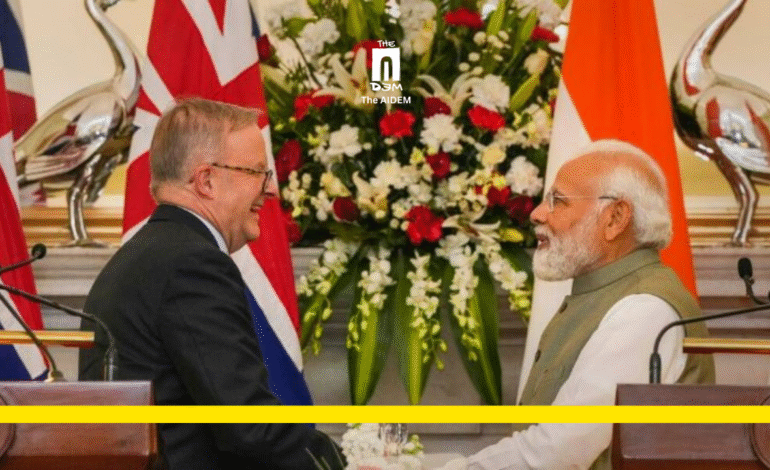
As a long-time observer who has followed developments in India’s nuclear energy sector for more than three and a half decades, I read with great interest the news of the finalisation of the Administrative Arrangement under the India–Australia Civil Nuclear Agreement during Prime Minister Narendra Modi’s latest visit to Australia.
According to a statement shared by Randhir Jaiswal, the official spokesperson for the Ministry of External Affairs, Prime Minister Modi remarked, “The outcomes during this visit reflect the confidence with which India and Australia are looking towards the future. Together, we will continue to unlock new opportunities for growth, innovation, and shared prosperity”. Notably, this arrangement was one of approximately 18 strategic outcomes and agreements concluded during the bilateral visit.
Since assuming office, Prime Minister Modi has successfully cultivated the perception that a “nuclear renaissance” is underway in India. This perception of a revival has been reinforced by the numerous civil nuclear cooperation agreements India has signed during his tenure with major partners, including Canada, Japan, the United States, France, and Australia.
While the Prime Minister characterised the latest uranium import arrangement as a reflection of mutual confidence in the future, it inevitably recalls a foundational agreement signed over a decade ago on September 5, 2014, to be precise with then-Australian Prime Minister Tony Abbott. Formally titled the “Agreement between the Government of Australia and the Government of India on Cooperation in the Peaceful Uses of Nuclear Energy,” it officially entered into force in November 2015. At the time of its signing, the Prime Minister hailed the pact as a “historic milestone,” as its primary objective was to clear the path for uranium exports to India.
Interestingly, despite that landmark 2014 agreement, India has been unable to import uranium from Australia on a commercial basis for more than a decade.
The Modi government signed similar civil nuclear cooperation agreements with Canada in 2015 and Japan in 2016. These pacts were pursued with the ambitious, declared goal of scaling India’s nuclear energy capacity to 100 gigawatts (GW) by 2047.
However, the real-world numbers tell a different story. When Prime Minister Modi assumed power in 2014, India’s installed nuclear capacity was roughly 4.5 gigawatts. Twelve years later, that capacity has only reached 8.9 gigawatts. Crucially, this modest growth primarily stems from projects long in the making: the Kudankulam Units 1 and 2 (conceived in the 1990s), Kakrapar Units 3 and 4 (initiated around 2010), and Rawatbhata Units 6 and 7 (commenced in 2011). In short, the much-touted “Modi magic” has failed to materialize in the nuclear energy sector.
What explains this sluggish performance? It is certainly not a reflection of incompetence among India’s nuclear scientists, who remain deeply capable, dedicated, and sincere. Instead, the stagnation stems from the inherent technical, economic, and safety challenges associated with nuclear technology itself.
For the time being, India’s much-heralded nuclear renaissance has largely been reduced to a bureaucratic exercise: removing legal and regulatory barriers to pave the way for greater private-sector participation.









**A thought-provoking article that questions the assumptions behind India’s so-called “nuclear renaissance.” True progress should be measured not only by technological ambition but also by economic viability, environmental responsibility, and public accountability. Thanks to the author for encouraging a deeper, evidence-based discussion on an issue that will shape India’s future