
KIIFB, the 2026 Collapse, and the Peasant’s Desiring-Machine

Part 5: The Oedipal Marxism
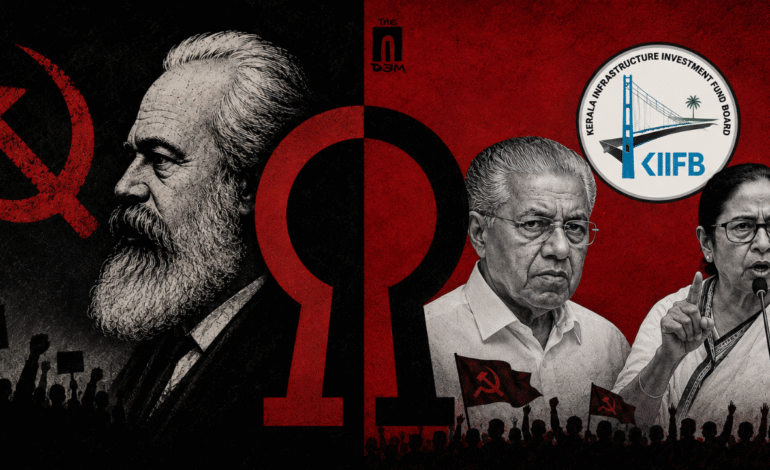
This is Part Five of The Oedipal Marxism, Solomon Mubash’s series on the crisis of Indian Marxism. Mubash reads KIIFB’s debt-funded infrastructure boom as a technocratic fetish that mistook concrete for socialism, traces the 2026 Kerala defeat through Trotsky’s warning on bureaucratic substitution, and revisits Singur and Nandigram, where a Left government turned its guns on the very peasantry it claimed to represent.
KIIFB Fetishism: Infrastructure as Ideology
The Pinarayi Vijayan administration’s vociferous projection of KIIFB as its political trump card marks the definitive moment of technocratic fetishism within the Kerala Left. Operating precisely within the parameters of Marxian commodity fetishism, the government elevated debt-funded mega-projects, concrete highways, high-tech school buildings, and industrial corridors into mystical, self-generating symbols of progress. This infrastructure fetishism successfully erased the underlying social relations of production: it masked the unorganised, precarious sweat of the migrant workforce that poured the concrete, and it silenced the primitive accumulation that dispossessed coastal and subaltern communities of their material habitats.
What does KIIFB fund? The list is revealing: land acquisition, the development of hill highways, coastal highways, the Wayanad tunnel road, IT parks, cultural complexes, schools, colleges, cancer centres, hospital buildings, and a zoological park. This is infrastructure for the new middle class, the upper-caste and upwardly mobile sections who have benefited from the existing order.

In a Deleuzian sense, KIIFB functioned as a vast apparatus of capture. It redirected the masses’ horizontal, revolutionary desires away from structural emancipations, such as the annihilation of the 3-cent colony model or the challenge to caste-capital alliances, and anchored them in the passive consumption of state-managed amenities. By relying on off-budget market borrowings and global financial mechanisms, the vanguard walked straight into the Oedipal Trap: it mistook the effective distribution of capitalism’s fruits for the advent of socialism. In doing so, the fortified Secretariat reduced its revolutionary purpose to that of a managerial clerk, attempting to construct a Scandinavian mirage on a foundation of financialised debt, entirely blind to the fact that concrete bridges cannot span the widening gulf between an alienated party bureaucracy and the subaltern soil.
Meanwhile, the landless Dalit and Adivasi families remained exactly where they were after the 1963 Land Reforms: on their 3-cent plots in colonies. The government’s response to this reality was not land redistribution but welfare schemes: pensions, rations, and housing that manage poverty without challenging its structural causes. The Kerala government that gave a Dalit family a title to their colony plot was the same government that put them in the colony in 1963, kept them there for sixty years, and now calls that plot “your property.” This is not liberation. It is administered containment.
The 2026 Defeat: The Managerial Collapse
The 2026 defeat did not occur in a vacuum. It was the culmination of a process that Leon Trotsky, nearly a century earlier, diagnosed as the logic of vanguard substitution. Trotsky warned that the revolutionary party would inevitably undergo a series of displacements: first, the working class would be replaced by the party; then the party by the central committee; and finally the central committee by a single leader. This is not a conspiracy; it is a structural tendency that arises when a party loses its organic connection to the masses and becomes a bureaucratic apparatus primarily concerned with its own survival. CPI(M) has become a highly efficient administrative machine rather than a revolutionary organisation.
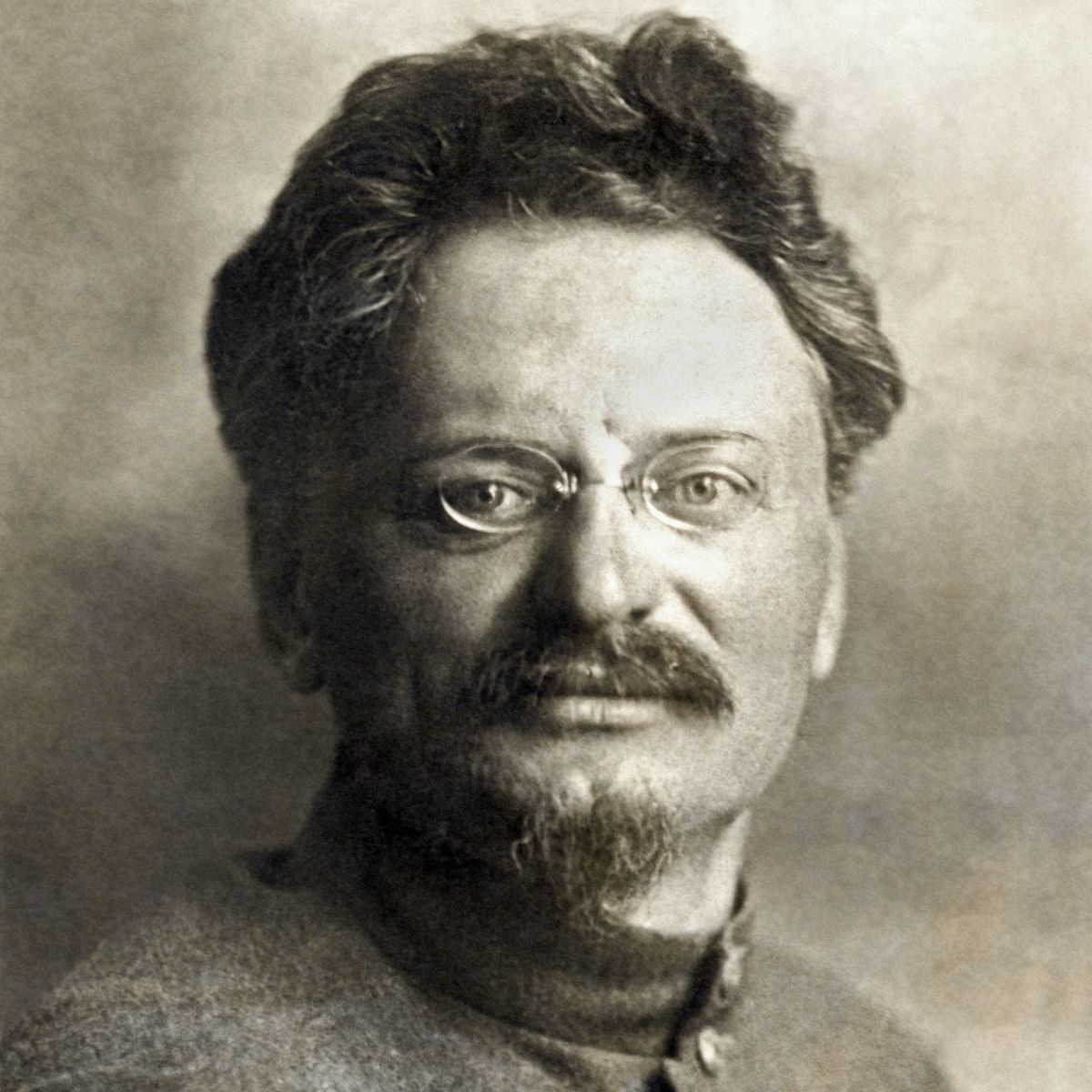
Kerala under Pinarayi Vijayan exemplified this tendency at its terminal stage. The working class was replaced by the party bureaucracy; the party by the Secretariat; the Secretariat by the Chief Minister’s office. By 2026, the CPI(M) had become what Trotsky called a “bureaucratic absolutism”, a structure in which power flows from the top down, loyalty is demanded not to the class but to the leadership, and internal democracy is replaced by a cult of discipline. This is not Stalinism; it is the Oedipal trap awaiting any vanguard that mistakes itself for the masses.
The Symptoms of Bureaucratic Substitution
The substitution of party for class, leader for party, and bureaucracy for leader produced several distinct symptoms in Kerala, each of which contributed to the 2026 collapse.
First, rule by bureaucracy. Power was outsourced to a hidden caucus of technocrats. The Secretariat became a fortified citadel of executive overreach, replacing political mobilisation with administrative management. This was not merely a matter of style but of substance. The KIIFB-led infrastructure fetishism, the reliance on off-budget borrowings, and the marginalisation of party forums in favour of expert committees all pointed to a fundamental reorientation of what the Party understood itself to be. It was no longer a revolutionary vanguard but a development administration suffering from political leprosy.
Second, the muzzle of leadership. The party comrade was reduced from a Subject to an Object. Loyalty was no longer to the class but to the bureaucratic machinery. Internal dissent, once the lifeblood of Marxist politics, was muzzled by an autocratic verticality. The Party ceased to be a site of debate and struggle and became an instrument of command. This is the Oedipal trap in its most advanced form: the revolutionary party, having killed the bourgeois Father, becomes the oppressive Father itself. The party has systematically transformed mass organisations (from SFI to Kisan Sabha) from autonomous agitational bodies into transmission belts for state policy. Their job is no longer to challenge the state, but to explain the state’s austerity measures to the masses while the left is in power.
Third, the sociology of alienation. The leadership emerged almost exclusively from student politics, filtering out those who “live by their sweat.” This created a leadership with a mystical, romantic illusion of revolution but, in practice, an upper-class lifestyle. They behaved like bureaucrats because they lacked the experiential grounding of the labouring body. They knew the theory of the proletariat but had never been proletarians. Their Marxism was a text to be recited, not a practice to be lived.
Fourth, tactical bigotry. Isolated from the masses, the leadership descended into what Deleuze and Guattari call “micro-fascism”, using Islamophobic rhetoric and pampering caste bigots like Vellapally Natesan to manufacture electoral majorities. The Left that once stood for secularism and anti-communalism found itself making common cause with the very forces it was supposed to oppose. This is the logical endpoint of a politics that has lost contact with the lived experience of the oppressed: in the absence of genuine solidarity, it substitutes tactical alliances that corrode its own principles.
The final symptom of bureaucratic substitution is micro-fascism, the replication of fascist behaviours at the scale of party organisation. As the leadership lost contact with the masses, it descended into a micro-fascism of the party apparatus: the demand for total loyalty, the creation of internal enemies (the “deviationist,” the “fractionalist”), the use of party discipline to crush dissent, and the leader as infallible Father. Trotsky anticipated this. He wrote that a bureaucracy which has lost its revolutionary moorings will seek support wherever it can find it, even from reaction. The Kerala Left’s embrace of Islamophobic rhetoric and its pampering of caste bigots was not a tactical error. It was the logical endpoint of a party that had substituted its own survival for the liberation of the oppressed. When a Marxist party tells a Muslim worker, “We will protect you from the BJP, but we will also use your community as a punching bag to win Hindu votes,” that party has crossed the line into micro-fascism. It no longer deserves the name “Left.”
The Desiring-Machine of the Peasant: Singur and Nandigram
The Singur and Nandigram agitations of 2006-2008 represent the most dramatic and traumatic rupture in the history of the Indian Left. For the first time, a Communist-led government, the CPI(M)-dominated Left Front in West Bengal, deployed armed police and party cadres to fire upon peasants who were almost lifelong supporters of the Left. At least fifteen people died in the Nandigram police firing on March 14, 2007. The Tata Nano project abandoned Singur. The Left Front, which had ruled West Bengal uninterrupted for thirty-four years, was swept out of power in the 2011 assembly elections.
The standard Marxist explanation in terms of neoliberal betrayal is not wrong but incomplete. It treats the events as a policy error. It failed to ask the deeper questions: how did the party that claimed to represent the peasantry come to see the peasant as an enemy? How did the apparatus of the revolutionary vanguard become a machine for state terror? And why did the resistance movements, initially spontaneous and horizontal, ultimately get captured by the Trinamool Congress and Maoists?
To answer these questions, we must understand what land means to the peasant. Land is not merely an economic asset. It is a territory in the Deleuzian sense, a space of attachment, belonging, identity, and generational memory. It is the ground on which his body has been stratified into a peasant-body, a cultivator-body. To lose land is to be deterritorialised, uprooted from the territory that gives one’s life meaning. The Left government could not see this. Its epistemology was purely economic. A fact-finding team led by historian Sumit Sarkar reported that the people of Singur and Nandigram had not been consulted at any stage of the land acquisition process. The peasant was not someone to be consulted; he was an obstacle to be managed.
What emerged in Singur and Nandigram was a desiring machine: a spontaneous, horizontal, affective assemblage of peasants who came together around a single demand: save our farmland. The movement was rhizomatic, linking peasants across party lines. It produced its own intensities. The Nandigram resistance was even more striking. The peasants drew up detailed plans to cut roads and bridges. They armed themselves. This was not a protest. This was a war machine.
But here we encounter the tragedy. The desiring machine was powerful but not self-sufficient. Into the vacuum stepped two forces: the Trinamool Congress and the Maoists. The Trinamool captured the movement, reterritorialising it onto the party-political apparatus. The peasants’ desire for land was redirected into the desire for a change of government. When that change came in 2011, the land was still not returned.
The most devastating aspect, however, is the behaviour of the CPI(M) itself. The party that claimed to represent the peasantry deployed its cadres to attack the peasantry. The party had lost the capacity to relate to the peasantry. It had become a bureaucratic apparatus concerned with its own survival. It could no longer feel the peasant’s attachment to the land because it had no attachment to any land except the land of the party and corporations. The party had become the Father who says, “I know what is good for you.” The peasant said, “No, you do not.” And the Father sent the police.
Singur and Nandigram were the warning signs. The 2026 Kerala defeat was the confirmation.
Read the Opening article here
Part 6: State Violence and the Making of the Neurotic Comrade, follows