

The Epistemological Crisis; How the Left Lost the Inner Domain

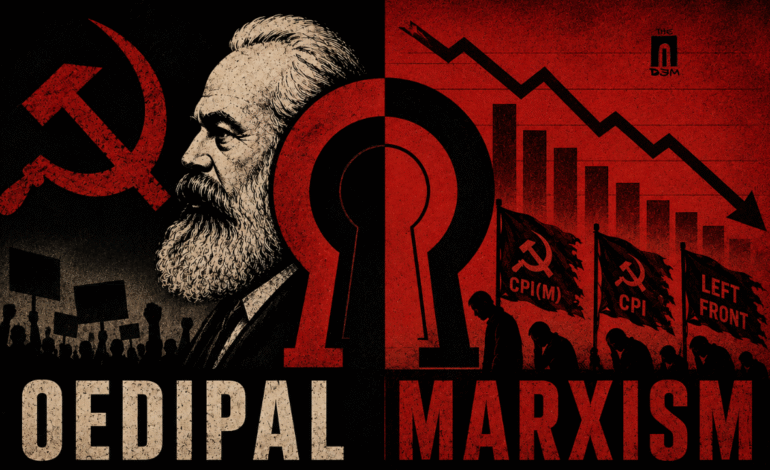
Part 1: The Oedipal Marxism
This is Part One of “The Oedipal Marxism”, Solomon Mubash’s seven-part series on the crisis of Indian Marxism. Having opened the series with the Cockroach Janta Party’s rhizomatic uprising at Jantar Mantar, Mubash now turns to the deeper diagnosis: how the Indian Left, ceding the “inner domain” of faith, ritual, and desire to the Hindu Right while fighting only on the terrain of the State and the economy, lost the very ground on which mass politics is won.
The Crisis of Epistemology
The history of the Indian Left is conventionally narrated through electoral arithmetic, factionalism, or strategic deviations from a presumed revolutionary line. Yet a deeper diagnosis suggests that the contemporary crisis, culminating in the definitive 2026 Assembly defeat in Kerala and the continuing marginalisation of the Left across the subcontinent, is not merely tactical but epistemological. For over a century, Indian Marxism has functioned as a derivative, “Oedipal” project: a movement that has obsessively followed the script of European modernity while failing to account for the distinct, stubborn contours of Indian social reality.
The failure is epistemological because the Left did not know that it did not know. It confidently misrecognised Indian reality, and that misrecognition was embedded in its most basic categories of analysis. The Left knew how to analyse the factory worker but lacked conceptual tools to analyse the Dalit labourer bonded by caste, the Adivasi whose relationship to land is not “private property” but spiritual and ecological, or the woman whose oppression is reproduced through gotra and kula. Because their epistemology prevented them from seeing these as primary relations of exploitation, they could never design adequate political responses. They were solving for X using an equation for Y. Reducing everything to economic class struggle is too simplistic for the modern world, where power also operates through race, caste, gender, media, and desire.

The 2026 defeat in Kerala is not an anomaly. It is the logical endpoint of a century of epistemological error. The Left, which had lost Kerala, had already lost West Bengal, had already been reduced to insignificance in Uttar Pradesh and Bihar, and had already become a minor player in the parliament. The Kerala defeat is the final confirmation that a Marxism which cannot speak to the inner domain, which cannot see caste as a primary relation, which has substituted its own bureaucratic survival for the liberation of the oppressed, has no future anywhere in India.
The Error of Reductionism: Caste as “False Consciousness”
The most damaging epistemological error was treating caste as a superstructural phenomenon, a backward ideology that would automatically dissolve once class relations were transformed. This is not a strategic miscalculation but a category error. Ambedkar pointed out that caste is not “class congealed”; caste is a division of labourers (endogamous, hereditary, sanctified by religion), whereas class is a division of labour (economic, mobile, secular).
When the Left insisted that “caste will disappear with capitalism,” they committed epistemological violence. They forced a complex, indigenous structure into a borrowed theoretical box that did not fit. The result was not only political blindness but also epistemic injustice: Dalit lived knowledge, that caste is the primary constitutive building block of Indian society, not an epiphenomenon, was systematically delegitimised as “narrow” or “identity politics.” Caste is not a costume over economic reality, as Indian Marxists thought. Caste creates economic reality, as Ambedkar said. The caste hierarchy is baked into the very fabric of society, not as a ghost of feudalism but as a living, active structure that produces and reproduces itself through birth, marriage, ritual, and violence.
To resurrect a liberatory politics today, we must move beyond the “State philosophy” of the traditional vanguard and towards a rhizomatic Marxism, one that is non-hierarchical, connective, and rooted in the heterogeneous soil of the subcontinent. This requires killing the “European Father” of orthodox theory and embracing a praxis that emerges from the lived experience of the Dalit, the Adivasi, and the worker who lives by their labour.
The Two Domains: Why the Left Lost the Inner World
Partha Chatterjee’s most enduring contribution to postcolonial theory is also the most painful for the Indian Left to confront. Chatterjee argued that Indian nationalism, from its inception, had made a strategic split. The nationalist elite conceded the “outer domain” to the colonial powers: the domain of the state, the economy, science, technology, and law, accepting that modernity would be fought on Western terms. But they fiercely preserved the “inner domain” as their sovereign territory: the domain of culture, spirituality, faith, family, community identity, and ritual practice. This inner domain was prohibited to colonial rationality, the site where the “true” self of the nation would be preserved and cultivated.
The tragedy of Indian Marxism is that it never questioned this split. It accepted the outer domain as its battlefield and dismissed the inner domain as irrelevant. It fought for the state, the economy, and legal rights, believing that once these were secured, the inner domain would automatically transform. It did not. While the Left was busy with the outer domain, the Hindu Right entered the inner domain, occupied it completely, and then used it as a launching pad to capture the outer domain, the state itself.
The outer domain includes everything that is measurable, formal, and public: the constitution, the parliament, the courts, the police, the army, the economy, the bureaucracy, the formal education system, the legal framework of rights and duties, and the public sphere of newspapers, political parties, and elections. This is the domain of the state and capital, governed by laws, contracts, and rational calculation. The inner domain includes everything that is informal, intimate, and affective: faith and religious practice, family structures and kinship networks, caste and community identities, rituals of birth, marriage, and death, culinary practices, notions of purity and pollution, sexuality and desire, myths and legends, festivals and pilgrimages, mourning and celebration. This domain is governed not by laws but by customs, taboos, emotions, and habits.
Chatterjee’s insight was that the anti-colonial nationalist elite made a strategic retreat. They accepted that the outer domain would be modern, secular, and Westernised. But they insisted that the inner domain would remain traditional, spiritual, and indigenous. This allowed them to be modern in public and “authentic” in private. It also allowed them to claim legitimacy from the masses, who lived their entire lives in the inner domain. The Indian Left, however, never understood this as a strategy. It took the nationalist split as a fact of nature. The Left assumed that the inner domain was a pre-modern residue that would dissolve once the outer domain was transformed. It therefore directed all its energy to the outer domain: nationalising industries, organising trade unions, drafting land reform legislation, fighting elections, and debating constitutional amendments. It considered the inner domain: faith, ritual, family, emotion, to be “false consciousness,” “superstition,” “backwardness,” or at best a private matter irrelevant to politics.
This was a catastrophic error. The Hindu Right understood that the inner domain was not a residue but the primary terrain of mass life. It entered that terrain, built institutions within it, captured its symbols, and used it as a base from which to conquer the outer domain. The Left, still obsessed with the outer domain, watched in disbelief as the Right captured the state.
The Indian Left operated on a highly mechanical interpretation of Marx: change the economic base, and the cultural superstructure will automatically follow. They engaged almost exclusively in what Gramsci called a War of Manoeuvre: a direct, vertical assault on the outer fortress of the state through elections, trade union strikes, and legislative manoeuvring.
The Hindu Right, conversely, understood that in a deeply religious and caste-stratified society, power must be won through a long, horizontal War of Position. They realised that the state is protected by a thick outer wall of civil society: temple committees, cultural festivals, local charities, and mythic narratives, customs, norms and so on. The Hindu Right weaponised these cultural networks. They transformed the inner domain into a factory of desire, coding the spiritual anxieties and caste alienations of the subaltern into a weaponised, aggressive nationalism. When the Ram Janmabhoomi movement exploded across the Hindi heartland in the late 1980s and early 1990s, the Indian Left witnessed it not as an organic, deep-seated crisis of mass desire, but as an annoying, irrational distraction from the “real” economic issues.
During the height of the Babri Masjid crisis, the Left’s response was confined entirely to the Outer Domain. Left-leaning historians, legal scholars, and politicians spent years producing dense, secular research papers, archaeological reports, and constitutional petitions. While the Hindu Right addressed the masses in a visceral, mythic language of wounded pride, ancestral memory, and sacred space, the Left responded with cold, Westernised legalism. They tried to counter an emotional, libidinal explosion with archaeological evidence.
The Weaponised Rhizome: How the Hindu Right Conquered the Inner Domain
To decode how the Right won, we must look at how they systematically executed Gramsci’s “War of Position” inside the Inner Domain to conquer the Outer Domain of state power. The traditional Left organising model is arborescent; it relies on the vertical structures of trade unions and party cadres. The Hindu Right’s mobilisation for Ayodhya, however, operated like a deadly, weaponised rhizome.
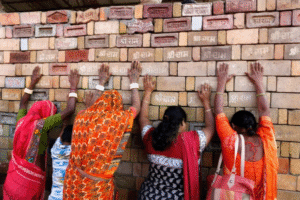
Consider the Ram Shila (consecrated brick) campaigns of 1989. The Right did not just hold rallies; they asked millions of ordinary people in remote villages to bake a single brick, consecrate it in their local temple, offer pooja, and send it to Ayodhya. This was a masterful intervention in the Inner Domain of ritual and family. It plugged the daily domestic life of a subaltern peasant directly into a national political project. The brick became a physical conduit for political desire, sublimated libido, and a mystical orgasm. It bypassed the formal, secular state machinery entirely, creating an unstoppable, horizontal network of cultural mobilisation that the vertical, urban-centric Left had no way to map or stop.
In the late 1980s, the Indian state-owned Doordarshan broadcast the Ramayan television series. The Hindu Right recognised that the television set had become the ultimate Ideological State Apparatus within the domestic family space. They captured the cultural fallout of that broadcast. They took the televised image of Ram and brought it into the streets, turning an inner-domain experience of evening family devotion into an outer-domain weapon of political warfare and jingoistic nationalism. Thus, the mythical Ram became a material force and started roaming around the streets.
Part 2: Desire, Biopower and the Libidinal Economy of Caste, follows







This is a sharp and deeply relevant critique of the Indian Left. Solomon Mubash rightly argues that the Left’s failure was not merely electoral or tactical, but epistemological—it lost touch with caste, culture, faith, identity and the emotional world of ordinary people. The most powerful politics is built not only in institutions, but also in the inner domain of society. A thought-provoking and necessary read