


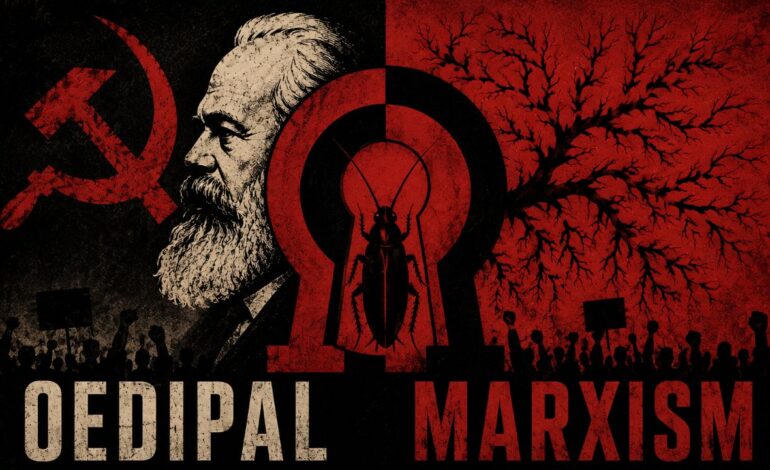
THE OEDIPAL MARXISM — a new political analysis series begins today!
The recent Gen Z uprising at Jantar Mantar, led by the Cockroach Janta Party (CJP) and the Left student organisations, offered a striking sign of hope for Indian democracy. It showed how decentralised and participatory action can channel public anger into a forceful political expression.
Against this backdrop, writer and socio-political analyst Solomon Mubash delves into the history of Left and Marxist movements in India, offering a stark historical perspective. The AIDEM presents his analysis as a seven-part series titled “The Oedipal Marxism”. The opening piece focuses on the Gen Z movement at Jantar Mantar.
Mubash argues that Indian Marxism faces not merely a tactical reversals but an epistemological crisis—blind to caste, deaf to the aspirations of the young, and increasingly trapped in the very structures of authority it once sought to overthrow.
Yet, he states, the CJP is more than a moment of protest. It points towards a new grammar of social action, suggesting that the future of emancipatory politics may lie beyond old vanguards—in unpredictable, rhizomatic and radically participatory forms of collective action.
The Summer of the Swarm
A sense of totalising capture increasingly haunts the contemporary political imagination in India. The state apparatus presents itself as an inescapable, arborescent monolith that counts, classifies, and neutralises every impulse towards genuine emancipation.
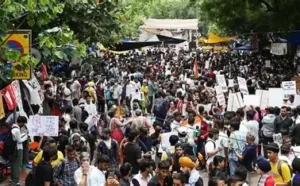
Yet history does not move along a single, linear railway track. In the summer of 2026, the historic mobilisation at New Delhi’s Jantar Mantar, spearheaded by the “Cockroach Janta Party (CJP)” shattered the illusion of absolute state capture. Born out of an organic, youth-led counter-culture that reclaimed a derogatory slur aimed at the unemployed and the student precariat, the CJP rapidly became a subterranean firestorm against systemic examination corruption, NEET paper leaks, and bureaucratic decay. By drawing tens of thousands of students, young workers, and marginalised aspirants, alongside middle-class professionals, lawyers, and concerned citizens to Jantar Mantar, executing a relentless Sansad Chalo march, and ultimately forcing the resignation of the Union Education Minister, the CJP demonstrated that when the molar apparatus of the state seems all-powerful, the underground currents of civilian desire can still open radical, unpredictable lines of flight.
To understand the CJP’s success, we must analyse how it managed the libidinal economy of Indian society, a task at which traditional Marxism has spectacularly failed.
The Concept of Libidinal Economy: Desire as Political Fuel
In Deleuze and Guattari’s framework, desire is neither a lack to be filled (as in Freudian psychoanalysis) nor a biological drive to be repressed. It is a self-propelling, productive force, a machine that generates connections, intensities, and assemblages.
The libidinal economy refers to how desire is organised, channelled, and captured by structures of power. It is not separate from the economic economy; it is its unconscious infrastructure. As Deleuze and Guattari argue, “the operations of the molar structures of power cannot be delinked from micro-political effusions of desire as generative of political momentum”.
Traditional Marxism, with its mechanical base-superstructure model, has no category for desire. It treats ideology as “false consciousness”, a distortion that will dissolve once the economic base is transformed. It has no language for the affective, the symbolic, the libidinal. This is why it has consistently failed to understand why masses do not act as their economic interests would predict. It could not answer Wilhelm Reich’s question: why did German workers march behind Hitler rather than the Communist Party?
The Hindu Right understood this. It understood that you do not win mass loyalty through economic arguments; you win it through desire. You capture the inner domain -faith, family, ritual, emotion – and you reterritorialize its flows onto your political project. The RSS did not invent discipline; it reterritorialized the existing disciplining of the male body in the patriarchal family onto the nation. The Ram temple movement did not invent the desire for a cosmic father; it took the longing for absolute paternal authority and projected it onto Lord Ram. By quietly entering the Inner Domain, the Right built an organic, everyday hegemony that the Left, trapped in its molar abstractions, could not even see, let alone contest.
The CJP’s Intervention in the Libidinal Economy
The CJP’s genius lay in its mastery of what can be termed “micro-political desiring-production”. It did not start with policy positions, party platforms, or electoral calculations. It started with a symbol, an affect, a wound. And from that wound, a political movement emerged.
Reclaiming the Slur: The Cockroach as Rhizomatic Identity
The CJP’s first and most brilliant intervention in the libidinal economy was its reclamation of the slur “cockroach.” When Chief Justice Surya Kant referred to unemployed youth as “cockroaches” and “parasites,” he was performing a classic act of biopolitical pathologisation, reducing a social group to bare life, to vermin that could be squashed. In the vocabulary of modern state power, the marginalised, unemployed, and protesting citizens are frequently pathologised as surplus, unproductive “pests”, bodies that disrupt the smooth functioning of the neoliberal market. They are reduced to bare life: biological bodies that can be managed, beaten back, or discarded without legal consequence.

But Abhijeet Dipke asked a different question: “What if all the cockroaches come together?” This was not a rhetorical question; it was a deterritorializing act. It took a signifier of degradation and reattached it to a new territory of resistance. It transformed a symbol of filth into an affective shield of solidarity. It asserted that an entity designed to be “squashed” is, in reality, ubiquitous, indestructible, and capable of swarming.
This is the molecular politics of the libidinal economy. The CJP did not plead for respectable inclusion; it embraced the monster. It did not seek the Father’s approval; it refused the Father’s name. It did not ask to be seen as human; it asserted that even as vermin, it was unstoppable.
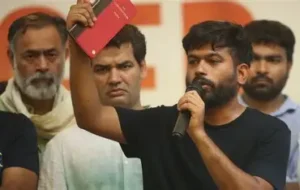
The effect was immediate and powerful. Within 78 hours, the CJP’s Instagram page had amassed three million followers. Within a fortnight, 22 million people were following. The movement went viral because it plugged directly into the libidinal economy, the shame, the anger, the desire for dignity that millions of young Indians felt but had no language for.
By explicitly naming themselves the “Cockroach Janta Party,” the movement performed a masterstroke of libidinal re-signification. Instead of pleading for respectable inclusion in the state’s terms, they embraced the monster. They asserted that an entity designed to be “squashed” under the boot of the sovereign is, in reality, ubiquitous, indestructible, and capable of swarming the state’s rigid architectures. The cockroach metaphor, originally intended as an insult to young people viewed as dispensable, was turned into a badge of resilience. The message was uncomplicated: those whom the system ignores will survive, multiply, and return.

This is what Deleuze and Guattari call “deterritorialization”, the liberation of a signifier from its fixed meaning and its reattachment to a new territory of resistance. In psychoanalytic terms, it is the refusal of the Oedipal structure: the child who refuses to accept the Father’s name and instead renames himself.
Art, Satire, and Affect: The Molecular Politics of Desire
The CJP did not organise through traditional political forms, hierarchies, committees, or manifestos. It organised through affect, through humour, satire, art, and collective creativity. This was its most profound intervention in the libidinal economy.
As documented at Jantar Mantar, protesting students turned the venue into an open-air gallery where art became a language of dissent. Hand-drawn illustrations, quirky costumes, poetic placards, caricatures, cartoons, and even memes lay scattered around the venue. One of the most striking displays was a sanitary napkin carrying the handwritten message, “…even this pad doesn’t leak,” satirising the examination paper leaks. Nearby stood a recreation of the iconic “three wise monkeys” – one covering its eyes with a bandage, another putting a lock over its mouth, the third pouring oil into its ears – urging authorities not to ignore, suppress, or remain deaf to students’ concerns.
Historical figures came alive through cosplay. Several participants came dressed as Mahatma Gandhi, with one portrayal featuring blood-like tears streaming from Gandhi’s eyes. Hand-painted portraits of Dr BR Ambedkar were displayed alongside posters of Che Guevara. Bollywood dialogues and popular culture featured prominently in placards.
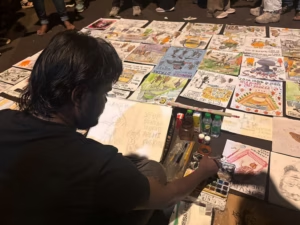
This is not decoration. This is “molecular politics”. Deleuze and Guattari argue that the molar structures of power cannot be challenged solely through molar means (elections, legislation, party politics). They must be challenged at the molecular level; through desire, affect, art, and everyday life. The CJP understood that you do not win people through economic arguments; you win them through desire. You capture their imagination, their creativity, their sense of humour, their shared identity. This is precisely what the Hindu Right did with the Ram temple; the CJP did it with satire. The Ram temple movement was not about archaeology; it was about affect. It was about wounded pride, ancestral memory, the desire for a cosmic father. The CJP understood that the same principle applies to progressive politics: you must speak to the heart, not just the head.
The Conversion of Fortified to Smooth Space
Jantar Mantar is traditionally a deeply “fortified” space, a tightly regulated, designated protest enclosure managed by state police, surveillance apparatuses, and barricades designed to tame and domesticate dissent. The Father-State permits protests there precisely to contain them, turning anger into a performative, manageable ritual within a pre-approved perimeter.
During the 2026 agitation, the CJP-led resistance broke this spatial containment. By blending digital meme culture, decentralised coordination, and organic participation, the movement turned Jantar Mantar into a dynamic smooth space that can be disseminated anywhere. It became a zone where spontaneous assemblies, open kitchens, collective art, and horizontal political teach-ins eroded the state’s calculated equilibrium. Students and citizens from across India converged at Jantar Mantar, holding placards in vernacular, performing rap and theatre, and sustaining a 23-day hunger strike by activist Sonam Wangchuk.

When the police deployed barricades, water cannons, and section orders, the rhizome did not collapse; it adapted, spilling over into adjacent streets, digital fronts, and localised regional chapters. The movement spread to Pune, Bengaluru, Hyderabad, Jaipur, Lucknow, Mumbai, Nagpur, and Amritsar. As one observer noted, “the protests spread to several cities, transforming the campaign from an online movement into a nationwide student mobilisation”. Police brutality, lathi charges, and the forced hospitalisation of Sonam Wangchuk only amplified the movement, as videos of police violence spread instantly across social media.
This is the power of the rhizome: it has no centre to decapitate, no hierarchy to co-opt, no single point of failure. The state’s attempt to suppress the movement through violence only generated more affective intensity, more desire, more solidarity, more resistance.
The Rejection of the Party-Form
The CJP’s most significant decision, and the one that best illustrates its rhizomatic character, was its refusal to convert the movement into a political party. As one analysis observed, “its significance lies not merely in the size of the crowds or the discomfort it has caused the government, but in its attempt to redefine how political power can be exercised without seeking office”.
The movement’s refusal to become a formal party was not timidity but strategic maturity. A party “would immediately require a hierarchy, membership rules, candidates, funding structures, electoral calculations and compromises with power brokers. It would also force the movement to speak on every contentious issue, dividing supporters who are currently united by a limited set of democratic demands”. This is precisely the trap that traditional Marxism fell into, the Oedipal trap of becoming the Father it swore to kill .
By remaining outside the party-form, the CJP maintained its rhizomatic character. It could “pressure governments regardless of which party is in office. It can support an opposition demand without becoming an opposition instrument. It can compel Parliament to debate an issue while retaining the right to criticise every parliamentary formation. Its success is measured not through ministerial posts but through resignations, reforms, investigations, withdrawn cases and changes in public behaviour.
In Deleuzian terms, the CJP remained a “war machine” rather than becoming a “state apparatus”. It did not seek to capture the state; it sought to shame the state, to expose the state, to force the state to retreat. The war machine “kills in the name of revolution, in the open, as a declaration of war.” The state apparatus “kills in the name of the law, in secret, as part of an administrative procedure.” The CJP remained a war machine. Traditional Marxism became a state apparatus.
The CJP’s Victory: The Father-State Retreats
The CJP’s victory was historically unprecedented. As one commentator noted, “no member of Prime Minister Narendra Modi’s ruling Bharatiya Janata Party (BJP) has ever given in to political pressure and resigned”. Yet on July 25, 2026, Education Minister Dharmendra Pradhan resigned, bowing to the CJP’s demands. The government also agreed to compensation for the families of students who died by suicide and dropped charges against protesters.

The significance of this victory cannot be overstated. The Father-State, with its vast apparatus of repression, lathi charges, water cannons, metro station closures, and Internet shutdowns, was forced to retreat before a swarm of “cockroaches.” As one political observer noted, “Measured in the binary of victory-versus-defeat, indeed, the youth-initiated and youth-led protest under the banner of the Cockroach Janta Party triumphed against the might of Narendra Modi’s BJP”.
But the victory also carried a warning. As Chatham House noted, “the grievances that led to its emergence have not disappeared”. The structural problems, flaws in the examination system, high youth unemployment, and economic stress remain unresolved. The CJP was a desiring machine that successfully deterritorialized the state’s control, but it did not (and perhaps could not) produce a lasting organisational structure to address the deep-rooted issues it exposed.
This is where a rhizomatic Marxism must step in: not to replace the CJP with a bureaucratic vanguard, but to sustain and amplify the insurgent energies it unleashed.
What Indian Marxists Must Learn from the Rhizome
For mainstream Indian Marxists, long trapped in a mechanical, 20th-century orthodoxy imported from Russian and European models, the success of the CJP agitation offers a profound theoretical lesson.
The Oedipal Trap and the Rhizomatic Way Out
The CJP agitation is not merely a story of successful protest; it is a diagnostic tool that exposes the structural failures of Oedipal Marxism. The Oedipal trap, as we will analyse in depth in this series, is the structural destiny of any party that mistakes itself for the masses. The party that claims to “lead” the working class inevitably becomes a hierarchical apparatus concerned primarily with its own survival. It substitutes its own bureaucratic logic for revolutionary ethics, becomes a micro-fascist organisation that demands total loyalty, and ultimately administers the very state violence it once opposed.
The CJP avoided this trap because it refused to become a party in the traditional sense. It had no central committee, no general secretary, no party congress, no official membership. It was a swarm, not a hierarchy. It was a movement, not an institution. This is why it succeeded where the institutional Left failed: it did not seek to capture the state; it sought to shame the state, to expose the state, to force the state to retreat.
The CJP’s success in managing the libidinal economy reveals what Indian Marxism has lost: the capacity to organise desire, to speak to the inner domain, to connect horizontally across differences, and to force the state to retreat without seeking to capture the state. It has become the Father it swore to kill; a bureaucratic, technocratic manager of state power rather than a living, underground machinery of human liberation.
The Question That Haunts Indian Marxism
The Cockroach Janta Party’s triumph at Jantar Mantar is not merely an isolated victory for student rights; it is a blueprint for contemporary civilian micro-politics. It proves that the Father-State, despite its terrifying apparatuses of repression, is not invincible. When ordinary citizens organise horizontally, when they reclaim the slurs hurled at them, when they convert striated protest space into smooth revolutionary territory, the state’s molar power becomes impotent and incompetent.
For the Indian Left, the lessons are unequivocal. The arborescent model, hierarchical, vanguardist, and bureaucratic, has led to electoral defeat, epistemological blindness, and the Oedipal trap of becoming the Father it swore to kill. The rhizomatic model – horizontal, affective, adaptive – offers a way out.
This is the introductory article of a series trying to answer the fundamental question: Why has Indian Marxism structurally failed over a century? The answer lies in its failure to understand the libidinal economy of Indian society: the organisation and direction of desire. It treated caste as a secondary contradiction, the inner domain as a pre-modern residue, and the subaltern as a client rather than a comrade. It substituted its own bureaucratic survival for the liberation of the oppressed and, in doing so, became indistinguishable from the Father it had sworn to kill.
The CJP agitation reveals that another politics is possible – a politics that does not seek the Father’s approval, that does not wait for the vanguard’s sanction, that does not reduce the complexity of civilian life to a single economic contradiction. By abandoning rigid, imported blueprints and embracing fluid, rhizomatic modes of organising, a reorganised Left can stop acting as a bureaucratic manager of state power and instead become an active, horizontal partner in the living, underground machinery of human liberation.
Having gone through the CJP agitation as a living example of rhizomatic resistance operating through the libidinal economy, now we turn to the central question that animates this entire series: “Why has Indian Marxism structurally failed over a century?” The answer, as we shall argue, lies in the transformation of a revolutionary movement into an Oedipal project; a derivative, European-imported framework that substituted its own bureaucratic survival for the liberation of the oppressed.
The articles that follow will trace, in painful detail, how Indian Marxism – from its derivative epistemology to its bureaucratic capture in Kerala, from its routinised charisma to its double standard on state violence – became the very thing it swore to destroy. They will examine how the vanguard became the Father, how the neurotic cadre was produced, how the colony model contained the Dalit body, and how the Hindu Right conquered the inner domain while the Left was busy with the outer domain.
The Cockroach has shown us the way. The question is whether the Left will learn to swarm.
Part 1: The Epistemological Crisis — How the Left Lost the Inner Domain, follows








Powerful and thought-provoking analysis by Solomon Mubash. The CJP story shows how anger, dignity, satire and youth energy can challenge an entrenched political system. The biggest lesson is clear: politics cannot survive on hierarchy and bureaucracy alone—people’s aspirations and collective imagination matter. A sharp critique of the Indian Left and a timely call for a more democratic, horizontal politics.