

Manufactured Certainty: When Absolute Logic Serves Capital


When we evaluate complex systems such as biological systems through the lens of absolute logic and general scientific principles, we often lose sight of the intricate interconnections that sustain them. By focusing exclusively on isolated components rather than on the systems that emerge from their interactions, official institutions propose solutions that fail to grasp the whole. Popular movements gain relevance precisely by recognizing that this approach is no accident: such “scientific” logics are carefully constructed to preserve the existing order.
Whenever financial markets and capital interests confront a crisis, these same scientific logics are readily summoned to their defense.

“Guns don’t kill people; people kill people” was a central argument advanced by the American gun lobby in the 1920s, as public alarm grew over rising gun violence. The claim was sufficient to satisfy common sense and, for a long time, shielded the lobby’s interests. It demonstrated how anything that threatened capital could be resisted with the tools of “science,” “data,” “faith,” and “pure logic.” Corporations repeatedly declared that “doubt is our product,” while the ruling class preferred the strategy of “kill the messenger.”
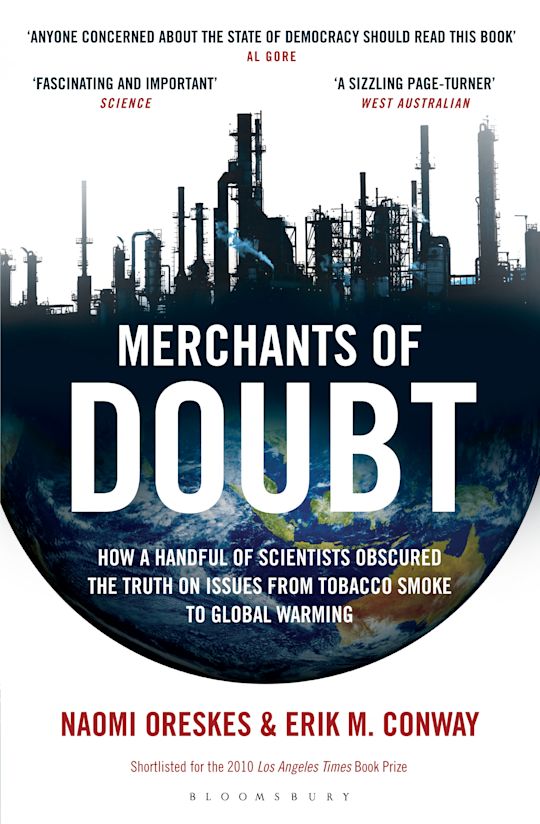
In Merchants of Doubt, Naomi Oreskes and Erik M. Conway present a detailed examination of “scientific research institutions” bankrolled by specialized industries. These bodies systematically cast doubt on research that endangers market interests and sow ideological distrust within the scientific community.
One telling example is the George C. Marshall Institute (GMI). Founded in the 1980s under the leadership of Frederick Seitz—a distinguished solid-state physicist and former president of the U.S. National Academy of Sciences—the institute became a key instrument of Wall Street propaganda. Seitz’s partners were Robert Jastrow, an astrophysicist at the Goddard Institute for Space Studies, and William Nierenberg, an oceanographer and director of the Scripps Institution of Oceanography.
In the 1980s the institute vigorously supported Ronald Reagan’s defense policies and helped shape measures aimed at containing the Soviet Union. After the Soviet bloc collapsed, its focus shifted to climate science and global warming. Financed on a large scale by tobacco companies and oil interests, the GMI specialized in manufacturing doubt and distrust. As Oreskes and Conway document, its scientists openly embraced the maxim “Doubt is our product,” deliberately undermining confidence in established research.
The institute’s principal activity was to attack climate-change science by every available means and to disseminate false scientific claims. It played a significant role in President George W. Bush’s decision to withdraw from the first major climate summit. Facing sustained criticism—including from the Union of Concerned Scientists—the GMI finally closed in 2015. Over three decades it had succeeded in shaping policy through fabricated evidence, influencing governments, the media, and decision-makers.

Seitz and the GMI possessed what they called “scientific evidence,” yet it was evidence tailored exclusively to the needs of the market and of capitalism. That evidence jeopardized the future of human society—an inevitable outcome of relying solely on abstract logic and selective data.
When those who maintain the system seek to evade responsibility for socio-ecological conflicts by dividing their victims, and when scientific findings are distorted or denied, fundamental questions arise:
- Does science possess an existence independent of political and social discourse?
- How far can scientific research rise above prevailing regimes and market interests?
- How long can science endure without reference to values?
- How “scientific” is the evidence placed before us?
- How independent are science and the scientific community from studies commissioned by the apostles of the free market to serve the interests of big capital? New times and new problems compel us to confront these questions.
No matter how far technological progress advances, human existence remains inseparable from biological systems. To reduce the complexities of those systems to pure logic is an illusion.










K. Sahadevan’s “Manufactured Certainty” exposes a dangerous truth: when science is bent to serve capital, “logic” becomes a tool of power rather than a search for truth. The real crisis is not the absence of evidence, but the deliberate manufacturing of doubt to protect vested interests. A powerful reminder that science must remain accountable to society, not subordinate to profit.